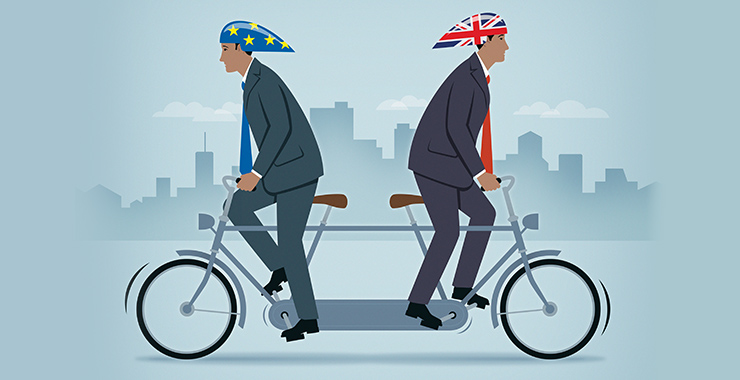
The political turmoil surrounding Brexit—the withdrawal of the United Kingdom from the European Union—is affecting the mental health of U.K. residents. In a poll conducted in March, at the height of the uncertainty about whether Parliament would reach a deal in time for the original Brexit deadline, the U.K.’s Mental Health Foundationopens in new window found that Brexit was having a big impact on the health of U.K. residents. The survey found that 43% of adults—more than 22 million people—were feeling powerless, 39% were feeling angry and 38% were worried.
"This is regardless of whether you voted to stay or to leave," says psychologist Chiara Lombardo, PhD, the foundation’s senior research officer (qualitative). An initial bump in well-being for "Leave" voters immediately after the 2016 referendum has been followed by significant decreases in well-being as the negotiations have dragged on and these voters’ expectations for a complete rupture with Europe have gone unfulfilled. While 59% of "Remain" voters reported feeling powerless, for example, more than a third who voted "Leave" felt the same, the poll found.
These emotions are spilling over into other aspects of people’s lives. Twelve percent of respondents said Brexit was causing them sleep problems, for instance. Brexit was also causing relationship conflicts, with almost 20% reporting disagreements about Brexit with family members or partners.
Another possible sign that U.K. residents are troubled: The number of antidepressants prescribed in England spiked after the Brexit referendum, according to a report by researchers at King’s College London and Harvard University (Vandoros, S., et al., Journal of Epidemiology & Community Health,opens in new window Vol. 73, No. 2, 2018). While the study couldn’t prove causation, the authors note, antidepressant prescriptions saw a relative increase of more than 13% compared with other drugs.
And Brexit could further undermine mental health in the U.K. if, as many predict, it plunges the country into a recession, warns stress researcher Brian M. Hughes, PhD, a psychology professor at the National University of Ireland in Galway, who is researching Brexit’s impact.
"We know in general terms that recessions have an impact on mental health," says Hughes, pointing to a rise in suicides in the country that coincided with the 2008 recession and the jump in unemployment it caused.
Brexit could also have an impact on physical health, adds Hughes, whose own research focuses on how stress damages the cardiovascular system. In addition to the damage constant physiological arousal can cause, he says, people may use unhealthy strategies such as overeating, not exercising and resorting to nicotine, alcohol or other substances to cope with Brexit-related stress. Plus, medications will likely become more expensive since the U.K. will no longer enjoy the lower costs of trade with fellow EU members. "It’s very much a vicious circle," says Hughes.
Grocers, pharmaceutical companies and other organizations have even been stockpiling supplies. And many individuals have been doing the same. A survey by Kantar Public in January found that a sixth of U.K. residents were either already stockpiling food and medicine or planning to start doing so.
Special populations
Certain groups are facing additional challenges associated with Brexit. Immigrants and ethnic and racial minorities, for example, are experiencing a wave of xenophobia and racism. Part of the motivation for "Leave" voters was a desire to limit immigration. That anti-immigrant, anti-Muslim sentiment is now manifesting itself in hate crime statistics. The U.K.’s Home Office has found that the number of hate crimes reported to the police in England and Wales has more than doubled over the past five years. Race was the motivating factor in more than three-quarters of recent hate crimes. While the Home Office attributes much of the increase to changes in the way police record hate crimes, it also cited a spike in crimes after the Brexit referendum.
At the same time, minorities of all kinds may lose some of the protections they have enjoyed under the EU Charter of Fundamental Rights. The charter, among other protections, prohibits discrimination on the basis of cultural and religious diversity, sexual orientation and other factors, and excising it from British law may leave gaps not covered by domestic laws.
"Discrimination on ethnic grounds perceived by blacks, Asians and minority ethnic individuals following Brexit, combined with existing stigma, may result in higher rates of mental illness in these groups," says Lombardo.
Workplaces are also feeling the strain, especially because the uncertainties surrounding Brexit make it difficult for organizations to plan, says industrial/organizational psychologist Richard Plenty, PhD, managing director of a company called This Is…. There are concerns about supply shortages and travel difficulties, for example. "And it’s outside of everybody’s control, which is ironical since the whole thing to start with was to take back control."
In addition to practical difficulties, workplace communication can be difficult, adds Plenty. "You have to be a bit cautious when you’re talking to people," he says. "Sometimes you’re working with people with very different values, which you may not have realized before."
The nation’s young adults—more than 70% of whom voted "Remain" on the referendum—are especially worried about the future, says Ashley Weinberg, PhD, a senior lecturer in psychology at the University of Salford, who chairs a new political psychology section for the British Psychological Society (BPS).
Students may have wanted to travel or live in Europe, opportunities that may no longer be available to them, for example. And for U.K. students who had planned to save money by studying in Germany, Finland or other European countries where tuition is free, that option may no longer be possible. Jobs are another major concern. "I’m telling students to look at a world view rather than one that’s European," says Weinberg, who advises students to consider job opportunities in North America, Australia, India and Pakistan. "It’s thinking about ways they can build relationships further afield, so they feel their future doesn’t have to be stuck in Britain."
The bigger picture
Brexit also threatens the U.K.’s academic landscape as a whole, says Nicola Gale, immediate past president of BPS. "Universities in the U.K. are hugely global these days," she says, noting the number of European and international students and faculty members, grants and research collaborations, and exchange opportunities. "We do want to work on a cross-European basis," says Gale, who represents BPS at the European Federation of Psychologists’ Associations and the International Union of Psychological Science.
Residents of Northern Ireland are also on edge as they await a fianl decision on Brexit and its impact on the border between Northern Ireland and the Republic of Ireland, says Tony Cassidy, DPhil, chair-elect of BPS’s Northern Ireland Branch.
The 1998 Good Friday Agreement between the U.K. and the Republic of Ireland, which brought peace to Northern Ireland, resulted in an invisible border between the two nations, with people and goods passing freely between them. Brexit could threaten that special status, with a return to checks on travel and goods plus duty taxes on goods.
"Because the Good Friday Agreement is guaranteed by both the Dublin and London governments, the U.K. leaving the EU would require a renegotiation of some form, which could lead to a breakdown in relations," says Cassidy. "Clearly this has the potential to return to the political conflict and likely a return to violence."
The country as a whole is deeply polarized, adds Esther Cohen-Tovée, DClinPsychol, who chairs BPS’s division of clinical psychology. "This is already a very wounded country, and things are likely to get worse whatever happens with Brexit," says Cohen-Tovée, director of allied health professions and psychological services at the Northumberland, Tyne & Wear NHS Foundation Trust, which provides National Health Service (NHS) services across the northeast of England. Psychologists should use the same clinical skills they use with clients—listening without judging or insisting they have all the answers—to help create a new narrative of inclusion, she says.
An overtaxed mental health system
"Psychologists can play an important role in supporting people who have suffered as a result of the current uncertainty," agrees Sarb Bajwa, chief executive officer at BPS.
But unfortunately, Brexit may also limit the NHS’s ability to support those suffering mental health problems by making it more difficult to recruit and retain psychologists and other mental health professionals from the EU.
EU clinicians currently represent a significant portion of the NHS’s workforce. According to a 2018 briefing paperopens in new window for Parliament, almost 6% of NHS staff in England are EU citizens from outside the U.K. In London, EU citizens represent more than 11% of NHS staff. But they and other staff members are leaving the system. Last year the U.K.’s Department of Health and Social Care revealed that 2,000 mental health clinicians per month were leaving the NHS. As a result, a tenth of mental health positions—more than 22,000 positions—were vacant in mid-2018.
"We’ve already got significant vacancies for clinical psychologists," says clinical psychologist Richard Pemberton, PhD, who chairs BPS’s clinical psychology professional standards unit, explaining that the NHS has long recruited EU psychologists. "People have started to leave, so we’re losing them. And people aren’t coming; we’re getting bad press that this is a bad place for anyone not born here."
Brexit is already causing distress among many EU psychologists who have chosen to stay in the country where they have built careers and formed families. Some may be able to acquire a "settled status" from the U.K. government that will allow them to live and work in the U.K. after it leaves the EU, but they will lose certain rights that they had before Brexit, such as the ability to vote in local elections.
"You’re a second-class citizen," says psychologist Emmy van Deurzen, PhD, who came to the United Kingdom from the Netherlands in 1977 and recently got British citizenship. EU citizens are already being denied mortgages and job opportunities because of Brexit-related uncertainty, she says. And some can’t stay at all, since settled status is only for those with five years of residence, an employment record and national insurance.
To help, the Existential Academy—a nonprofit group van Deurzen founded—is offering up to 12 online or telephone emotional support sessions with psychologists and other mental health providers to EU psychologists and psychotherapists distressed by the situation.
"People feel terribly betrayed," says van Deurzen. "They came here in good faith and put down roots because they believed it to be safe, then suddenly realized that that was no longer the case."