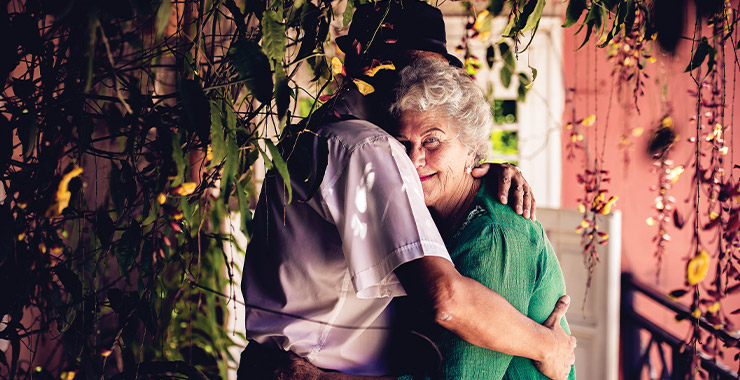
More than 28 million people in the United States provide care for chronically ill, disabled or older family members during any given year, according to a 2015 reportopens in new window from the National Alliance for Caregiving. Roughly one in 10 of them cares for a spouse. It can be a full-time job: On average, caregiving spouses spend 44.6 hours per week attending to their loved ones’ needs.
As more people live long enough to experience multiple health issues and dependency, chances are good that at some point many of us will spend long hours either taking care of or being cared for by our partners.
While the statistics on older adults tending to their spouses have been closely tracked for many years, the physical and psychological impacts on such couples of providing that care are less well documented. What happens to a couple’s emotional relationship when one partner turns caregiver? What factors help protect a happy, satisfying union? How does caring for a spouse affect the caregiver’s health? These are just some of the questions that drive the research of the Social Gerontology and Health Lab, helmed by Joan Monin, PhD, a psychologist and associate professor at the Yale School of Public Health.
"Joan’s lab is on the cutting edge of trying to understand how to improve the emotional lives of caregivers in an evidence-based way," says Monin’s longtime collaborator Becca Levy, PhD, also a psychologist at the Yale School of Public Health. "She’s really advanced this field of research that has traditionally been much more anecdotal by applying rigorous experimental and survey methodologies to examine important topics."
Over the past decade, the research coming out of Monin’s lab strongly suggests that caregivers’ perspectives are a huge factor in determining how they fare. "All caregivers experience emotional distress to some extent," Monin says. "Those who can remain positive and effectively regulate their feelings in response to stressful circumstances tend to suffer less."
Recently, she has turned her attention to developing interventions to help caregivers do just that. "In many cases, we’ve already figured out what works—helping people build resilience and mutual understanding with their partners," Monin says. "It’s now time to give families the tools they need to thrive."
Three labs in three rivers
Monin first became interested in the field as an undergraduate student at the University of Rochester when she took a course on emotion and close-relationship processes from Harry Reis, PhD, who is often credited as an early pioneer in the field of relationship science. "That class really opened my eyes. I just couldn’t believe that someone could actually have a job where they got to think about how relationships work and why and how people express their emotions to one another," Monin says. "I kind of fell in love with social psychology at that point."
She then worked as an undergraduate research assistant with developmental psychologist Patrick Davies, PhD, on a study of how marital conflict affects children’s emotional development. Her introduction to studying emotion expression in close relationships came in graduate school, at Carnegie Mellon University, where she worked in the lab of psychologist Margaret Clark, PhD, another leader in personal relationship studies. Their early work together focused on the function of emotion expression as a way to communicate needs or satisfaction of needs. Together they would later investigate emotional expression in caregiving spouses, finding that caregivers (particularly caregiving wives) were less stressed when care recipients were willing to express more interpersonal emotions, such as compassion or guilt, to their partners ( Emotion , Vol. 9, No. 1, 2009 opens in new window).
When Clark left for another position, Monin moved across the hall to the lab of psychologist Brooke Feeney, PhD, where she focused her dissertation studies on how young adults respond to their partners’ expression of anxiety. Among Monin’s discoveries were that when anxiously attached people witness their romantic partners going through stressful situations, they perceive greater anxiety in their partners, feel more distressed in response to their partners’ anxiety and are less effective caregivers ( Personal Relationships , Vol. 19, No. 3, 2012 opens in new window).
Immediately after wrapping up her doctorate, Monin began studying caregiving again, but this time in older adults. She accepted a postdoctoral research fellowship with Richard Schulz, PhD, a University of Pittsburgh gerontologist who studies older adult caregiving. Her three-year collaboration with Schulz produced more than a dozen publications, on topics ranging from spouses’ reactions to perceived suffering in their loved ones to interpersonal emotion expression in the context of caring for those with Alzheimer’s disease.
"Rich had done all of this work creating and evaluating multicomponent interventions for caregivers to support mainly instrumental needs," Monin says. "But there was still little focus on the emotional aspects of the relationship between the caregiver and the care recipient, especially in terms of how caregivers deal with witnessing a partner suffering on a daily basis."
One study Monin conducted in Schulz’s lab revealed that spouses’ blood pressure and heart rate increased significantly when watching and talking about their partners’ suffering, relative to watching a stranger’s suffering ( Journal of Gerontology: Series B , Vol. 65B, No. 2, 2010 opens in new window). "Overall, we found it’s not so much the act of having to give care day in, day out that’s burdensome for caregivers; it’s seeing your partner suffering and not being able to do anything about it that takes an emotional and physical toll," Monin says.
Another study found that how caregivers make sense of their partners’ suffering impacts caregivers’ well-being. When talking about a time when their partners were suffering, caregiving spouses who used more positive emotion words and more cognitive processing words—such as think, realize and because—had lower heart rate reactivity, which suggests that thinking about the bigger picture and positive aspects of their lives with their partners made caregivers feel less stressed ( Psychology and Aging , Vol. 27, No. 4, 2012 opens in new window).
Delving deeply into the dyad
Following her postdoctoral work with Schulz, Monin was hired by the Yale School of Public Health, opening the Social Gerontology and Health Lab in 2010. Her initial studies focused on learning how people care for themselves as they witness their partners in chronic pain. She discovered that caregivers who actively try to understand what they’re feeling when witnessing their partners’ pain—for example, sadness, anguish and helplessness—tend to experience less stress than caregivers who become engrossed in thinking about their partners’ pain.
Monin then began to delve more deeply into the caregiver-care recipient dyad by exploring how older spouses with multiple chronic physical and mental conditions both provide care to and receive care from each other. Using large epidemiological data sets, she found that a spouse’s frailty and depressive symptoms (Journal of the American Geriatric Society, Vol. 64, No. 4, 2016), as well as their physical activity levels ( Stress & Health , Vol. 32, No. 3, 2016 opens in new window), were predictive of these same qualities in their partners. In a study performed in her lab, she had couples engage in role-playing exercises to experimentally manipulate which spouse—just the wife, just the husband or both—received social support from his or her partner. She discovered that men benefit more from receiving support than women do. Also, mutual support provided no additional benefits to either men or women. "Like a number of other studies using survey methods, we saw that men tend to be more emotionally supported by their wives and may receive more comfort from marriage," Monin says.
A recent finding from Monin’s lab that has garnered considerable media attention is her team’s genetic analysis of the oxytocin receptor, which has been associated with characteristics such as trust, empathy and social skills. She found that marital satisfaction is higher if at least one partner was born with a version of the receptor called the GG genotype, a correlation that was mediated by measurements of attachment security ( PLOS ONE , Vol. 14, No. 2, 2019 opens in new window). "There’s been a news story in almost every language," Monin laughs. "It’s not a finding that directly relates to caregiving, but it does tell us about the emotional lives of older adult couples, with implications for caregiving. And it’s one of those findings where people get really excited and wonder, ‘Do I have the GG genotype?’"
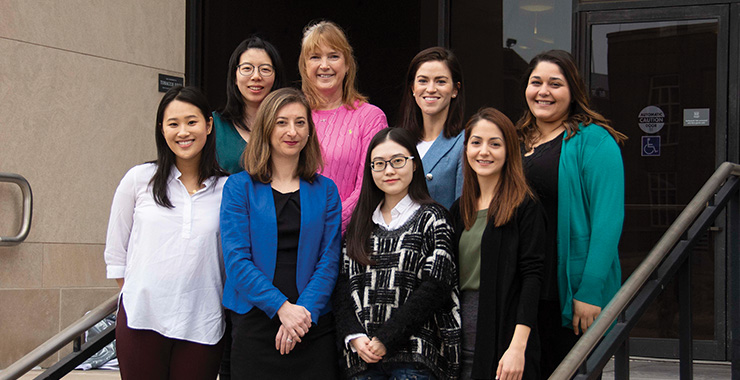
Monin’s research tackles other issues of aging beyond caregiving. She has published frequently with colleagues across several academic disciplines at Yale University, including epidemiologists and geriatricians. "I like doing work where you’re bouncing ideas off other people," says Monin, whose lab consists of one doctoral student she co-advises as well as four MPH thesis students, three research assistants and three undergraduate students.
Among her most frequent collaborators is Levy, with whom Monin has studied stigma associated with aging. Their analysis of a large archive of American books, magazines and newspapers—some 400 million words in all—showed that negative perceptions of older adults have been rising over the past 200 years (Ng, R., et al., PLOS ONE, Vol. 10, No. 2, 2015opens in new window). Other studies with her Yale colleagues have focused on elder abuse, caregiving related to essential tremor and the mental health of veterans.
The time to intervene is now
After almost 10 years doing basic social psychology research on caregiving relationships, Monin says she’s eager to translate her findings into interventions that can help people. The first place she has started is with Alzheimer’s disease. "That period right after diagnosis is really scary for people as they wonder what’s going to happen," Monin says. "This worry can really damage a relationship in those early days."
With support from the National Institute on Aging (NIA), which has funded most of her previous research, Monin is collaborating with New York University and University of Hamburg psychologist Gabriele Oettingen, PhD, to implement a program called the Wish, Outcome, Obstacle, Plan, or WOOP, intervention. WOOP is a mental strategy for inducing behavioral change via a four-step process in which participants specify a health, relationship or career wish or goal, the desired outcome, potential obstacles, and a plan to achieve the goal. WOOP has helped study participants in specific populations increase healthy behaviors, including physical activity in stroke patients and self-care in diabetes patients.
Now, Monin is studying whether WOOP can help couples manage the distress that can occur after an Alzheimer’s diagnosis when symptoms, such as asking the same question over and over again, are starting to emerge. In this case, the wish might be to respond calmly when the partner asks a question repeatedly; the outcome might be for both partners to feel respected and happy; the obstacle might be feeling impatient; and the plan might be to take a deep breath, take the partner’s perspective and then answer the question.
With another grant from NIA, Monin is also studying the dynamics between adult children and their parents with early-stage dementia. Guided by attachment theory, this project will be the first to focus on how the parent and child’s relationship early in life affects how well the adult child embraces the caregiving role. "This can be really challenging for some people to become their parent’s caregiver because it’s a total role reversal and can be affected by their history together," Monin says. The goal of the project is to develop an intervention that protects the emotional health of both the parents and their adult children who are their primary caregivers.
"There’s been so much focus on drugs to alleviate dementia symptoms, and many resources developed to help provide instrumental care," Monin says. "We want to be able to help people nurture the well-being of their relationships through these tough times."