During the seventh week of the “Psychology of Oppression” class taught by Richard Harvey, PhD, at Saint Louis University, students gather around an uncommon teaching tool: Monopoly boards. The games they’re about to begin are unusual, too. While one player in each group plays by normal Monopoly rules, other players are hamstrung or helped by seemingly arbitrary changes to the rules. One player, for example, goes to jail after any roll of the dice higher than a seven. Another can’t buy properties valued over $150. Meanwhile, one lucky player gets to rule the board in “easy mode,” collecting extra money for passing “Go” and buying properties at a steep discount.
It doesn’t take long for the room to fill with rueful laughter as the privileged player pulls ahead and the two disadvantaged players head toward bankruptcy. After 15 or 20 minutes, Harvey changes the game: Everyone may now play by the normal rules. After another half hour, the students take stock. Invariably, the players who started out disadvantaged are still in the hole, while the privileged players are riding high. Harvey asks the disadvantaged students when they think they might catch up. Almost always, the answer comes back: “Never.”
No one, Harvey says, walks away from the game—which he calls “Intergroup Monopoly”—thinking that adopting fair rules in the present is enough to fix past inequality.
It’s a powerful lesson likely to reach far beyond the classroom and an example of what social psychologist Scott Plous, PhD, calls “action teaching.” The phrase encompasses project-, community- and classroom-based activities that aim to effect social change while educating. Given the need to address growing problems such as income inequality, climate change, immigration reform and health-care disparities, Plous says, he sees action teaching as a way for educators to have an impact sooner rather than later.
Learning with an impact
The concept of action teaching arose from “action research,” a term coined by psychologist Kurt Lewin in 1944 to describe research that investigates and helps solve a problem simultaneously. For example, Lewin ran studies in a factory where workers were given differing levels of control over their jobs. More control led to better performance and higher morale, and solved real-world workplace problems for the factory management, according to education researcher Clem Adelman (Educational Action Research, Vol. 1, No. 1, 1993).
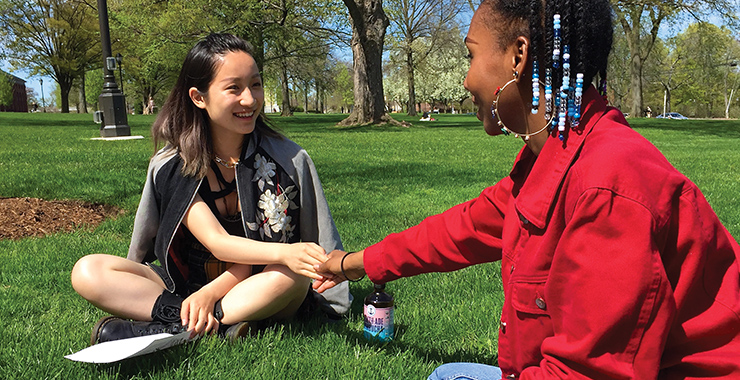
As an early career professor at Wesleyan University in Middletown, Connecticut, in the late 1990s, Plous began to wonder why no similar concept existed for teaching. So, he defined one in a 2000 article on a classroom role-playing activity in which students practiced responding to bigoted comments (Teaching of Psychology, Vol. 27, No. 3, 2000opens in new windowlogin requiredlogin required). The idea was to teach about a psychological concept (in this case, prejudice) while making a real-world dent in the problem by calling out prejudice in the moment.
Action teaching is closely related to service learning and other community-based educational projects, and the terms frequently overlap. The difference, Plous says, is that action teaching does not require students to leave the classroom. However, the activities should connect immediately to attitudes and issues affecting the broader world.
“That’s very different from the traditional model of education, in which we focus on teaching students about a particular topic and then we hope that after graduation they will contribute to the betterment of society in some undefined way,” Plous says.
Intergroup Monopoly provides an example. Students don’t just read about research on prejudice and inequality; they experience it (albeit in a simulated setting), making the lesson more visceral. Harvey says he’s seen the game change people’s minds when lectures or arguments could not. In one case, he says, he ran the exercise with a group of colleagues from St. Louis, and a white man who’d been vocally resistant to diversity initiatives in the past told an African American co-worker, “I finally get it.”
Action teaching can be used in elementary schools, high schools, business schools and schools of education. To offer instructional support to teachers, Plous maintains ActionTeaching.org, a website that hosts an ever-expanding list of sample activities, student assignments and free resources.
There is no large-scale, direct research comparing action teaching outcomes with those of traditional pedagogy, though action teaching does reflect a broader trend in education toward project- and experience- based learning. Overall, research shows these methods can be effective. One meta-analysis found that problem-based learning, which involves students working in groups to solve open-ended problems, outperforms traditional pedagogical methods in fostering skill development, long-term retention and satisfaction with learning (Strobel, J., & van Barneveld, A., Interdisciplinary Journal of Problem-Based Learning, Vol. 3, No. 1, 2009opens in new window). However, service learning has a mixed track record. A 2009 meta-analysis, for example, found that it led to a moderate improvement in academic outcomes and smaller improvements in participants’ sense of justice and citizenship (Conway, J., et al., Teaching of Psychology, Vol. 36, No. 4, 2009opens in new window). But a recent study of a specific service-learning project at Xavier University in Cincinnati—one of few to use a quasi-experimental design—found no significant differences in social, citizenship or academic outcomes between a service-learning group and a control group taught the same material without a service-learning component (Zucchero, R.A., & Gibson, J.E., Psychology Learning & Teaching, online first, January 2019opens in new window). The only significant effect of the project was on the students’ sense of self-efficacy.
Case examples
Nevertheless, action teaching is a topic of educational interest. Plous says he’s clocked more than 300,000 page views on ActionTeaching.orgopens in new window in the past decade.
In one action teaching project, Carie Forden, PhD, a social psychologist at The American University in Cairo, used Facebook to connect her Egyptian students with students in a sister social psychology class at Clarion University in rural western Pennsylvania. Students at both universities completed parallel research studies on topics such as prejudice and conformity, and collaborated online to compare their results. The project not only enabled students to compare psychological results across cultures, it also led to declines in prejudice and a greater appreciation for diversity among the students, Forden and her collaborator Amy Carrillo found (Psychology Learning & Teaching, Vol. 13, No. 3, 2014opens in new window).
“Having students gather data and do online or in-class discussions and assignments is a common teaching technique,” Forden says. “In this case, we simply made the usual assignments more profound by doing them in collaboration with students from another culture.”
Even activities that require more planning can be well worth the effort, says Kimberly McClure Brenchley, PhD, a psychologist at St. John Fisher College in Rochester, New York. She worked with her university’s Center for Service-Learning and Civic Engagement to arrange for undergraduate students in her health psychology class to work with a local homeless shelter for pregnant or parenting teenagers (Journal of Social and Political Psychology, Vol. 5, No. 2, 2017opens in new window).
The students visited the shelter weekly for four weeks, dining with the residents and getting to know them and their challenges. Then the students created a pair of workshops on stress and coping techniques. It was a mutually beneficial experience, McClure Brenchley says: The shelter residents improved their coping skills and the health psychology students experienced learning on a wider and deeper level than if they had not participated.
To ensure everyone benefited, McClure Brenchley prepared for the lesson by meeting with the shelter staff and identifying how their needs aligned with her educational goals. “Those preparatory meetings were crucial,” she says.
Sometimes, prepping for an action teaching project requires not more work, but different kinds of work. That was the case for Elyssa Twedt, PhD, an assistant professor of psychology at St. Lawrence University in Canton, New York. As a graduate student, Twedt had designed a course on art and aging in which students worked with community members with dementia to create digital memory projects (Journal of Social and Political Psychology, Vol. 2, No. 1, 2014opens in new window). The goal of the course was to teach students about aging, memory, dementia and the literature on the healing power of art and nature. The curriculum included guest speakers and meetings with the community members. As a result, Twedt says, she spent less time prepping for lectures and more time recruiting guest experts and coordinating schedules. “That was a learning experience for me,” Twedt says.
For students, action teaching should provide an immediate, realistic test of comprehension, says Dana S. Dunn, PhD, a professor of psychology and director of academic assessment at Moravian College in Bethlehem, Pennsylvania, who is not involved in action teaching projects. “Being able to take a concept from class and apply it in a real situation should obviously reinforce learning and retention,” Dunn says.
Action teaching also aligns with what research shows psychology undergrads do with their degrees, says R. Eric Landrum, PhD, a professor of psychology at Boise State University in Idaho who studies education and student success. Only 14% of undergraduate psychology majors go on to earn master’s or doctoral degrees in psychology, Landrum says, citing 2017 data (www.apa.org/workforce/data-tools/degrees-pathways). More than half go straight into the workforce, while around 30% go on to get advanced degrees in fields other than psychology. Given those facts, the most valuable takeaway from a psychology education might be the skills students pick up along the way—skills that action teaching is well-situated to impart, says Landrum.
“We know that our psychology majors are going to need critical-thinking skills, oral communication skills, scientific reasoning skills and ethical skills,” he says. “We know employers want our students to have teamwork skills and to be creative.”
Some action teaching projects require funding. Plous runs a massive open online course with a capstone action teaching project on compassion, and the student with the best project gets an expenses-paid trip to meet a global luminary known for compassion (past winners have met the Dalai Lama and Jane Goodall). He pays for the trips with funds from the Stanford Center for Compassion and Altruism Research and Education and the Social Psychology Network. But, he says, most projects don’t require a budget at all. For those that do, funds are sometimes available through university service learning offices or discretionary accounts controlled by department chairs, Plous says.
Looping in the university’s administration can have another benefit: heading off problems that might arise if an action teaching project touches on sensitive topics such as values or politics. Many schools encourage such projects, Plous says, but for some topics students might need an option to opt out, and instructors should take care not to let conversations veer into partisan rancor.
But students can be surprising. Harvey’s Intergroup Monopoly project touches on raw issues in American society, including race, inequality and reparations for injustice. He’s conducted games with students, community groups, police officers, lawyers and even Missouri Supreme Court justices, and he says he’s never had a bad experience with the activity. No one’s ever stormed out.
“They may not agree with all of the things I have to say after,” Harvey says, “but they really do get it.”