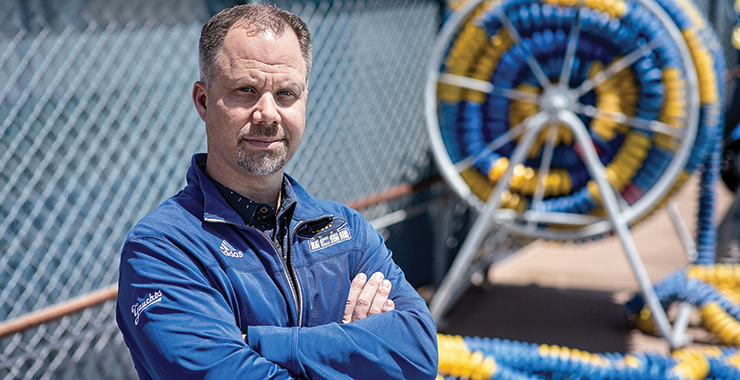
When Dave Botsford, PsyD, joined the University of California, Santa Barbara, in 2015 as its first full-time clinical sport psychologist, his biggest challenge was earning the trust of his new university’s athletic community.
That’s why, even though Botsford’s position is based in the university’s counseling center, his office is located in the athletic department, so that he is visible and accessible not only to the 450 student athletes who train there, but also to the coaches and athletic staff who guide them.
Before earning his doctorate in clinical psychology, Botsford was a competitive snowboarder. He spent three years on a boardercross pro-am circuit while earning a master’s degree in exercise and sport science. He spoke to the Monitor about his work and his path from snowboarding to psychology.
What does your typical day include?
There’s a lot of variety. Every day, I meet with four to seven student athletes to provide mental health counseling or performance consulting on the psychological aspects of their sport. I also run a support group for student athletes, where we talk about common topics and struggles they have.
I also work closely with coaches, sports administrators, sports medicine staff and doctors, athletic training staff and academic support staff, consulting with them on concerns about an athlete or a situation on a team.
What concerns do student athletes face?
Athletes perform best when they’re fully present. That sounds easy enough, but it becomes surprisingly difficult during downtimes or unexpected changes in schedule. So, for example, in a sport like baseball or golf, there are very intense, very precise instances of performance that require focus and specialized technique, but then there’s a lot of downtime. Athletes need to have that awareness that you can’t just be “on” all of the time. Similarly, if you’re not plugging in when you’re standing at the plate or when you’re about to hit a 30-foot putt, you’re also not going to get the results you want.
Another thing that makes student-athletes unique is logistics. They have a lot less time and energy than the average student to explore classes, relationships and other things. When you’re spending 30-plus hours a week training, traveling and competing in your sport, you’re lucky to get some sleep, go to class and maybe have a little time to hang out with friends. Some common presenting concerns are depression or anxiety, and sometimes that can be related to feelings of isolation and loneliness.
Student-athletes are socialized to be independent, tough it out, push through it and be persistent. That’s how they’ve gotten where they are. But when it comes to a mental health issue, you can’t strong-arm your way through. I’ve worked at a few universities, and that stigma about asking for help is one of the biggest struggles I’ve come across.
What’s rewarding about your work?
One of the things I enjoy most about working with athletes is that they already have a tremendous amount of resources in terms of the knowledge, skills and abilities they’ve had to develop, both physically and mentally, to be successful in their sport. Oftentimes they don’t realize those same qualities or skills can be adapted to things off the field, outside of the pool or off the court. I look at my job as trying to help them identify and repurpose the resources they already have so they can apply them to other aspects of their life.
What’s challenging about your job?
The hours. I work longer hours because students’ schedules of training, competition and classes can make it difficult to find available times during the week. I also try to make appearances at practices and games for many of our 19 teams. Athletes often appreciate the support. Plus, behavioral observations can sometimes inform our work together in the office.
If student-athletes don’t see me at games, at practices, in the weight room or the athletic training center, then the implicit message is “You only see Dave when there’s a problem.”
That’s not the message I want to send. I want people to think of me less as “Dave the clinical psych,” and more as another person to help—just like the strength-and-conditioning coaches help them get faster, stronger and develop more endurance.
Working with coaches also can be challenging. Coaches are very knowledgeable about training and competing in their sport, but many coaches don’t receive as much training and education related to helping student-athletes handle common social, emotional and developmental experiences outside of sport.
A student athlete who is dealing with a mental health issue might need time away from sport, whether it is an adjusted training schedule or even a “redshirt” year, which is when athletes don’t compete so they can extend their eligibility to play. While most coaches are concerned with student athlete well-being, coaches also experience significant personal, professional and financial pressures of their own. These pressures often contribute to coaches’ urgency to get student athletes back to competition as soon as possible. This is why relationships with coaches are so essential to my role as a provider within the athletic department.
How did you get the training and experience to do your job?
I’ve always been an active person. I’d been a multisport athlete through high school and the beginning of college. But I was never an all-star, so I was trying to figure out another way to develop myself as an athlete.
My junior year of college, a friend of mine convinced me to take a sport psych class, and I found that I liked the material. Then my senior year, the university started a master’s program in sport psych, and I talked my way into taking a master’s-level class. The professor got me really excited about the field.
I earned a master’s at the University of Utah and then went to the clinical sport psychology program at the Arizona School of Professional Psychology. The chair of the program was, at the time, the sport psychologist for U.S. Ski & Snowboard, which supports the national team. Not only did I get to learn about his experience, but I did my dissertation research with national team snowboarders.
Because I knew I wanted to work with college student-athletes, I tailored my clinical training to the most common concerns that affect student-athletes—things like depression, anxiety, substance use issues, eating disorders and family relationships. I did a practicum in substance use and another in assessment, which really sharpened my diagnostic skills.
For my internship, I went through the Association of Psychology Postdoctoral and Internship Centers match twice. I knew I wanted to work at a university counseling center. But none of my practicum training was in a university setting. When I applied the first time, I was getting compared with people who had hundreds of hours of practicum experience in university settings. I didn’t realize what a disadvantage that was. I got one offer, but it just wasn’t what I wanted to do. I turned it down.
Then I did some outside-the-box thinking to get supervision with university students to be more competitive in the match the following year. I called the counseling center training director at Ithaca College, my undergraduate alma mater, explained my situation and basically offered to work for free at Ithaca for supervision. She supervised me for a whole year and I learned a lot.
I reapplied for the match and got literally my dream internship experience at the University of Oklahoma in the athletic department. If I’d pushed through that first year and taken what was offered to me, and not stuck to what was really my passion, I really would have missed out.
After getting my doctorate, I spent two years as a staff psychologist at the University of Massachusetts, Dartmouth, which included working in the counseling center and consulting with the athletic teams, then moved to California State University, Fullerton, where I served as the sport psychologist for the athletic department for four years.
Can you describe a work experience that was particularly meaningful to you?
I worked with an elite ski academy at the beginning of my career. One of the high school athletes I worked with was such a hard worker, even if he wasn’t the most talented kid on the team. After a race, he caught a ski tip, went off the trail and broke his neck in the crash.
I’ll never forget when I heard about the situation. His coach said, “Dave, he wants to talk to you.” I saw him at the hospital, and he told me as soon as he got out, he wanted to start working on his mental program. He was so positive and so motivated.
He went on to make a full recovery and was able to begin racing again. It was pretty inspiring for me. I often think about him and his phenomenal resiliency. I hope I had as much of an impact on him as he had on me as a professional.