Can a chimpanzee cook you dinner? It sounds like a sitcom setup, but Alexandra Rosati, PhD, an assistant professor of psychology and anthropology who heads the Cognitive Evolution Group at the University of Michigan, realized the question might reveal clues about the evolution of the human mind.
“Cooking is thought to be a major evolutionary shift in the human species,” Rosati explains. According to the hypothesis proposed by Harvard University primatologist Richard Wrangham, PhD, embracing a cooked diet allowed our pre-Homo sapiens human ancestors to extract more energy from food, thereby growing bigger brains and evolving into the species we are today. But that hypothesis hinges on the idea that cooking was adopted early in human evolution—a theory that remains contested. “We thought that psychology could bring a new line of evidence to this evolutionary idea,” Rosati says.
Cooking is a complex behavior that requires multiple cognitive abilities, including the preference for cooked food over raw, the patience to wait for food to cook, a causal understanding that a cooking device can transform raw food into cooked, the willingness to hand over valued food with the expectation that it will return in a more delicious form later and the ability to plan ahead by saving raw food to cook later instead of eating it right away. With her University of Michigan psychology colleague Felix Warneken, PhD, Rosati performed a series of experiments using a homemade faux chimpanzee “microwave,” a covered bowl in which researchers could surreptitiously swap slices of raw potato for cooked potato. They found the chimps demonstrated all the cookingrelated cognitive abilities they tested (Proceedings of the Royal Society Bopens in new window, Vol. 282, No. 1809, 2015).
“If chimps can do it, our early human ancestors probably could do these things, too,” Rosati says—a finding that adds another piece of support to Wrangham’s cooking hypothesis. “This experiment lets us see how a set of psychological abilities can, potentially, let an animal move into a new evolutionary niche,” she adds.
Rosati’s research is part anthropology and part evolutionary biology. But her lab is situated in the psychology department, and she couldn’t tackle existential questions about the evolution of human thinking without leaning heavily on psychological science. “My overarching research goal is to understand where complex human cognition comes from, and more generally, how cognition evolves at all,” she says. “By combining ideas from psychology, about how the mind works, with ideas from anthropology, about what the mind is for, we can come up with entirely new things to study—things that perhaps nobody would have thought of otherwise.”
Lemurs, apes and humans
Rosati has an undergraduate degree in psychology from Harvard University and earned her PhD in evolutionary anthropology, with a certificate in cognitive neuroscience, from Duke University in 2012. She spent two years as an assistant professor at Harvard before moving her lab to Michigan in 2017. As a fairly new arrival, she’s still growing her lab—she currently advises two graduate students and one postdoc.
“People sometimes wonder why we do this work with animals. But it’s a unique opportunity to explore how other minds work, how they see the world and what that can tell us about the evolution of the human mind,” says second-year PhD student Averill Cantwell.
Rosati’s team takes a comparative approach, studying a variety of primate species from lemurs (the most primitive of the living primates, and the most distantly related genetically to humans) to apes (our closest living genetic cousins in the animal kingdom). Rather than keep animals on campus, Rosati and her students travel to them, studying free-ranging primate populations in sanctuaries, parks and research centers in the United States, Europe and Africa. That model allows them to study a more diverse range of animals in situations that mimic their natural physical and social environments. “That’s important, since we want to understand how cognition works in complex real-world environments,” Rosati says.

In fact, many of her methods borrow from developmental psychology. Like human babies, chimps and monkeys can’t fill out surveys or answer questions. Instead, the researchers rely on methods such as gaze-following to track an animal’s attention and using looking time as a marker of surprise.
Making decisions
One theme in Rosati’s research is studying how and why animals make the decisions they do. The research is inspired, in part, by findings from behavioral economics that show humans make some strange choices. We favor short-term consumption over long-term investments, for example, and arbitrarily assign greater value to products based on popularity and status. Our primate cousins can help us better understand those quirks. “Animals don’t use money or credit cards, but they do have to make a lot of decisions about value when foraging for food or looking for mates,” Rosati says. “We’ve been exploring the hypothesis that even though some of our human biases look irrational from an economic perspective, they might actually be quite rational from a biological perspective.”
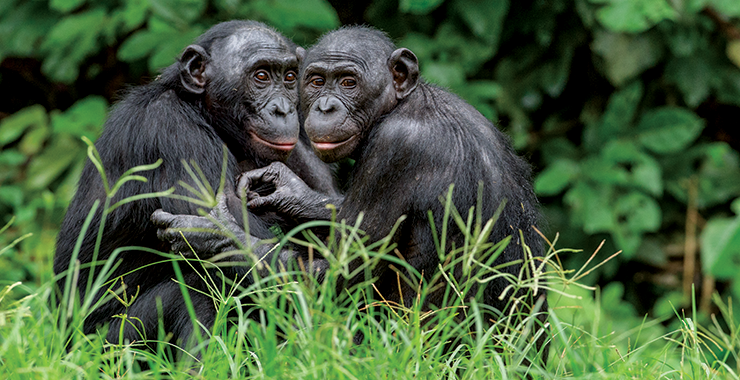
In one example, she compared chimpanzees with their sister species, bonobos. Though similar in many ways, the two apes live very different lives. Chimps have evolved to feed on highercalorie foods that are more difficult to come by: hard-to-find fruits, nuts that require cracking and ants that they must “fish” for with sticks inserted into the ants’ nests. Bonobos eat fruit but rely more heavily on plentiful vegetation, and unlike chimps, they’ve never been seen using tools in the wild. Those differences play out in the two species’ decision-making behaviors, as Rosati described in a recent review article (Trends in Cognitive Sciencesopens in new window, Vol. 21, No. 9, 2017). Chimps, she found, are more patient than bonobos, have better spatial memory and are more willing to take big risks in hopes of big payouts. What looks irrational in one environment seems perfectly logical in another.
What about us? People, Rosati found, tend to look more like chimps in their risk-taking behavior—suggesting that our species might have evolved in an environment similar to the one chimps evolved in, she says. Indeed, human hunter-gatherers today often forage for high-risk, high-reward food (such as hunting for meat and gathering honey). Yet Rosati also found that while humans are chimplike when making decisions about food rewards or prizes, they’re more risk averse when money is at stake. That suggests there might be something evolutionarily novel about money, she says—and that different psychological processes might be involved when we’re thinking about concrete versus abstract rewards (Evolution and Human Behavioropens in new window, Vol. 37, No. 2, 2016). It’s a finding that could have implications for anyone who studies behavioral economics. “Studies that use money as a reward might not be capturing the full picture of how humans make decisions,” she says.
Friends and fruits
It might seem obvious that an animal’s physical environment would influence its evolutionary path. Yet much research on primate and human cognition has focused on the role of living in complex social groups, Rosati says. To fully understand how the human mind came to be, she argues, scientists should consider how social and ecological pressures work in tandem.
Lemurs make excellent subjects for that, says Francesca De Petrillo, PhD, a postdoctoral researcher of Rosati’s who is now based at the Institute for Advanced Study in Toulouse, France. All types of lemurs share a single common ancestor, but some lemur species live in complex social groups, while others have much looser social affiliations. Some graze on readily available leaves, while others eat fruit, a more cognitively demanding food source that requires finding fruits, determining whether they’re ripe and, if not, waiting until they’re ready to pick.
In one ongoing project based at the Duke Lemur Center at Duke University, De Petrillo is comparing the leaf-eating Coquerel’s sifaka lemur with the fruit-eating red ruffed lemur to determine whether each species is capable of logical inference—that is, if they can use information they’re given about where food is located to deduce new information about the location of hidden foods. “We want to understand how ecology, and especially diet, may have shaped their cognition,” she says.
In other work, Rosati’s team is zeroing in on the social side of the equation. In a number of studies, she has compared a population of free-ranging rhesus macaques in Cayo Santiago, Puerto Rico, with Barbary macaques living in a forested park in the United Kingdom. Rhesus macaques are aggressive and despotic, Rosati says. Closely related Barbary macaques are much more socially tolerant and generally have a calmer temperament.
Rosati and Laurie Santos, PhD, a professor of psychology at Yale University, compared the two species to test how their divergent social systems might have influenced their social cognitive skills. They found that as juveniles, both species engage in similar rates of gaze following—turning to look at the things other members of their troops are looking at. Barbary macaques continue that behavior into old age. But by adulthood, rhesus macaques engage in gazefollowing much less often (Animal Behaviouropens in new window, Vol. 130, 2017). “The more tolerant Barbary macaques remain interested in these social cues over their life span. But for the intolerant rhesus macaques, once they reach maturity, that’s not in their bag of tricks anymore,” Rosati says.
Living long and living well
Looking across the life span is another recurring theme in Rosati’s work. One common way to understand human cognition is to explore how it develops in infants and children, she notes. Another is to look to our primate cousins to understand the evolutionary roots of cognition. Rosati wants to do both. “We’re combining those approaches to look at how cognition, behavior and physiology change across the life span,” Rosati says.
Even without modern medicine, humans can easily live past 70. Wild chimps tend to die by age 50, and macaques live just half that long. “Why is it that we’re living so long, and what can that tell us about human cognition and behavior?” Rosati asks.
In one new project, she and her colleagues are studying aging in chimpanzees. Partnering with scientists who study wild chimps, they are drawing from socioemotional selectivity theory—a psychological theory that maintains that as humans age, they hone their social networks and invest in more emotionally meaningful relationships and goals—to predict how wild chimps might behave over their life spans. “We’re trying to bridge the kinds of controlled experiments we’re doing in these sanctuaries and parks with the kinds of observational techniques that are used in the wild,” she says.
The chimpanzee work is funded by the National Institute on Aging, while other projects are largely supported by the National Science Foundation. And in 2019, Rosati was awarded a prestigious Sloan Research Fellowship in neuroscience, a two-year, $70,000 award that is helping her to dig more deeply into the origins of complex thinking.
Rosati is driven to answer fundamental questions about the evolution of cognition. She’s also thankful that her work allows her to support animal welfare. The sanctuaries where she does much of her research care for animals orphaned by hunting and the pet trade, and she serves as a technical adviser to the Pan African Sanctuary Alliance, an association of wildlife sanctuaries across 13 African nations. “Through our research, we’re able to support organizations that are playing a crucial role in primate conservation and law enforcement,” she says. “It’s a privilege to study these animals, and we need to put their welfare and well-being first.”