Long gone are the days of chalkboards and overhead projectors. Today’s psychology faculty have a wealth of technological tools to choose from, including virtual and augmented reality devices that bring lessons to life and sophisticated software for grading, detecting plagiarism and hosting virtual classrooms.
“Technology has reshaped human cognition—for better or worse—in terms of how we perceive, remember and learn,” says Richard Harnish, PhD, professor of psychology at Penn State New Kensington and co-editor of “The Use of Technology in Teaching and Learning,” an e-book released by APA’s Div. 2 (Society for the Teaching of Psychology). “Faculty need to recognize its impact and adjust accordingly.”
New realities in academia
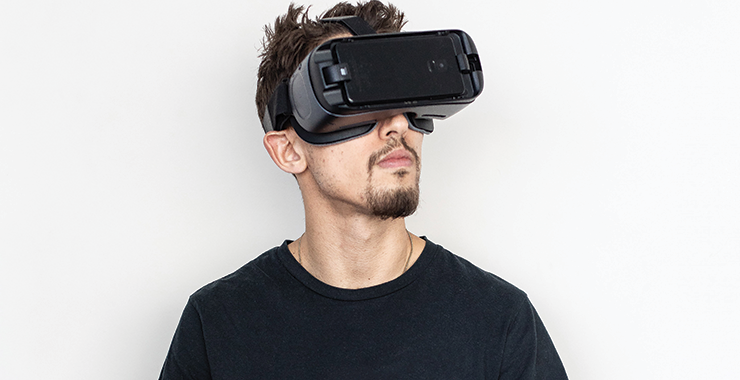
One of the most promising additions to education has been virtual reality (VR) technology, which research shows can fully immerse the viewer in a virtual experience and increase his or her empathy (Schutte, N.S., Motivation and Emotionopens in new window, Vol. 41, No. 6, 2017). “VR gives people a sense of what it’s like to be in someone else’s shoes, which is the low-hanging fruit for psychologists,” says Mina Johnson-Glenberg, PhD, research professor of psychology at Arizona State University and founder of Embodied Games LLCopens in new window, a company that uses VR and motion capture to create science education content.
At Stanford University, psychologist Jeremy Bailenson, PhD, founding director of the Virtual Human Interaction Labopens in new window, says he uses VR in the classroom “the same way any teacher would use a field trip. VR field trips have all of the assets of an actual field trip—going to special places specifically chosen for teachable moments—but they also allow for the impossible.”
To enable students to understand serious mental illness more deeply, psychologists at the Australian College of Applied Psychology, for example, have designed a VR simulation to help students experience the type of auditory and visual hallucinations that people with schizophrenia often face. A study of the simulation found that students and other participants displayed increased knowledge and empathy toward those with the disorder in a post-test (Formosa, N.J., Australian Journal of Psychologyopens in new window, Vol. 70, No. 1, 2018). Other educational simulations have used virtual spiders to teach students about phobias, and amplified sounds in a library setting to mimic the experience of a person with attention-deficit hyperactivity disorder (ADHD).
To make educational applications of VR as useful in the classroom as they can be, Johnson-Glenberg is also developing a tool to help instructors evaluate the usefulness of VR applications for teaching. Known as the Quality of Education in VR Rubric, or QUIVRR, the tool helps teachers assess the content and mechanics within a VR experience.
“People are creating VR tools that look great, but there’s not always an added value in terms of pedagogy,” Johnson-Glenberg says.
Meanwhile, Tyler Ard, PhD, assistant professor of research neurology at the University of Southern California’s Mark and Mary Stevensopens in new window Neuroimaging and Informatics Instituteopens in new window, is exploring another frontier: augmented reality (AR). Ard and his team, which includes psychologists, neuroscientists and computer scientists, have developed Schol-ARopens in new window, a smartphone app that allows users to aim their phones’ cameras at an image in a textbook, journal article or conference poster and pull up supplementary visuals, including 3D images, animations and interactive components. For example, a reading on an fMRI might include an embedded animation of a 3D brain that users can manually manipulate to view regions of heightened neural activity.
Other tools for teaching
Technology is also changing the way psychology faculty manage their courses, including how they deliver lectures, grade exams and even identify plagiarism.
Those who teach online or hybrid courses, which combine in-person and online learning, are using asynchronous conferencing software that enables a near replication of the discussion that occurs in a traditional classroom. As students watch recorded lectures at different times throughout the day, they add video questions and comments, which are synced with the lecture video to facilitate ongoing discussions. “It’s a huge improvement over message boards,” says Beth Doll, PhD, professor of educational psychology at the University of Nebraska–Lincoln.

Also in use are “virtual presence systems,” otherwise known as videoconferencing robots, which give remote students an enhanced presence in classrooms and meetings. Remote students can control the robots, which help them stay engaged in hybrid courses through high-quality audio, 360-degree video and wheels. They’re also useful for faculty who perform practical observations—for example, of students in Doll’s school psychology professional program—because they allow instructors to evaluate students as they administer tests and deliver psychological services but don’t trigger the kind of behavioral changes in students that occur when a supervisor sits in the room. “Growth occurs more rapidly because we can give students very specific feedback, but the coaching is much less intrusive,” says Doll.
When it comes to grading exams, scantrons are being replaced by ZipGrade, a smartphone and tablet app that allows instructors to create custom bubble sheets, scan completed sheets with their smartphones and immediately obtain test scores. ZipGrade also calculates the correlation between students’ responses to a given question and how they performed on the test overall to help instructors evaluate the efficacy of each question.
As for detecting plagiarism, Turnitin—which checks submitted assignments against online sources and its own database—is still the primary resource used by most institutions, but an upcoming program called Google Assignments, currently being tested, performs a similar function for free. By automatically running assignments submitted via Google Docs through a Google search, the new tool may be a time and money saver for faculty, especially because Google Docs offers integration with popular course management systems such as Canvas.
Promoting research
Psychologists in academia are also reimagining how to summarize and share research findings. Online social networks, including Twitter and ResearchGate, are increasingly being used for sharing research findings quickly with professional networks. A survey conducted by the Pew Research Center found that nearly half of American Association for the Advancement of Science members use social media to discuss science and follow new discoveries (How Scientists Engage the Publicopens in new window, 2015), while institutions such as the Mayo Clinicopens in new window now consider social media activities when making decisions about academic appointments and promotions.
APA’s Thank a Scientist initiative, an annual weeklong Twitter campaign that recognizes the contributions of influential psychologists, has gained significant traction since its launch in 2017. More than 100 other scientific and educational organizations have now joined the appreciation effort.
Other psychologists are finding creative ways to promote evidence-based practices in an online environment. Helping Give Away Psychological Scienceopens in new window (HGAPS), founded by Eric Youngstrom, PhD, professor of psychology at the University of North Carolina at Chapel Hill, partners with Wikipedia to create and revise entries on psychological research. Since HGAPS launched in 2015, its hundreds of Wikipedia pages have been viewed more than 100 million times.
“The future of sharing information with nonexperts involves identifying partners in the online space that already have significant traction,” says Andres De Los Reyes, PhD, immediate past chair of the APA Board of Educational Affairs and professor of psychology at the University of Maryland, College Park. “Wikipedia and other popular online networks allow content we’ve created in other spaces to scale up to the masses in a way that we could never do on our own.”