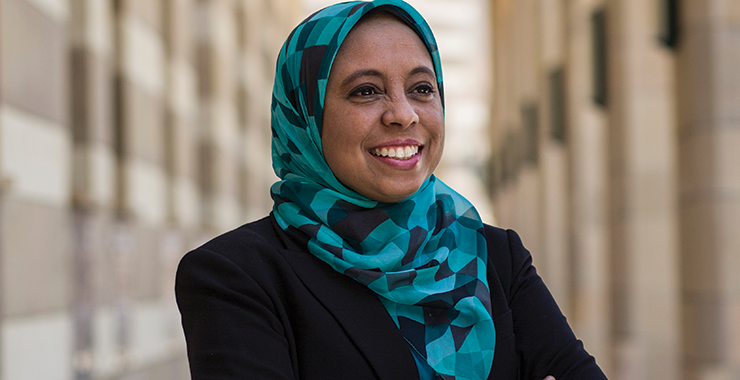
As a psychology graduate student at Southern Illinois University 15 years ago, Germine Awad, PhD, searched for others in psychology who shared her Egyptian American background. She discovered and became active in APA’s Div. 45 (Society for the Psychological Study of Culture, Ethnicity and Race), but even within that group, she seldom encountered another Middle Eastern or North African (MENA) psychologist.
“I just wanted so badly to meet someone who was Arab/MENA and see myself reflected in somebody who had made it in psychology,” she says. “But we were invisible in all of these spaces.”
Eventually, Awad began to find other MENA American psychologists through APA conventions. They created informal networks to share their research ideas and practice insights, as well as their professional and personal challenges, though they dreamed of having a more formal presence in psychology.
Now that dream is realized. Awad is a founding board member of the American Arab, Middle Eastern, and North African Psychological Association (AMENA-Psy) with Mona Amer, PhD, and Nabil El-Ghoroury, PhD. It officially launched in 2017, and Awad serves as its first treasurer.
“This population has been left out of the discourse for many years,” says Amer, past president of AMENA-Psy and chair of the psychology department at the American University in Cairo. “It was really important to establish this organization so that we can have a voice, be more visible and work toward supporting these communities.”
Increased visibility
AMENA-Psy has two aims: to expand and support the MENA American psychologist workforce and to foster the well-being of Arab, Middle Eastern and North African people who live in the United States and Canada. Those communities are religiously and culturally diverse and include, for example, people of Egyptian, Iranian, Iraqi, Lebanese, Moroccan, Palestinian, Somali, Syrian and Turkish descent.
Although research on the mental health needs of these people is expanding, it is still woefully inadequate, according to an analysis of MENA scholarship in the “Handbook of Arab American Psychologyopens in new window” by Amer and Awad.
When Bahaur Amini, a third-year counseling psychology graduate student at the University of Kansas, was writing her master’s thesis on divorce among Iranian Americans, she struggled to find enough relevant studies in the literature to complete the work.
“Students pursuing psychology graduate degrees are facing similar challenges today that Dr. Awad faced before,” says Amini. She joined AMENA-Psy to connect with others who share her research interests and to advocate for MENA American well-being.
One advocacy priority for MENA American psychologists is improving how the United States collects demographic information about race and ethnicity. The U.S. Census Bureau categorizes MENA people as “white,” which has led to an undercounting of the population, says Awad. That has farreaching implications—making it difficult for psychologists and others to identify educational and health disparities that need intervention, for example. Moreover, most demographic forms, including APA’s, use the Census Bureau’s categorization.
“These categories trickle down,” adds Amer. “We don’t have categorization listed in, for example, journal article statistics. Our invisibility is a major detriment to the development of scholarship, practice and advocacy within our field because it’s difficult to identify and collaborate with other people who have similar interests or come from similar backgrounds.”
While an effort to include a MENA category on the 2020 census failed, the form will allow people to write in ancestry information for the first time.
A sense of belonging
AMENA-Psy welcomes all psychologists and psychology students, whether they have a MENA background or just want to connect with others who are working with the community.
Like other ethnicminority psychological associations, AMENA-Psy is invited to send a nonvoting member to APA’s Council of Representatives to contribute to council discussions. AMENA-Psy plans to work toward having a MENA American representative in other groups that promote diversity in psychology and to advocate for the collection of demographic data on MENA psychologists.
Among its member benefits, AMENA-Psy offers annual awards and a list of resources on its websiteopens in new window, including books, course syllabi and scholarly articles. Leaders are also planning a referral database of qualified mental health practitioners, a mentoring program and a database of potential thesis and dissertation advisers for MENA graduate students. One day, they hope to host their own conference.
Meanwhile, members collaborate and share experiences on the association’s discussion list. Some of the issues they discuss include finding referrals for clients, research gaps and professional opportunities. It’s also a place to find a sense of belonging, says AMENA-Psy President Ayse S. Ikizler, PhD, an assistant psychology professor at St. Mary’s College of Maryland who conducts research on how discrimination affects the mental health of MENA Americans.
“This association gives me a sense of hope that my research is going to continue to be seen as valid and important,” she says.