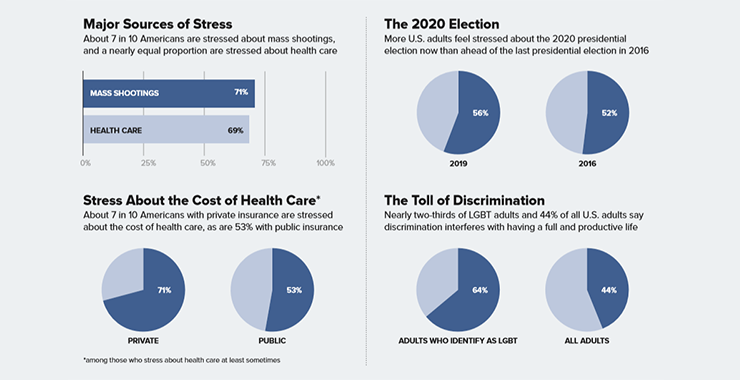
A year before the 2020 presidential election, Americans report various issues in the news as significant sources of stress, including health care, mass shootings and the election itself, according to a new Stress in America™ survey by APA. More than half of U.S. adults (56%) identify the 2020 presidential election as a significant stressor, an increase from the 52% of adults who reported the presidential election as a significant source of stress when asked in the months leading up to the 2016 contest.
The Stress in America survey was conducted between Aug. 1 and Sept. 3, 2019, by the Harris Poll among 3,617 adults living in the United States.
According to the survey, around 7 in 10 adults (69%) say that health care is a significant source of stress—nearly equal to the 71% who say mass shootings are a significant source of stress. Among adults who experience stress about health care at least sometimes (47%), the cost of health care is the most commonly cited source of that stress (64%). Adults with private insurance (71%) are more likely than those with public insurance (53%) to say the cost of health care causes them stress. More than half of adults overall (55%) worry that they will not be able to pay for health-care services they may need in the future.
Mass shootings are the most common source of stress cited by U.S. adults in 2019, with more than 7 in 10 adults (71%) saying mass shootings are a significant source of stress in their lives. This is an increase from 2018, when more than 6 in 10 adults (62%) said mass shootings were a significant source of stress. By demographic, Hispanic adults are most likely to say mass shootings are a significant source of stress (84%), followed by black (79%), Asian (77%), Native American (71%) and white (66%) adults.
Stress related to climate change/global warming has increased significantly since 2018 (56% in 2019 vs. 51% in 2018). And more adults are reporting that widespread sexual harassment causes them stress today than said the same in 2018 (45% in 2019 vs. 39% in 2018).
“There is a lot of uncertainty in our world right now—from mass shootings to climate change. This survey shows us that more Americans are saying these issues are causing them stress,” says Arthur C. Evans Jr., PhD, APA’s chief executive officer. “Research shows us that over time, prolonged feelings of anxiety and stress can affect our overall physical and mental health. Psychologists can help people develop the tools that they need to better manage their stress.”
Immigration and discrimination
Immigration is cited as a stressor by nearly half of adults (48%), with Hispanic adults most likely to identify it as a stressor (66%), followed by Asian (52%), Native American (48%), black (46%) and white (43%) adults.
Discrimination is another stressor that has become more prevalent in recent years (25% in 2019 vs. 24% in 2018, 21% in 2017, 20% in 2016 and 20% in 2015). In 2019, the majority of people of color (63%) say that discrimination has hindered them from having a full and productive life, with a similar proportion of LGBT adults (64%) expressing the same sentiment.
When looking at the responses of people of color, the 2019 results represent a significant increase from 2015, the last time this set of questions was asked, when less than half (49%) said that discrimination prevented them from having a full and productive life.
“This survey shows us that current events affect Americans differently, with people of color more likely to say they feel stressed about health care, immigration and discrimination,” says Evans. “While these are important societal issues that need to be addressed, the results also reinforce the need to have more open conversations about the impact of stress and stress management, especially with groups that are experiencing high levels of stress.”
While average reported stress levels remain constant compared with 2018 (4.9 in 2019 and 4.9 in 2018 on a scale of 1 to 10, where 1 is “little or no stress” and 10 is “a great deal of stress”), there continues to be a generational difference, with Gen Z adults reporting the highest average stress level (5.8), followed by Gen Xers (5.5), millennials (5.4), baby boomers (4.2) and older adults (3.0).