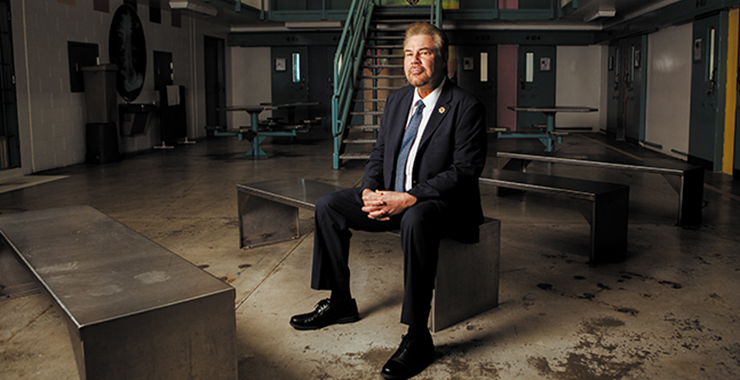
Dean Aufderheide, PhD, had never considered pursuing a career in corrections until his wife showed him an ad for a position at a men’s facility 20 years ago. He was open to a new role at the time because the evening hours of his private practice afforded little time with his young family, so the work schedule and potential challenge of a prison setting seemed attractive. Aufderheide applied for and secured a senior psychologist position at Walton Correctional Institution in DeFuniak Springs, Florida, a decision that unearthed for him a deep passion to improve mental health care for inmates nationwide.
“Throughout my career, I’ve worked with patients in the hospital, community mental health, military and private practice settings, and the incarcerated population with mental illness has been the most rewarding and challenging group of people I’ve treated,” says Aufderheide, now director of mental health services for the Florida Department of Corrections. “I get to foster a sense of hope and restoration in people who have often been disenfranchised and disregarded by society.”
The demand for correctional psychologists is higher than ever because the institutions housing the nation’s 2.2 million inmates have become de facto mental health facilities for people who struggle to access services in the community. In fact, about 10 times more individuals with serious mental illness are in jails and prisons than in state mental hospitals, according to a reportopens in new window from the Treatment Advocacy Center, a national nonprofit organization focused on eliminating barriers to treatment for mental illness. And, according to a surveyopens in new window of more than 100,000 inmates conducted by the Bureau of Justice Statistics, more than one-third of prisoners and 44% of jail inmates had been told that they had a mental health disorder at some point in their lives.
The roles for psychologists who work in correctional facilities are numerous. Some offer one-on-one therapy, while others provide crisis intervention for inmates in restrictive housing, also known as solitary confinement. Some psychologists are members of medical teams that support inpatient units, while others serve as the main mental health contact for wardens or commissioners of a state system.
Here, psychologists share how they found jobs in corrections and the challenges and rewards of working with inmates.
Supporting juvenile offenders
Like Aufderheide, Tracy Shelby, PhD, wasn’t planning to pursue work in corrections, but she was hooked after a practicum experience at a regional juvenile detention center in Florida.
“There’s a common misperception that youth in detention are bad kids, but I learned that many of them had been forced to deal with adult life stressors that they were not equipped to handle,” says Shelby, director of mental health and substance abuse services at the Florida Department of Juvenile Justice. “Often they are angry, rightfully so, and they don’t have the supports that many other teens have.”
Shelby worked with one boy who had been arrested for shoplifting food at a market while his five younger, hungry siblings waited outside, and with a girl with schizophrenia who was arrested for trespassing because she was proselytizing in front of a corner market. In cases like these, Shelby assesses the needs of these youths, contacts their family members and sometimes the Florida Department of Children and Families, and offers treatment for substance use, trauma or other disorders. “One of the most important things I do is listen to these kids, because many have never had an adult sit down and show that they are important,” she says.
After providing direct services for 18 years, Shelby transitioned to her director role, overseeing five employees who support the contracted providers that serve the 86,000 youths in the state’s detention center and residential programs. As part of that work, she developed a training program in trauma-informed care that teaches all staff—including janitors, correctional officers and administrators—about common stressors for youths who have experienced trauma and strategies to help them after a triggering event. For example, correctional officers could consider playing soft music if silence is a stressor or assign a roommate to someone who experiences stress from being alone.
For Shelby, one of the most fulfilling aspects of her job is reducing the risk of recidivism among youths in detention. “I have an opportunity to help them heal,” she says. “Once they trust me, they are honest and open and want to change.”
One-on-one therapy
Heidi Hawkins, PhD, psychological program manager of the North Carolina Correctional Institution for Women, was drawn to the challenge of treating people who had severe cases of post-traumatic stress disorder (PTSD), schizophrenia, psychosis, bipolar disorder and other mental illnesses.
“I had worked in a variety of mental health treatment settings in graduate school, but I never encountered the severity of mental illness that I see in corrections,” she says.
Hawkins trains the facility’s clinical and nonclinical staff on how to communicate with inmates who have severe mental illness. For instance, she emphasizes the importance of tone of voice and of using simple, direct language when giving them instructions rather than telling them multiple steps at one time. She also supervises the psychologists, social workers, recreational therapists and correctional behavioral specialists who provide services such as individual and group therapy. These treatment options are known as “outpatient services” in the correctional system.
Because correctional psychologists treat patients who often lacked care in the community, they see significant progress in short periods of time. Mehjabeen Ali, PsyD, a supervising psychologist with Correctional Health Services in Los Angeles, saw such rapid progress when she was treating an inmate in her 20s who started experiencing symptoms of psychosis. Over time, the woman had stopped showering, eating regularly and interacting with others. Ali helped her understand that she had a mental illness, and she became willing to participate in rehabilitation to regain life skills. Ali also advocated for the woman by writing letters to the court about the benefits of releasing her from jail and continuing her rehabilitation. A judge granted the request.
“I enjoy working with this acute population in jail,” Ali says. “There’s a chance they wouldn’t otherwise engage in treatment so willingly in the community, and it’s rewarding to see them make progress.”
Collaboration in the inpatient unit
Although the outpatient setting offers advantages, like a predictable caseload and extended time to work one-on-one with inmates, the lack of connection to other team members in this role was a drawback for Jordan Dropkin, MA. He had been working with juvenile sex offenders at a facility in western North Carolina, many of whom had been sexually abused themselves. Witnessing the impact of the cycle of abuse eventually led Dropkin to experience symptoms of burnout. So, he transitioned to the inpatient unit at the North Carolina Correctional Institution for Women, where he now works on a team that includes a psychiatrist, a social worker and another clinician.
“I enjoy the depth of insight that is gained from others’ clinical expertise and judgment, and having the ability as a unit to cover multiple tasks simultaneously,” says Dropkin.
Dropkin oversees several units. One is a 10-bed acute inpatient unit for inmates who require continuous observation because they are suicidal or exhibiting self-injurious behavior or symptoms of psychosis. He also runs the 12-bed stepdown unit for those who are less of a safety risk and ready to participate in services like group therapy. And he sees patients on the 24-bed residential unit, which is reserved for inmates with intellectual disabilities or severe cases of schizophrenia, bipolar disorder, PTSD or other mental illnesses who need longer-term support.
On these units, corrections staff members—such as security officers—partner with the mental health team to design the treatment plan. This collaboration was critical when one inmate was transferred to the inpatient unit because she had been ingesting objects: a battery, a bra strap, a staple and a spork. “It became clear that she was doing this because she craved attention and was trying to create the family she never had with staff members,” Dropkin says. The team developed a safety plan to prevent her from accessing anything that could be swallowed, and they agreed that correctional staff should stop responding to familial nicknames she gave them. After therapy and medication adjustments, she started learning how to have appropriate interactions with others and she stopped ingesting objects.
Although inmate patients can make significant progress, one challenge of working in a prison is dealing with the conflicting priorities of mental health providers and the correctional staff, says Dropkin. “Safety is No. 1, which means clinical needs can take a back seat,” he says. This can slow down progress if officers are reluctant to relax restrictions on an inmate who has acted out but also needs mental health treatment.
Addressing fear
For psychologists who enjoy unpredictable crisis intervention work, roles in restrictive housing units may be another option. In many cases, the crises involve inmates who are hurting others or attempting to hurt themselves because they are afraid of other inmates, says Nicole Taylor, PhD, JD, mental health director at the Arizona Department of Corrections. They may fear bullying or retaliation from other inmates because they committed a particularly egregious crime or have accumulated some kind of debt in prison. “Inmates can get very stressed out about their housing situations, which can lead to anxiety, depression and impaired functional abilities,” she says. “We’ve seen cases of significant self-injurious behavior and even suicide that were prompted by fears about personal safety, so we take these concerns very seriously.”
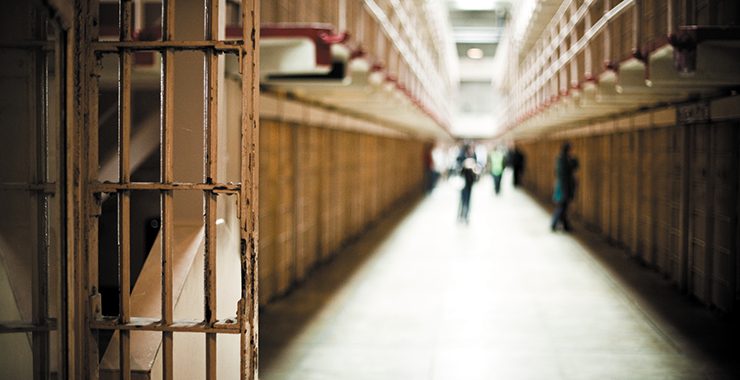
If, for example, inmates barricade themselves inside their cells, Taylor usually starts with brief supportive therapy. She will ask questions to learn what prompted the behavior and talk to the corrections staff to gather more information. Inmates may resort to self-injurious behavior or other methods to increase the odds of being transferred to a preferred housing unit. “I’m often in the role of a negotiator between the staff and the inmates,” she says. If needed, she may advocate to have an inmate moved to a new housing situation, but she is careful not to make these decisions quickly or without input from other team members.
“They have spent years developing maladaptive behaviors, and they often want a quick fix to a problem rather than investing the time to address the larger mental health issues,” Taylor says. But she has seen remarkable changes for those who are willing to engage in mental health services. “They can learn prosocial ways to engage with the world and gain insight about their triggers.”
Taylor believes it’s important to give inmates in restrictive housing the opportunity to demonstrate these prosocial behaviors as a means to gradually earn privileges, such as more phone calls, less time in restraints and increased time outside their cells. This system can also improve conditions for inmates in restrictive housing, which has been the subject of controversy in recent years. Taylor leads trainings at the National Institute of Corrections, part of the U.S. Department of Justice, about when to use restrictive housing and how to create a tiered incentive program. “The vast majority of inmates are eventually released back into their communities, and it’s critical to give them opportunities to practice prosocial behaviors while they are still incarcerated,” she says.
Influencing policy
Other psychologists work with inmates who have been incarcerated for sexual offenses. Adam Deming, PsyD, executive director of the Indiana Sex Offender Management and Monitoring Program, is bothered by the common misperception that sex offenders “won’t change and won’t benefit from treatment,” he says.
Sex offenders released back into the community have historically been considered at high risk of reoffending and are usually subject to uniform supervision requirements, such as prohibited contact with minors, including their own children, even when they have no history of sex crimes against minors. Factors such as their age at release, prior criminal history and their victims’ characteristics can predict recidivism risk, which is low for many offenders, says Deming. Now, he leads presentations and trainings throughout the United States and internationally to teach mental health providers, attorneys, judges, parole officers and others about how to tailor supervision strategies and interventions for sex offenders based on these risk factors and the characteristics of individual offenders.
“Many of our current sex offender statutes were passed based on fear and poorly vetted information regarding risk,” Deming says. “It’s important to educate the public and provide legislators with accurate information that speaks to the real risks and needs of this population.”
Another common problem in correctional systems is the lack of support for inmates with less severe mental illnesses. They can struggle to function in the general inmate population but do not qualify for an inpatient unit, says Aufderheide. Often, these inmates act out in some way and are sent to restrictive housing units—settings that can exacerbate mental illnesses. To help inmates in this situation, Aufderheide advocated for a new series of residential mental health units in Florida prisons where inmates can access the treatment they need. The patients sleep and receive treatment in the unit but, unlike those in the inpatient unit, can eat their meals, go to chapel and work in jobs outside the unit.
He used data to show how this model could reduce costs and threats to institutional security, and he developed a plan for the innovative program that defined eligibility, staffing and treatment programming requirements. Since the plan was implemented in 2018, there has been a significant reduction in inmate misconduct and an increase in prosocial behaviors, treatment compliance and well-being, says Aufderheide.
For him, leveraging his psychology expertise to initiate such far-reaching changes is deeply rewarding. “I love the fact that I’m helping not only inmates but also the correctional staff and the public itself,” he says. “By integrating mental health services into the programming, we are making everyone safer.”