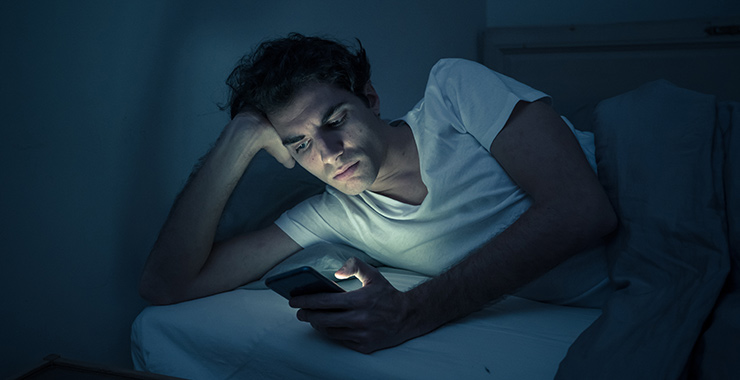
While the amount of time people spend checking their mobile weather apps, charging their phones, or making calls at night may seem inconsequential, a growing cadre of researchers is showing how smartphones have the potential to enhance psychology’s insights into human behavior.
Historically, one way researchers often studied behavior was by asking participants to self-report information, yet research has shown that people can be inaccurate when it comes to remembering specifics about their actions, says Samuel Gosling, PhD, a professor at the University of Texas at Austin who works in social and personality psychology. “We now have a device that people keep with them from the minute they wake up until they fall asleep that can detect movement, communication, and numerous other behavior patterns,” Gosling says. “I don’t think psychologists could have imagined a more ideal tool for research.” Gosling and other researchers have started leveraging this new form of data collection to explore whether smartphone usage footprints can be used to accurately assess personality traits such as extraversion, conscientiousness, and openness. Psychologists are also exploring whether smartphones have the potential to help clinicians identify when people are at higher risk of certain mental health conditions.
While this is tremendously exciting for some researchers, Gosling acknowledges that this new method of tracking behavior also raises significant privacy concerns in nonresearch settings when consumers are unaware of how commercial companies are using their data. “Do you really want Google to know about your personality?” he says.
In the research setting, participants consent to having their smartphone patterns followed by a downloadable app or by some other method of collecting information. In one recent study coauthored by Gosling, psychologists and computer scientists analyzed data from more than 600 adults in Germany that included a wide range of behavior patterns, such as when they started using their phones in the morning, how far they traveled each day, which apps they used, and how many calls they received. The participants also completed a standardized personality assessment questionnaire, and the researchers created a machine-learning algorithm to determine which phone behaviors best predicted Big Five personality trait levels ( PNAS opens in new window, Vol. 117, No. 30, 2020).
People who spent more time using weather apps, timers, and health checkup apps and who went to bed before 11:00 p.m. were more likely to have high scores for the trait of conscientiousness. “We didn’t study why certain behaviors were correlated to personality traits, but perhaps people who spend more time checking the weather are making plans for the next day,” says study lead author Clemens Stachl, PhD, a postdoctoral fellow in the Department of Communication at Stanford University. “This could reflect behavioral tendencies of conscientious individuals, such as being organized and planning ahead.”
The phone behavior also revealed writing text messages longer than 50 characters and using longer words and sentences in these messages predicted higher levels of openness, which relates to the willingness to pursue new experiences. One of the traits that could not be linked to phone usage patterns was agreeableness, and Stachl attributes this to the fact that the researchers did not analyze the content of messages and calls for privacy reasons. “This trait is related to how people express themselves through language rather than the quantity of communications that we tracked in the study,” he says.
Enhancing well-being
Psychologists are also starting to leverage smartphone data to investigate how movement patterns are linked to well-being. Sandrine Müller, PhD, a psychology postdoctoral research fellow in the Data Science Institute at Columbia University, studied smartphone GPS records in combination with survey responses from more than 1,700 college students about how they were feeling at different times throughout the day and week. The students completed the surveys via a mobile app or a link sent to their emails ( European Journal of Personality opens in new window, Vol. 34, No. 5, 2020).
“We found that people who were more depressed and lonely showed more irregular, erratic movement patterns rather than sticking to a routine throughout the week,” Müller says. “And people who traveled shorter distances were more anxious and stressed.” In the future, psychologists could potentially design interventions that encourage well-being based on an individual’s data, she says. For instance, an app could send a message showing nearby parks, hiking trails, and open-space preserves to someone who experiences well-being in those environments.
Researchers are also combining smartphone and MRI data to understand the brain bases of behavior and emotion. In an exploratory study with college student participants, Mikio Obuchi, PhD, and colleagues at Dartmouth College found that longer and more frequent phone conversations in a day were linked to higher levels of connectivity between the ventromedial prefrontal cortex—which is responsible for self-control, decision-making, and risk evaluation—and the amygdala, a part of the brain involved in emotional processes ( Proceedings of the ACM on Interactive, Mobile, Wearable and Ubiquitous Technologies opens in new window, Vol. 4, No. 1, 2020). Previous work indicates that higher connectivity between these regions is associated with lower levels of depression and anxiety.
The more people unlocked their phones in a day, the farther they traveled, and louder environments—from conversations, music, or other noise—were also all associated with higher connectivity between these brain regions. “Once we can start to understand the functioning of the brain behind our mobile phone behaviors, then we might be able to get a glimpse of an individual’s level of well-being and possibly the need for interventions,” says Jeremy Huckins, PhD, a postdoctoral fellow in the Department of Psychological and Brain Sciences at Dartmouth, who contributed to the research.
Personalized solutions for the future
Although the field of psychology is still in the early stages of understanding how smartphones can be leveraged as a tool in research, some psychologists aim to use these mobile devices to improve mental health. Researchers are beginning to investigate how phone use patterns could provide clues to when people are experiencing major depression, severe anxiety, or even suicide risk.
“We know that nearly 80% of people who die by suicide explicitly deny suicidal thoughts and intentions in their last communication,” says Matthew Nock, PhD, a psychology professor at Harvard University who studies suicide (Busch, K. A., et al., The Journal of Clinical Psychiatry opens in new window, Vol. 64., No. 1, 2003). “These thoughts can really ebb and flow, so people may not be thinking about it during their last conversation.”
In an effort to better predict and prevent suicide, Nock recently launched a study that uses two devices to follow the patterns of 600 teenagers and adults who were recently hospitalized for suicidal thoughts and behaviors: a smartphone that collects text, call, screen time, and location data, and a wearable biosensor that keeps track of heart rate, movement, and skin conductance (skin becomes a better conductor of electricity when stimuli are physiologically arousing).
“We are trying to get a better understanding of who’s at highest risk and when so we can send them interventions,” Nock says. He has developed one game app that showed promise in reducing suicidal plans and behaviors and a chat bot app that referred people who were experiencing mental health crises to support services.
Pinpointing exactly when and what type of mental health intervention is needed are two powerful pieces of information smartphones may be able to provide, says Paola Pedrelli, PhD, an assistant professor at Harvard Medical School and a clinical psychologist at Massachusetts General Hospital in Boston. There are apps available that help with mental health treatment, but users often lose interest quickly because these apps are not equipped to detect when someone is experiencing a serious problem, she says. “Digital tools that can monitor the severity of depression could not only deliver coping skills through an app at the most appropriate moment but also determine when someone should be seen by a clinician,” Pedrelli says.
She recently received funding from the National Institute of Mental Health to collect data from 100 participants using an Android smartphone and a wristband sensor. She is investigating whether this combination of information can predict the severity of depression on a given day. The phone will monitor a participant’s activity level and calling, texting, and app use patterns, while the wristband will monitor heart rate, movement, and skin conductance. The participants will also be asked to speak different sentences and consonants into the phone daily because vocal features such as tone, volume, and speed of speech can predict depressive symptoms, says Pedrelli.
She hopes that this model of monitoring patients will someday make mental health care more efficient and personalized. While more research is needed to determine if this will become a new normal in the future, psychologists like Pedrelli are optimistic that smartphone data will play a key role in increasing access to care.
“Traditionally, individuals are expected to seek out treatment and call back if they are struggling, but many people do not do this,” she says. “Closer monitoring of symptoms could allow us to decrease delays in treatment and reduce the risk of prolonged suffering, and that is very exciting to me.”