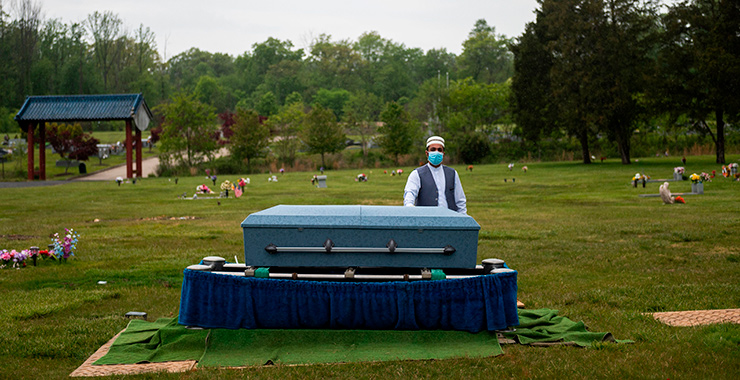

Losing someone in the era of COVID-19 is a unique burden. Visits have been forbidden or strictly limited at hospitals and nursing homes, personal protective equipment blocks out faces, and the comfort of family embraces and loving funerals are circumscribed or gone.
Meanwhile, the virus has killed more than 565,000 Americans and at least 2.6 million people worldwide. Each of these deaths leaves behind a constellation of loved ones. Specialists in loss worry that some of these survivors may suffer from “dysfunctional grieving,” in which grief interferes with daily functioning or leads into conditions such as prolonged grief disorder.
“The circumstances under which people are experiencing grief in COVID disadvantage us in our grieving in almost every conceivable respect,” said clinical psychologist Robert Neimeyer, PhD, the director of the Portland Institute for Loss and Transition.
Even those who have not lost someone directly to COVID-19 may be grieving other types of losses, ranging from time with loved ones to meaningful employment to a sense of a just world.
Psychologists who specialize in grief are working to track people’s reactions to these losses and to determine who is at risk for struggling to cope. They are also building tools to connect professionals to resources and grieving individuals to support.
Ubiquitous grief
Grief is a normative experience, and in most cases, people weather loss without long-lasting damage. “There is emotional pain,” said George Bonanno, PhD, a clinical psychologist at Columbia University who studies grieving, “but the majority of people continue to function.”
In a recent review of 54 studies on loss and trauma, Bonanno and his colleagues found that almost two-thirds of people respond with resilience (Clinical Psychology Reviewopens in new window, Vol. 63, 2018). They may be heartbroken, but they are able to work, connect with others, and concentrate on daily living almost immediately after trauma or loss. A pre-pandemic study focused on bereavement, specifically the loss of a spouse, found that 71% reacted with resilience, 24% had moderate difficulties but improved with time, and 5% experienced prolonged difficulties without improvement (Depression & Anxietyopens in new window, Vol. 37, No. 1, 2020).
This latter group may meet the criteria for prolonged grief disorder, defined in the ICD-11 as a pervasive yearning for the deceased that persists past 6 months, coupled with emotional numbness and difficulty functioning. In November 2020, the American Psychiatric Association approved prolonged grief disorder for inclusion in the DSM-5-TR, and a 13-item scale has been validated for measuring the condition (Prigerson, H. G., et al., World Psychiatryopens in new window, Vol. 20, No. 1, 2021). The scale includes items measuring the bereaved’s yearning for the deceased, emotional pain, difficulties engaging in life, and feelings of numbness and meaninglessness. The proposed DSM-5-TR criteria require that 12 months have passed since the loss. A meta-analysis by Marie Lundorff, PhD, a postdoctoral researcher at Aarhus University in Denmark, and colleagues found that around 10% of bereaved people will meet criteria for this diagnosis (Journal of Affective Disordersopens in new window, Vol. 212, 2017).
If this number holds for COVID-19 deaths, the impact of dysfunctional grief could be significant. An estimate by Penn State University sociologist Ashton Verdery, PhD, and colleagues found that for every COVID-19 death in the United States, approximately nine people lose a grandparent, parent, sibling, spouse, or child (Proceedings of the National Academy of Sciencesopens in new window, Vol. 117, No. 30, 2020). At half a million COVID deaths, that is 4.5 million bereaved individuals, and possibly 450,000 people with prolonged or complex grief.
In a study coauthored by Neimeyer, Christopher Newport University psychologist Sherman Lee, PhD, and Curtin University psychologist Lauren Breen, PhD, a convenience sample of 307 people in the United States bereaved by COVID-19 answered questions on measures of depression, anxiety, post-traumatic stress, dysfunctional grief, and functional impairment. Their answers revealed a striking mental health impact. Seventy percent were in the clinical range for generalized anxiety, 74% for depression, 63% for functional impairment, and 66% for dysfunctional grief (Journal of Pain and Symptom Managementopens in new window, Vol. 61, No. 4, 2021). In a follow-up study of 831 Americans, two-thirds scored in the clinical range for dysfunctional grief (Death Studiesopens in new window, online first publication, 2020). That sample may not be representative of all COVID-bereaved Americans, as it was an online sample recruited specifically based on loss. However, one worrying finding, Neimeyer said, is that there was no association in the studies between symptom severity and time since the loss. The studies compared different cohorts, but the finding merits further attention, he said.
“Resilience, when it is shown, usually makes itself quite visible in those early months of loss,” Neimeyer said. “And we see no evidence that this anguish is attenuating across time.”
Having lost an immediate family member rather than a more distant relative was associated with more severe mental health symptoms. The researchers also found that certain COVID-related experiences raised the risk of dysfunctional grief and functional impairment. These included not being able to have a funeral, feeling resentment toward medical professionals who were treating the deceased, picturing the loved one suffering in the hospital, feeling isolated, and questioning why God or the universe sent this punishment. Another risk factor was counterfactual thinking—what-ifs about ways the deceased could have avoided getting sick. Having been diagnosed with COVID-19 oneself was associated with worse coping. Researchers are not yet sure why those who had COVID-19 fare worse, but they might be grappling with survivor’s guilt. “My guess is that if you’ve experienced some of the symptoms of COVID-19 and you know someone who died of it, you may be able to relate to the suffering that they experienced,” Lee said.
End-of-life experience
The end-of-life experience with COVID-19 may be particularly difficult for survivors to process. Holly Prigerson, PhD, has long studied end-of-life decisions and bereavement at Weill Cornell Medical College. Her work has shown that family involvement at the end of life is beneficial for patients and families. Family members, for example, are more attuned to breathlessness in intensive care unit (ICU) patients than are hospital staff, and they can advocate to make patients more comfortable (American Journal of Respiratory and Critical Care Medicineopens in new window, Vol. 199, No. 11, 2019). COVID-19 has temporarily rolled back many gains in involving family members in end-of-life care. Making matters worse, patients with COVID-19 decompensate quickly, meaning families have little time to process the impending death, which Prigerson experienced when her mother became sickened with COVID-19 in January.
“With dementia and long-term chronic terminal illnesses like cancer, there is some time and ability to acclimate to what’s really happening,” Prigerson said, “which is unlike someone being pretty well-functioning and within a matter of hours being confronted with making life-and-death decisions about whether they should be put on a ventilator or have a tracheotomy.”
Prigerson’s mother died soon after being transferred to the ICU, which evoked a feeling of utter powerlessness, helplessness, and frustration, Prigerson said. At first, she had no way to contact her mother, who did not have her cell phone with her when she was transported from her long-term care facility to the hospital. Later, hospital staff tried to enlist Prigerson’s help over the phone in calming her mother, who, distressed and confused, was trying to pull off the BiPap face mask delivering her high-flow oxygen.
“Psychologically, I’m haunted by those memories,” Prigerson said. “It’s just a nightmare, the lack of communication, the lack of ability to be there.”
The period after death may be particularly surreal. Some family members of COVID-19 victims may be in isolation after testing positive themselves; some may delay the memorial service or hold a virtual funeral via Zoom. “For a lot of people this is very distressing, especially if it becomes a religious issue like how you treat the body at a certain time,” Lee said.
Family members are not the only ones at risk under the weight of COVID grief. Many professionals who work with the elderly or with end-of-life issues are overwhelmed. Funeral homes in hard-hit areas have had to rent refrigerated trucks to store bodies, and funeral home staff have had to work overtime in stressful conditions. The grief of families spills over to the workers.
“I usually end up hugging families in normal times, so not being able to even touch them is really, really hard, emotionally,” Stacey Kleinman, a funeral director in Aurora, Colorado, told local news station 9Newsopens in new window in December 2020.
Nursing home staff are also struggling with anxiety and grief, said Sheri Gibson, PhD, a geropsychologist in Colorado Springs, Colorado. Long-term care staff must live with the fear of carrying the coronavirus from their clients to their homes and from the community to their clients. They have a front-row seat to the devastating loss and isolation in many facilities. Some have even had to take over duties that normally would have been done by funeral home staff, like cleaning and dressing bodies of residents who have died, Gibson said.
“It has been heart-wrenching on some level to really understand and appreciate the struggles that direct-care staff have had to deal with in long-term care settings,” she said.
Other types of loss
The experiences of long-term care residents and staff highlight that it is not just death that causes grief. “The loss of time is huge,” Gibson said, especially for older adults. “When our mortality is in front of us and we’re staring at it, we start to make decisions that are meaningful to us: How do I want to make the best of these years? Well, imagine what that’s like when you look backward in the rearview mirror and you see that you’ve lost a year.”
While not everyone views the year as a loss, Gibson has seen many older adults struggling with anticipatory grief, or fear and dread of an impending loss. They imagine their own death or the death of a loved one from COVID-19, she said. Uncertainty about the future and isolation add additional stress, she said.
One prominent theory of why grief arises is that it is not, in fact, about the severing of an attachment but about the shattering of one’s conception of the world. Everyone has an assumptive world, a basic view of how the world works and their place in it, said Darcy Harris, PhD, the director of the Thanatology Program at King’s University College at Western University Canada. At their core, these beliefs encompass the idea that the world is basically benevolent, that life is meaningful, and that the self has worth (Harris, D. L., ed., Non-death Loss and Grief: Context and Clinical Implicationsopens in new window, Routledge, 2019). Death, especially traumatic death, can rupture these core beliefs. But so can other types of losses. After Hurricane Katrina, Columbia University psychiatrist Kathy Shear, MD, and colleagues interviewed a representative sample of more than 3,000 survivors and found that half of those with prolonged grief had not lost a person but instead had lost tangible objects such as a home or possessions (Depression and Anxietyopens in new window, Vol. 28, No. 8, 2011). Almost a quarter of those with prolonged grief reported losing intangibles, such as a sense of security or their way of life.
Watching irretrievable moments and milestones vanish could lead to similar grief, according to psychologists. Many of these moments—graduations, proms, meeting a newborn grandchild, supporting a loved one during a health scare, a child’s kindergarten year—are lost forever. People may also struggle with feeling like their government, workplace, or family did not do enough to protect them or their communities. “You really have to recognize that you are feeling a loss,” Harris said. “People will minimize—‘Well at least I haven’t had someone I loved die’—but you’ve had the way you live your life die.”
Risky grief
Responding to all of these types of grief falls to medical workers, mental health professionals, and communities. Prigerson and her colleagues have been working to get information to frontline medical workers about the importance of assessing bereaved family and referring them to support. Small gestures, such as a condolence call by the medical team or a physician asking about the deceased during an unrelated medical visit, can make the bereaved feel less alone. The mnemonic CARE covers the basics of what professionals should do to support a grieving person: cultivate and communicate compassion, assess risk factors and needs, refer when appropriate, and ensure continuity of care over time (Annals of Internal Medicineopens in new window, Vol. 173, No. 10, 2020).
Though prolonged grief disorder focuses on mental health 6 to 12 months after the loss, there are usually red flags that someone is struggling far earlier than that. One, Bonanno said, is how people speak about the loved one immediately after death. His research finds that people who laugh and smile amid their tears are likely to recover better than those who have only negative emotions (Journal of Abnormal Psychologyopens in new window, Vol. 106, No. 1, 1997). Positivity seems to serve two purposes, Bonanno said. First, part of grieving is creating a slightly idealized summary of the lost person and the lost relationship. Funny anecdotes and happy memories are part of this summary. Second, laughter draws people in and connects the bereaved to others who can support them. “It’s very adaptive,” he said.
Those struggling after a loss are less able to find humor in their memories, Prigerson said. Prigerson and her colleagues use a second mnemonic, GRIEF RISK, to highlight factors known to make grieving more difficult. The mnemonic stands for guilt, regret, isolation, experienced multiple losses or other stressors, financial hardship, relationship dependency or challenges with the deceased, individual history of mental health challenges or trauma, suddenness or distressing circumstances of death, and kinship type (with closer relationships linked to more risk).
Neimeyer and Lee have developed a five-item Pandemic Grief Scale, available in their paper published in December 2020 in Death Studies, that discriminates between people with and without dysfunctional grief with 87% sensitivity and 71% specificity. Items on the scale are: a death wish or suicidal thinking, confusion over one’s identity or role in life, apathy, difficulty accessing positive memories of the deceased, and a sense of meaninglessness or emptiness in life.
Physicians and other medical professionals need to be aware of how grief manifests, Breen said. “When people go to their family doctor or reach out for support, they themselves might not realize that their issues could be related back to grief,” she said. Sleeplessness or trouble concentrating are two common symptoms, she said.
Given the large number of bereaved people they may encounter, psychologists and other mental health professionals should seek out grief training, said Neimeyer. Because dysfunctional grief is often linked to suicidal ideation, professionals should also be prepared to assess clients for suicide risk. Many organizations specializing in bereavement have made webinars and trainings available online (see Resources for Grief Training).
For older adults, Gibson uses dialectical behavioral therapy with a focus on radical acceptance, mindfulness, and relaxation skills. She also coaches these clients on ways to build meaning in their lives, often through volunteerism. Psychologists can also help clients recognize their own resilience and understand that feeling sorrow does not mean that they are not resilient, Bonanno said.
This moment of mass grief is also a call to refocus on the almost universal experience of bereavement, Breen said, but offering support to a bereaved person can be fraught. “It’s actually a really, really complex process of different components, where so many things can go wrong and often do,” she said.
For example, an offer of childcare might feel helpful to one person but offensive to another, who might feel the offer insulting to their parenting ability. Breen has been publishing on the concept of building “grief literacy” in communities, which could include grief and loss training not only for professionals but for laypeople (Death Studiesopens in new window, online first publication, 2020). Similarly, Prigerson and her colleagues are working to connect bereaved individuals to support by matching them with other bereaved people who have experienced a similar type of loss and needs. They are still researching the efficacy of these online tools, but psychologists working one-on-one with clients can help those clients identify the strengths and weaknesses of friends and family members to help them reach out more effectively for support, Prigerson said.
“I would love to see many more initiatives that help us to talk about grief and loss,” Breen said. “There’s never been a stronger imperative to consider what we do at the community level to try to build capacity to support one another in times of loss.”