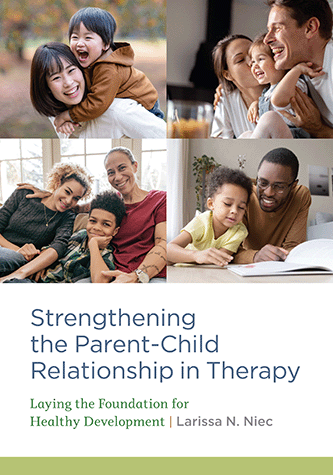
Strengthening the ParentChild Relationship in Therapy
Available formats
Also available from
The most important thing a psychologist can do to foster a child’s well‑being is to help build a healthy, effective parent‑child relationship.
The relationship between a child and their primary caregiver(s) is the cornerstone of child development. Interactions in early childhood initiate a developmental cascade that impacts an individual's functioning throughout childhood, adolescence, and into adulthood.
This book integrates the basic and applied literature with the concrete, evidence‑based strategies and empirically-supported interventions mental health providers need to help build and strengthen the parent‑child relationship.
It has long been understood that the quality and effectiveness of the parent‑child relationship influences children's emotional, behavioral, and physical health. Today, studies increasingly demonstrate that the parent‑child bond influences the relation between socioeconomic status and child functioning, and that increasing parenting effectiveness can even decrease the negative impact of poverty on children's brain development.
With clinical case examples and lists of key takeaways and questions for clinicians to consider, this book provides the practical guidance mental health practitioners need when working with parents and young children.
Part I: The Influence of the Parent-Child Relationship on Child Development
- Chapter 1. When I Need You, You're Here: Initiation of the Parent-Child Relationship
- Chapter 2. Keep the First Domino Standing: How Healthy Parenting Builds Healthy Children
- Chapter 3. Risk and Disruption in the Parent-Child Relationship
Part II: Repairing & Strengthening the Parent-Child Relationship in Therapy
- Chapter 4. Determining Treatment Targets and Monitoring Progress: The Importance of Assessment
- Chapter 5. Fostering Responsive Parenting
- Chapter 6. When Negative Emotion is a Positive Experience: Healthy Limit-Setting in the Parent-Child Relationship
- Chapter 7. Relationship-Based Interventions for Parents and Young Children
Part III: Overcoming Barriers to Success
- Chapter 8. Engaging Fathers in Treatment
- Chapter 9. Difficult Cases, Therapist Burnout, and the Importance of Self-care
- Chapter 10. Knocking Down Barriers to Effective Treatment: A Call for Advances and Culture Shifts
Dr. Larissa N. Niec is a professor of psychology and the director of the Center for Children, Families, and Communities at Central Michigan University. She has been a parent–child interaction therapy (PCIT) clinician, trainer, and researcher for nearly 30 years.
Dr. Niec is involved in national and international efforts to disseminate effective treatments to community therapists. She has written extensively on the evidence-based use of play in clinical practice and on parent–child interaction therapy.
This beautifully written and engaging book covers all aspects of the parent–child relationship. Larissa Niec is an expert in the field and presents developmental theory, up-to-date empirical literature on assessment and intervention, and a variety of clinical examples and guidelines. The book presents a comprehensive view of healthy parent–child relationships, implications for development, and how to foster and improve these relationships in clinical settings. It is a major contribution to the field.
—Sandra Russ, PhD, Distinguished University Professor and Louis D. Beaumont University Professor, Department of Psychological Sciences, Case Western Reserve University, Cleveland, OH, United States
Advances in epigenetics, neuroscience, and epidemiology have affirmed what astute psychologists have noted for ages: What happens in childhood does not stay in childhood. When parenting is responsive and effective, children develop the safe, stable, and nurturing relationships that not only buffer adversity but promote the basic social–emotional skills needed to flourish. Although primarily written for practicing therapists, Strengthening the Parent–Child Relationship in Therapy is for every professional who works with the families of young children and understands that early relationships are nothing less than the foundation for all that they do.
—Andrew Garner, MD, PhD, FAAP, Clinical Professor of Pediatrics, Case Western Reserve University, Cleveland, OH, United States; Coauthor, Thinking Developmentally: Nurturing Wellness in Childhood to Promote Lifelong Health