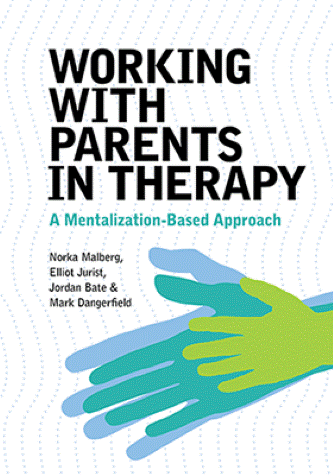
Working With Parents in Therapy
Childhood has long been recognized as a developmental process. This book examines parenting through a similar lens, offering mental health providers a mentalizing framework for working with parents at all stages of parental development.
Parenting is a developmental process that fluctuates and transforms throughout the lifespan. To support working with parents, the authors present a mentalizing approach that considers the current socio-cultural environment and its impact on the developmental process of parenting. This approach integrates a wealth of psychodynamic clinical research, theory, and practice.
This book provides the reader with principles to inform evaluation, formulation, and treatment in their work with parents. It provides clinical examples followed by clinical formulations offering illustrations of the application of one approach to diverse clinical challenges in the context of working with parents, grandparents, and other caregivers.
Introduction: Our Framework to Mentalization-Based Therapy With Parents
I: A Mentalization-Based Framework for Working With Parents
- Chapter 1. Mentalization and Parental Reflective Functioning in the Context of Development
- Chapter 2. Our Mentalizing Framework: Building on a Foundation of Epistemic Trust and Mentalizing Affectivity
- Chapter 3. Developmental Psychopathology: Ghosts in the Nursery
- Chapter 4. Assessment With Parents From a Mentalizing Approach
- Chapter 5. Mentalization Informed Treatment with Parents: A Scaffolding Process
II: Mentalizing Parenting Across the Lifespan
- Chapter 6. Parenting Today
- Chapter 7. Just a Twinkle in My Eye: Mentalizing and the Transition to Parenthood
- Chapter 8. Learning to Let Your Child Walk Away and Come Back: Mentalizing the Toddler Years
- Chapter 9. Working with Parents of School-Age Children (5 to 12)
- Chapter 10. Adolescence: Redefining Boundaries
- Chapter 11. David and Goliath: Mentalizing Young Adulthood
- Chapter 12. Couple Therapy With and for Parents
- Chapter 13. Concluding Remarks: Bringing It All Together Is Never Easy
Appendix A: Assessment Measures for Mentalizing Reflective Functioning
Appendix B: Mentalizing-Informed Work With Parents—Assessment and Formulation Worksheet
Appendix C: Mentalizing-Informed Work With Parents Adherence Scale
Norka T. Malberg, PsyD, is a certified child and adolescent psychoanalyst trained at the Anna Freud Centre in London. She received her doctorate from University College London for her work on clinical applications of attachment theory for chronically ill adolescents, their families, and medical staff.
She is currently in private practice in New Haven, Connecticut. She is also on the clinical faculty at the Yale Child Study Center and teaches and supervises at Yale’s Medical school child psychiatry residency program.
Dr. Malberg is coeditor of the Lines of Development Book Series by Karnac Books for which she coedited the first book: The Anna Freudian Tradition. She is on the editorial board for the Psychoanalytic Study of the Child and the Journal of Infant, Child And Adolescent Psychotherapy. She is the coeditor of the Child and Adolescent Sections of the upcoming PDM-2 (Psychodynamic Diagnostic Manual) edited by Guilford Press and cowriter of the upcoming book by APA press on mentalization based treatment with children.
She has authored numerous articles on topics relating to clinical applications of mentalization based therapy, trauma, early childhood intervention and the interface of infant and adult mental health.
Elliot Jurist, PhD, is professor of psychology and philosophy at the Graduate Center and The City College of New York (CCNY), The City University of New York (CUNY).
From 2004 to 2013, he served as the director of the Clinical Psychology Doctoral Program, CCNY, CUNY. From 2008 to 2018, he was the editor of Psychoanalytic Psychology, the journal of Division 39 of APA.
He is also the editor of a book series, Psychoanalysis and Psychological Science, from Guilford Publications, and author of Minding Emotions: Cultivating Mentalization in Psychotherapy (2018), from the same publisher. He is the author of Beyond Hegel and Nietzsche: Philosophy, Culture, and Agency (MIT Press, 2000) and coauthor of Affect Regulation, Mentalization and the Development of the Self (Other Press, 2002), the latter of which won two book prizes and has been translated into five languages.
He is also the coeditor of Mind to Mind: Infant Research, Neuroscience, and Psychological (Other Press, 2008). He is the author of numerous articles and the cocreator of The Mentalized Affectivity Scale, which has been translated into 10 languages.
Jordan Bate, PhD, is an assistant professor in the Combined School-Clinical Child Program, Ferkauf Graduate School of Psychology, Yeshiva University, where she coleads the psychodynamic practicum and teaches courses in beginning work with children, parents, and families and cognitive assessment of children.
She is also a supervising psychologist in perinatal and child psychotherapy services at Northwell Health, Lenox Hill Hospital, and maintains a private practice in Manhattan, New York.
She has written multiple papers on attachment and mentalization in psychotherapy with parents and children, as well as the impact of parents’ Adverse Childhood Experiences (ACEs) on their attachment and parenting. Her research lab focuses on the applications of attachment to psychotherapy process, and innovative ways of training clinicians in mentalization and interpersonal skills.
Mark Dangerfield, PhD, received his doctorate from Ramón Llull University, Barcelona. He was trained in mentalization-based treatment and the AMBIT model (Adolescent Mentalization-Based Integrative Treatment) at the Anna Freud National Centre for Children and Families in London and was the clinical manager of the pioneering ECID project.
The project, which he helped develop at the Vidal and Barraquer Foundation in Barcelona, is based on the AMBIT model and focuses on young people with high psychopathological risk and high risk of social exclusion.
He is currently a professor at University Institute of Mental Health of the Ramón Llull University, teaching advanced courses in psychoanalytic psychotherapy and family therapy, and serves as director of the University Institute of Mental Health at Ramón Llull University.
He has published articles on AMBIT, the ECID project, and related topics, and has extensive experience in clinical supervision.
The research makes clear that working with parents and carers is essential if we are going to support the mental health of children and young people. But how should we work with them? And do we have to approach the work differently when working with the parents of a toddler compared with, say, a teenager? This brilliant book draws on a mentalizing model to show how we can all learn to do this work better. It is the kind of book that I wish I could have read when I first started working in this field; but it also offers important insights and practical advice for the experienced psychotherapist.
—Nick Midgley, PhD, Professor of Psychological Therapies With Children and Young People, University College London and the Anna Freud Centre, London, United Kingdom
Adults who become parents are developing alongside their infants and children. They are especially learning how their mental life shapes and is shaped by their children. In this very accessible and clinically rich volume, the authors describe this developmental journey that is the privilege and responsibility of parenting. Their insights are invaluable to clinicians and parents alike.
—Linda Mayes, MD, Arnold Gesell Professor, Yale Child Study Center, Yale School of Medicine, New Haven, CT, United States