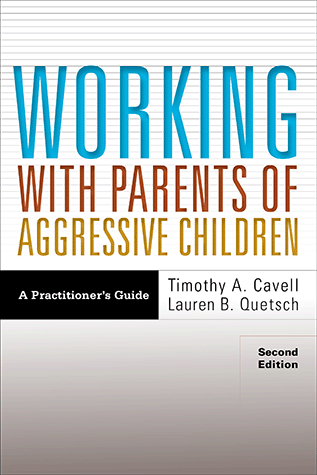
Working With Parents of Aggressive Children
This second edition features new scholarship in children’s emotional socialization and childhood aggression and offers parenting interventions developed through the lens of equity, diversity, and inclusion.
Healthy parent-child relationships reflect parents’ capacity to accept, contain, and lead their children, and under-girding healthy-parent child relationships are parents’ goals, parents’ health, and family structure. This comprehensive guide shows mental health providers how to discuss setting reasonable expectations and goals that are attainable through therapy, promoting parent self-care, and promoting family structure.
Instead of a one-size-fits-all approach, the authors explain how clinicians can tailor their work to the unique needs of each family. They offer compelling, realistic examples that accurately reflect the range of diversity that exists among parents and families, and examine the opportunities and challenges that can arise when working with families from diverse backgrounds.
Series Foreword
Julia Ogg
Preface
- 1. Aggression in Childhood
- 2. A Framework for Working With Parents of Aggressive Children
- 3. Managing the Alliance
- 4. Goals
- 5. Health
- 6. Structure
- 7. Accept
- 8. Contain
- 9. Lead
- 10. Working With Parents Through the Lens of Equity, Diversity, and Inclusion
with Harlee Onovbiona
References
Index
About the Authors
Timothy A. Cavell, PhD, is a professor in the Department of Psychological Science at the University of Arkansas and a clinical psychologist who uses short-term, problem-focused therapy that builds on existing strengths.
Dr. Cavell's prevention research has been funded by the National Institute on Drug Abuse and the Institute of Education Sciences. Funded projects involve school-based prevention for aggressive children at risk for later substance use and school support for children from military families.
Other projects focus on school-based mentoring for chronically bullied children, natural mentoring supports for adolescents exposed to dating violence, and parents' capacity to promote safe, informal mentoring relationships for their children.
Lauren B. Quetsch, PhD, is a professor in the Department of Psychological Science at the University of Arkansas. She attained her BA in psychology from Georgetown University and her PhD in clinical psychology with a specialty in child clinical psychology at West Virginia University in Morgantown.
Dr. Quetsch's specialty is in children with disruptive behavior disorders, and she is establishing her career in adapting evidence-based treatments for children on the autism spectrum. Simultaneously, she is continuing to ask questions related to dissemination and implementation of evidence-based treatments for underserved families and children with disruptive behaviors by collaborations with community mental health agencies.
The book reaffirmed the importance of early intervention, the need for compassion and contextual awareness, and the essential role of being whole-hearted and open-minded when working to improve the lives of children and their families.
—Communique (CQ), National Association of School Psychologists (NASP)
Drs. Cavell and Quetch are masters of translating and applying complex contextual concepts using clinically relevant language and examples. Their approach is remarkably compassionate, accessible, and practical, yet grounded in the latest evidence-based theories and research. The result is an important and timely resource for beginner or seasoned child clinicians interested in delivering the highest standard of care in diverse settings.
—Terry Stancin, PhD, ABPP, clinical child & adolescent psychologist; APA fellow; and professor, Case Western Reserve University, Cleveland, OH
Professors Cavell and Quetsch have produced the book that many in our profession have been waiting for. This book is grounded in the latest evidence and exhibits a humanity that speaks to the lived experiences of the parents who struggle with raising aggressive children and the therapists who seek to improve the lives of these families. I fully expect to find this book on the shelves of department clinics the world over and as required reading for graduate students’ practicum coursework.
—Andres De Los Reyes, PhD, editor-in-chief, Journal of Clinical Child and Adolescent Psychology, and professor of psychology, University of Maryland at College Park