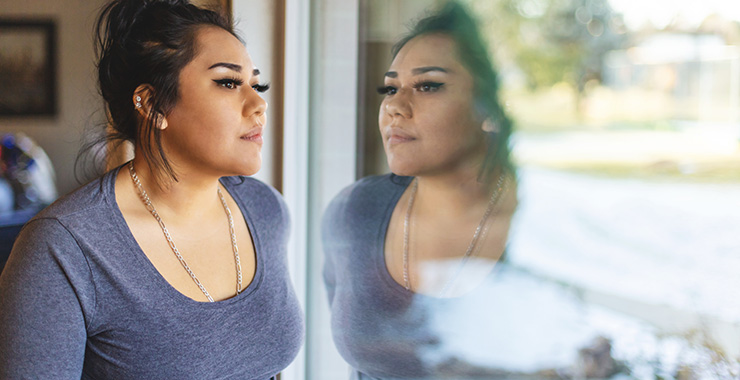
All of us have experienced that excruciating feeling that comes with awaiting uncertain news. Maybe you were waiting for results from a biopsy or to hear if you got the job or passed an exam. Most people find that type of waiting distressing, and many of us spend the time anxiously ruminating over every possible outcome and anticipating the worst one.
To understand how best to help people cope with intense uncertainty, Kate Sweeny, PhD, a professor of psychology at the University of California, Riverside (UC Riverside), studies these stressful periods and how people respond to them. “[Psychologists] don’t know that much about waiting and uncertainty,” Sweeny said. She noticed when she started the Life Events Lab at UC Riverside in 2008 that people in social psychology had studied topics like existential uncertainty or ambiguity of information but not that very familiar, gut-wrenching feeling of not knowing something you really want to know. “So, I decided to try to figure it out,” she said.
In 2012, Sweeny published a paper that introduced the “uncertainty navigation model,” a theoretical framework for understanding the thoughts, feelings, and behaviors that arise during these difficult waiting periods (Health Psychology Reviewopens in new window, Vol. 6, No. 2, 2012). Over the years, Sweeny and her team of undergraduate and graduate students—which spans anywhere from 35 to 50 people—have studied an array of populations while they waited for information in high-stakes situations, including law school students awaiting bar exam results and women waiting for breast biopsy results.
The COVID-19 pandemic has made their research more vital than ever. People around the globe have been forced time and again into incredibly uneasy and indefinite periods of waiting for positive news. “COVID is this waiting period where the entire world is going through this one really, really crazy thing,” said Sarah Knapp, a 6th-year graduate student in Sweeny’s lab. “This speaks to our work and has directed our research in one way or another.”
Preparing for the worst
Sweeny admits that she is a worrier by nature. “Like most people, I don’t love uncertainty,” she said. When she was a teen, her mother was diagnosed with non-Hodgkin’s lymphoma and successfully battled the disease through intensive treatment. The experience ultimately served as a source of inspiration for Sweeny’s research career; she has frequently looked to her mother to better understand the harsh realities that come with facing a life-changing medical diagnosis. “I was drawn to the topic of uncertainty because it’s something that I’ve struggled with,” Sweeny said.
As an undergraduate, she attended Furman University in Greenville, South Carolina, and studied psychology. There, she met and worked for social psychologist Beth Pontari, PhD, who took Sweeny under her wing. Pontari also introduced her to James Shepperd, PhD, a social psychologist from the University of Florida (UF) who studies how people respond when they receive challenging information and would ultimately become Sweeny’s adviser during her graduate studies at UF.
In Shepperd’s lab, Sweeny’s work focused on the moments leading up to the receipt of bad news. Shepperd’s previous research had shown that people tend to display unrealistic levels of optimism when predicting what will happen in their future, but that their optimism often drops when they are approaching the moment of truth, such as when students are about to get their exam grades back. That shift happens in part because they are preparing themselves for the possibility of bad news (Journal of Personality and Social Psychologyopens in new window, Vol. 70, No. 4, 1996; Personality and Social Psychology Bulletinopens in new window, Vol. 24, No. 9, 1998).
Sweeny’s graduate school research elaborated on these findings, and she identified when and why people are most likely to brace for the worst, what happens at the time when bad news is delivered, and the consequences of this coping strategy (Current Directions in Psychological Scienceopens in new window, Vol. 15, No. 6, 2006; Personality and Social Psychology Bulletinopens in new window, Vol. 33, No. 8, 2007). She also wrote her dissertation on how to convey bad news and developed a model to guide people through the process (Review of General Psychologyopens in new window, Vol. 11, No. 3, 2007).
After earning her doctorate in social psychology, she joined the faculty of UC Riverside as an assistant professor of psychology and launched the Life Events Lab to study the experience of waiting for uncertain news.
To better understand the waiting process, one of Sweeny’s earlier studies involved 50 law students who were preparing for the California bar exam. They completed questionnaires at six separate time points: shortly before and after the exam, at two intermediate points during the 4-month waiting period, and immediately before and after learning whether they passed. She found that waiting is more difficult at the start and end of a waiting period, and that optimists report lower levels of anxiety and rumination on average (Journal of Personality and Social Psychologyopens in new window, Vol. 106, No. 6, 2014).
Another study asked this question: Is waiting really the hardest part? Sweeny and her colleagues surveyed law students who had failed the bar exam and other participants who had waited for news that ultimately turned out badly. They discovered that the answer to this question depends on whether one prefers to be racked with anxiety or burdened with the anger, disappointment, and regret that comes with receiving bad news (Personality and Social Psychology Bulletinopens in new window, Vol. 41, No. 11, 2015).
“One of the things I’ve had to battle throughout my career in studying this is that knee-jerk reaction from people in the field of ‘Isn’t this just one type of stress and coping?’ which we know a lot about,” said Sweeny. “I was pretty convinced at the onset, and have only become more convinced since then, that the kind of thing I study is really a different beast when it comes to stress and how we navigate it.”
Achieving flow
Along with studying how people react to stressful waiting periods, Sweeny’s team of researchers has also investigated coping strategies that can help make these spells more manageable.
In 2019, the lab looked at whether “flow,” or a state of complete immersion in one activity, helped people during three separate anxiety-provoking periods: law graduates waiting for their bar exam results, doctorate-level students in the academic job market awaiting matches to internships and residencies, and undergraduates waiting for their peers to rate their physical attractiveness. They found that engaging in flow—which was either self-reported flow-inducing activities or a game of Tetris—boosts an individual’s sense of well-being during a period of uncertainty and makes the waiting a little bit easier (Emotionopens in new window, Vol. 19, No. 5, 2019).
“When people feel like the time is passing more slowly, they actually report more distress,” said Kyla Rankin, PhD, who earned her doctorate in June from UC Riverside and is first author on the study. “The thing about uncertainty and waiting was just trying to get the time to pass more quickly.”
The same finding rings true for people in quarantine, according to a study published last year in PLOS ONEopens in new window (Vol. 15, No. 11, 2020). Sweeny and Rankin collaborated with scientists from Central China Normal University in Wuhan to study the impact of flow and mindfulness on long periods of quarantine. More than 5,000 participants in Wuhan and other major cities in China affected by COVID-19 completed an online survey where they assessed the length of their quarantine, their overall well-being during the past week, and any flow and mindfulness—a state of focusing one’s awareness on the present moment—that they experienced during the same period.
When looking at overall well-being, Sweeny and Rankin found that people in a lengthy quarantine who reported higher-than-average flow experiences were no worse off than people who had not yet quarantined. Therefore, engaging in flow-inducing activities such as running, painting, and gardening “may be a particularly effective way to protect against potentially deleterious effects of a period of quarantine,” Sweeny and Rankin wrote.
Improving doctor-patient communication
The other big question in the Life Events Lab is how to help medical professionals communicate with their patients throughout their care and improve how they deliver bad news. “One of the key things with communication and effectively communicating with patients is recognizing their values and being empathic and compassionate toward them,” said Brandon Tran, a 6th-year graduate student in the lab who studies how aspects of doctor-patient communication can have downstream effects. If something goes wrong at the beginning of the interaction, it can affect how patients and providers interact throughout the rest of the consultation, along with the patient’s perceptions and trust of the doctor, Tran noted.
For example, Sweeny and colleagues found that clinicians who are actively involved in their patient’s care, ask questions that prompt patients to think about their health in new ways, and show optimism about their patient’s ability to initiate health behaviors are the most effective at motivating patients toward better health outcomes (Journal of Health Psychologyopens in new window, Vol. 23, No. 5, 2018).
This type of communication could be especially beneficial for people who are suffering from chronic health conditions or are waiting to hear back about a biopsy. In a 2018 study that interviewed female patients at a breast biopsy appointment, Sweeny found that the women tended to focus on their feelings of risk, subjective health, and perceptions of support (Annals of Behavioral Medicineopens in new window, Vol. 53, No. 7, 2019). Proper communication from their physicians can go a long way toward helping these patients, said Sweeny.
In speaking to the nurses and doctors who are treating these breast biopsy patients, Sweeny knows they want to help their patients stay calm. “They know their patients are stressed out by uncertainty, but they are maybe in a limited position to resolve it, either because the information about their test is not available yet or because they can’t deliver the results in that moment,” she said.
Exactly what health care systems should do to solve this dilemma is not perfectly clear, but Sweeny has one idea. “Don’t do the ‘We’ll call you when your results are in,’” she explained. In a study published in 2017, Sweeny found that 93% of health care providers surveyed use this type of open-ended timing when giving patients medical exam results (Patient Education and Counselingopens in new window, Vol. 100, No. 2, 2017). “It adds an extra layer of uncertainty, which is, ‘When the heck am I going to get these results?’” said Sweeny. Instead, doctors should schedule a phone appointment at a designated time to disclose the patient’s results.
This research on doctor-patient communication is especially applicable now, when many medical professionals are likely speaking to patients who are hesitant to get their COVID-19 vaccine, said Tran. “Patients who have negative reactions with their providers before the pandemic are much more likely to be reluctant [to listen to them] this time around, and that’s actually costing people’s lives,” he said. “Communication is more important than ever.”
Sweeny is also working to expand the scope of their work and focus even more on health care contexts where uncertainty and waiting have the greatest stakes. For the past 5 years, her team has been building a toolbox for members of the public that is filled with tips and tricks to help people through these rough waiting patches. Its advice includes suggestions on how to engage in flow and mindfulness meditation, which can give people a break in those moments where they’re so worried that it is negatively impacting their day, said Sweeny. The lab also aims to develop a flow intervention for female breast biopsy patients to see if it helps them while they’re waiting to hear back about their medical exam.
“Uncertainty is an underaddressed source of suffering,” said Sweeny. It’s also something that people may not feel comfortable talking about, so the research is not always straightforward, she said. But the work is worth it. “Uncertainty is really important to understand [because] it has a direct impact on people’s lives.”