


1. COVID-19 disruption on college students: Academic and socioemotional implications
Tasso, A. F., Hisli Sahin, N., San Roman, G. J.
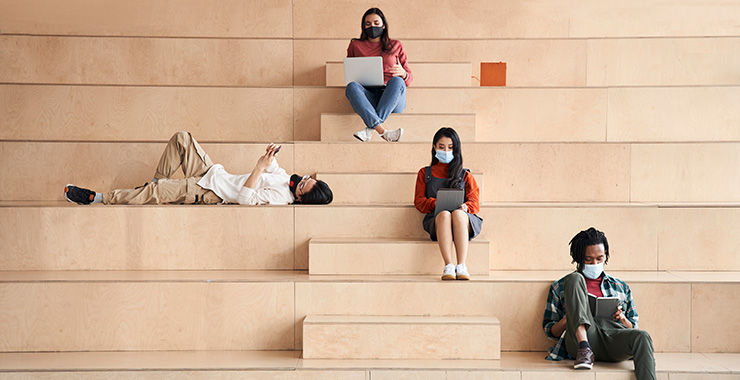
This study in Psychological Trauma: Theory, Research, Practice, and Policyopens in new window (Vol. 13, No. 1) reveals that college students experienced emotional distress on many levels during the COVID-19 pandemic. Researchers surveyed 257 students at a U.S. college who all participated in remote learning off campus during the spring of 2020 because of the pandemic. Students reported being afraid of contracting COVID-19 and even more afraid of people within their social network contracting the virus. They also reported worrying about themselves or loved ones becoming severely ill, academic-related distress following the transition to remote learning, and COVID-19-related mental health distress, including interpersonal disengagement, struggles with motivation, and boredom, as well as anxiety, depression, and sleep disturbances. DOI: 10.1037/tra0000996opens in new window
2. COVID-19 and the workplace: Implications, issues, and insights for future research and action
Kniffin, K. M., Narayanan, J., Anseel, F., Antonakis, J., Ashford, S. P., Bakker, A. B., Bamberger, P., Bapuji, H. Bhave, D. P., Choi, V. K., Creary, S. J., Demerouti, E., Flynn, F. J., Gelfand, M. J., Greer, L. L., Johns, G., Kesebir, S., Klein, P. G., Lee, S. Y., Ozcelik, H., Petriglieri, J. L., Rothbard, N. P., Rudolph, C. W., Shaw, J. D., Sirola, N., Wanberg, C. R., Whillans, A., Wilmot, M. P., Vugt, M.
This article in American Psychologistopens in new window (Vol. 76, No. 1) presents possible workplace trends resulting from COVID-19, including remote work, virtual teamwork and management, social distancing, and unemployment. The analysis suggests that working from home will continue and expand post-pandemic. As for effects on workers, the authors predict increases in economic inequality, loneliness, stress, burnout, and addiction. Other workplace changes the authors forecast include virtual work arrangements that may foster more participatory relationships, new performance management and evaluation systems for remote workers, and new modes of surveillance by companies to check in on employees working remotely. DOI: 10.1037/amp0000716opens in new window
3. A closer look at appearance and social media: Measuring activity, self-presentation, and social comparison and their associations with emotional adjustment
Zimmer-Gembeck, M. J., Hawes, T., Pariz, J.
This Psychology of Popular Mediaopens in new window (Vol. 10, No. 1) study presents a tool to assess youth’s preoccupation with their physical appearance on social media. Researchers administered a 21-item survey about social media to 281 Australian high school students. They identified 18 items with strong inter-item correlation centered on three categories of social media behavior: online self-presentation, appearance-related online activity, and appearance comparison. In a second study with 327 Australian university students, scores on the 18-item survey were found to be associated with measures of social anxiety and depressive symptoms, appearance-related support from others, general interpersonal stress, coping flexibility, sexual harassment, disordered eating, and other issues. The researchers also found that young women engaged in more appearance-related social media activity and appearance comparison than did young men. DOI: 10.1037/ppm0000277opens in new window
4. When social isolation is nothing new: A longitudinal study on psychological distress during COVID-19 among university students with and without preexisting mental health concerns
Hamza, C. A., Ewing, L., Heath, N. L., Goldstein, A. L.
In this study in Canadian Psychologyopens in new window (Vol. 62, No. 1), researchers examined the psychological impacts of COVID-19 on the mental health of postsecondary students with and without preexisting mental health concerns prior to the pandemic. The researchers surveyed 773 college students in Canada in May 2019 and again in May 2020 about recent stressful experiences and their mental health status. They found that students with preexisting mental health concerns showed improving or similar mental health during the early pandemic compared with 1 year prior. By contrast, students without preexisting mental health concerns were more likely to exhibit declining mental health during the pandemic, perhaps because they had less experience with social isolation than did students with preexisting mental health issues, the researchers suggest. DOI: 10.1037/cap0000255opens in new window
5. Trauma-focused cognitive-behavioral therapy (TF-CBT) for interpersonal trauma in transitional-aged youth
Peters, W., Rice, S., Cohen, J., Murray, L., Schley, C., Alvarez-Jimenez, M., Bendall, S.
This pilot study in Psychological Trauma: Theory, Research, Practice, and Policyopens in new window (Vol. 13, No. 3) indicates that trauma-focused cognitive behavioral therapy (TF-CBT) is an effective treatment for young people who have experienced post-traumatic stress disorder (PTSD) following interpersonal trauma such as child physical or sexual abuse, maltreatment, or neglect. Researchers delivered 15 TF-CBT sessions over 25 weeks to 20 youth ages 15 to 25 (transitional-aged) in Australia, 16 of whom had a PTSD diagnosis. They found that following treatment, 15 of 16 participants no longer met criteria for a PTSD diagnosis, and self-report measures of PTSD, depression, and anxiety showed improvement, though some participants reported transient increases in symptoms. The researchers plan to conduct a larger randomized clinical trial to examine the effectiveness of TF-CBT for PTSD and other frequently co-occurring symptoms, including anxiety, depression, and substance use. DOI: 10.1037/tra0001016opens in new window
6. Social media use and friendship closeness in adolescents’ daily lives: An experience sampling study
Pouwels, J. L., Valkenburg, P. M., Beyens, I., van Driel, I. I., Keijsers, L.
Adolescents who use social media apps such as Instagram more frequently than their peers feel closer to their friends, suggests this study in Developmental Psychologyopens in new window (Vol. 57, No. 2). Researchers asked 387 adolescents ages 13 to 15 in the Netherlands to report six times per day for 3 weeks their Instagram, WhatsApp, and Snapchat use in the previous hour, as well as their momentary experiences of friendship closeness. They found that participants who used WhatsApp and Instagram with close friends with whom they felt a sense of trust, support, and intimacy more frequently throughout the 3 weeks experienced higher levels of friendship closeness during the study than their peers. However, participants felt less close to their friends after they had used Instagram or WhatsApp in the previous hour, perhaps, the researchers suggest, resulting from unmet expectations that friends would immediately provide feedback on their posts. Neither association was found with Snapchat. DOI: 10.1037/dev0001148opens in new window
7. Every (Insta)gram counts? Applying cultivation theory to explore the effects of Instagram on young users’ body image
Stein, J.-P., Krause, E., Ohler, P.
This study in Psychology of Popular Mediaopens in new window (Vol. 10, No. 1) suggests that young people who frequently browse Instagram in a highly engaged way are more critical of strangers’ bodies and indulge more often in disordered eating—even if their own body image is unaffected. Researchers asked 228 participants ages 18 to 34 in Germany about changes in weight-related knowledge, attitudes, and self-reported dietary restraint. They found that participants, especially women, who browsed Instagram’s content more actively than their peers formed harsher views about the weight of strangers as well as an increased risk for disordered eating, but not a reduction in satisfaction with their own bodies. DOI: 10.1037/ppm0000268opens in new window
8. Nonverbal overload: A theoretical argument for the causes of Zoom fatigue
Bailenson, J. N.
This review article in Technology, Mind, and Behavioropens in new window (Vol. 2, No. 1) combines theory and prior research to derive four explanations for “Zoom fatigue,” the feeling of exhaustion brought on by video calls: excessive close-up eye contact with speakers, constant self-evaluation of one’s own image on the screen, remaining in a fixed position in view of the camera, and the increased cognitive load of sending and receiving nonverbal communication. The author offers the following solutions: reduce the size of the Zoom window to minimize face size, hide “self-view,” position the camera further away to allow for moving beyond a fixed sitting position without disrupting the call, and take “audio-only” breaks by both turning the camera off and turning away from the screen. DOI: 10.1037/tmb0000030opens in new window
9. Coping during the COVID-19 pandemic: Relations with mental health and quality of life
Shamblaw, A. L., Rumas, R. L., Best, M. W.
During the COVID-19 pandemic, people using avoidance coping strategies experienced increased depression and anxiety, while those using approach coping strategies, such as positive reframing, received the largest mental health boost, suggests this study in Canadian Psychologyopens in new window (Vol. 62, No. 1). In April 2020, researchers surveyed 797 online participants in the United States and Canada about 14 different approach or avoidance coping strategies as well as symptoms of depression, anxiety, and quality of life. One month later, 395 of the participants took the survey again. The researchers found that avoidance coping was associated with higher depression, higher anxiety, and lower quality of life at baseline and increased depression and anxiety 1 month later. Approach coping was associated with lower depression and better quality of life at baseline but not over the 1-month period. Of the specific coping strategies examined, reframing negative aspects of the pandemic was the most beneficial. DOI: 10.1037/cap0000263opens in new window
10. Integrating responsive motivational interviewing with cognitive-behavioral therapy for generalized anxiety disorder: Direct and indirect effects on interpersonal outcomes
Muir, H. J., Constantino, M. J., Coyne, A. E., Westra, H. A., Antony, M. M.
This study in the Journal of Psychotherapy Integrationopens in new window (Vol. 31, No. 1) indicates that adding motivational interviewing (MI)—a psychotherapy module that helps people resolve feelings of ambivalence—to cognitive behavioral therapy (CBT) to treat generalized anxiety disorder (GAD) can bring about long-term changes in nonassertiveness and overaccommodation. In other words, the combination treatment helps people better assert themselves and not give in to others’ demands. Researchers randomly assigned 85 Canadian patients with GAD to a brief treatment of CBT or MI-CBT. Patients completed measures of nonassertiveness and overaccommodation throughout the treatment and across a 12-month follow-up. The researchers found that both MI-CBT and CBT reduced nonassertiveness and overaccommodation, but at 12 months, MI-CBT had helped patients more than CBT alone. This effect was explained by MI-CBT therapists’ ability to help patients overcome midtreatment resistance. DOI: 10.1037/int0000194opens in new window