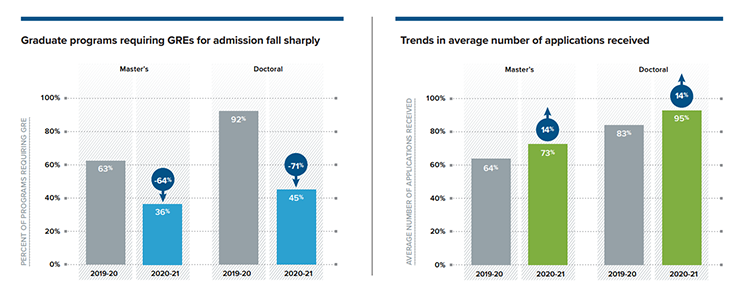
As a result of the COVID-19 pandemic and increased attention to systemic racism, many higher education programs in the United States and Canada have waived requirements temporarily or permanently for submitting GRE scores as part of applications. For psychology doctoral and master’s degrees, the percent of programs requiring GRE scores decreased by about half between the 2019–20 and 2020–21 academic years, dropping from 92% to 45% for doctoral programs and from 63% to 36% for master’s programs.1 The GRE may present a barrier to graduate education due to cost, access to test preparation instruction, and other factors. Preliminary data show that the elimination of this barrier, in addition to other factors such as labor market conditions, may have led a greater number of students to apply to psychology graduate programs.
1Graduate Study in Psychology is an annual survey conducted by APA’s Office of Graduate and Postgraduate Education and Training. For the 2019–20 cycle, a total of 423 departments or schools in the United States and Canada provided responses on 1,288 graduate programs in psychology. For the 2020–21 cycle, a total of 334 departments in the United States and Canada provided responses on 912 graduate programs in psychology. Want more information? See CWS’s interactive data tools at or contact CWS.
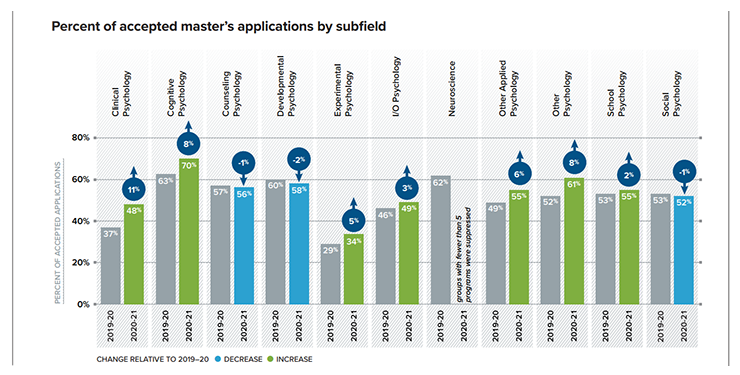
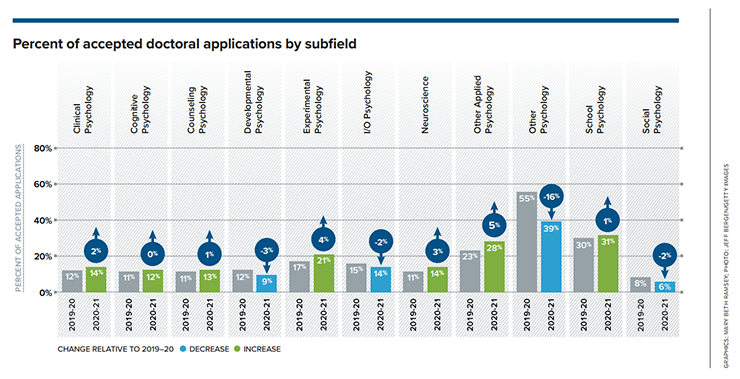
Acceptance rates varied by subfield, with the greatest increases in clinical psychology and cognitive psychology programs at the master’s level, and smaller increases in other applied psychology, experimental psychology, and clinical psychology at the doctoral level. Finally, more degrees were awarded in 2020 than in 2018 or 2019, with larger increases in health service psychology fields than in research fields. This at least temporarily breaks the flattening and downward trends in the number of degrees awarded (see CWS Data Tool: Degrees in Psychology).