A typical Monday through Wednesday will find Ann-Louise Lockhart, PsyD, ABPP, seeing patients and reviewing clinical notes. Toward the end of the week, though, the San Antonio-based pediatric psychologist is more likely to be found in front of her computer riffing on the latest meme to create parenting advice videos for Instagram.
Lockhart, whose handle is @dr.annlouise.lockhart, is one of a growing number of psychologists who now operate as much on social media as they do in private practice or academia. She focuses her outreach on a group that is ravenous for information: parents. On Instagram, home of “momfluencers” and tastefully neutral nursery design inspiration, the desire for substantive, research-based parenting-related advice is strong. By putting their credentials up front, citing the research behind their advice, and offering education and resources in a nonjudgmental way, psychologists can break through the racket of conflicting information to provide some clarity.
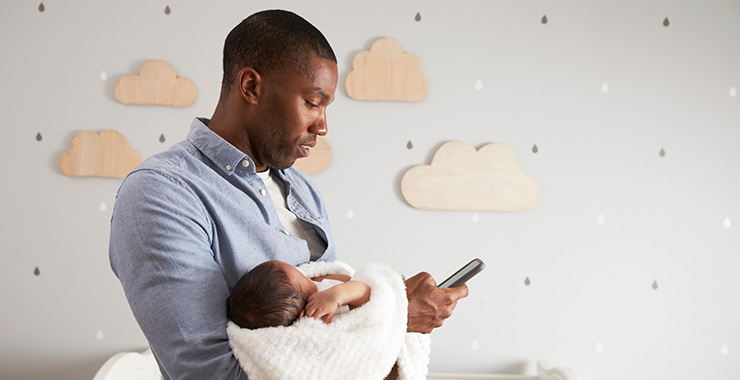
In many ways, the platform is perfect for busy caregivers. Information is delivered in bite-size snippets, ideal for a quick peek while a toddler naps. Parenting problems can be challenging and all-consuming, but many are common enough that general evidence-based advice can help. And parents can find community in the comments of an account like Lockhart’s—a community that is there to affirm hard feelings and frustrations at any hour of the day.
Though psychologists who offer parenting advice online must be careful about ethical boundaries, they are finding that they can be a source of information, inspiration, and support for parents, particularly in the context of ongoing pandemic stress and a growing mental health crisis.
“These social media sites and online resources are giving people a lot of resources that they would never have otherwise had access to,” Lockhart said.
Pocket psychologists
Raising children is full of moments when nothing feels simple: when it’s 3 a.m. and your 6-month-old won’t stop screaming, when your toddler throws a plate of food against the wall and drops to the floor wailing, when your preteen delivers the most cutting remark you can imagine and slams the bedroom door.
In those moments, a tiny boost of support can make all the difference, said Laura Markham, PhD, a clinical psychologist and founder of Aha! Parenting, a parent coaching and resources business that does outreach on Instagram. “Most parents know how to be better parents, but it’s hard. It’s hard to do in the moment when there is complete chaos in the house and your kid has looked right at you and socked their brother,” Markham said. “Parents just need the support of somebody who says, ‘Yes, this is so hard; you’ve got this, you can do it.’”
In that sense, social media can be better and faster than the traditional ways psychologists have shared evidence-based parenting strategies, such as through books or news articles. “I get feedback all the time from people who have been following me or accounts I recommend saying, ‘The messages came at just the right time,’” Lockhart said.
Thousands of parents follow these psychologists’ accounts for practical tips and ways to parent differently than previous generations. Krissy Hadick, who runs a baby gear and parenting website, said she’s picked up tips on how to empathize with her 3-year-old son’s emotions and offer choices to give him a sense of control. For Lisa Forsythe, who started a website curating activities for small children during the pandemic, psychology accounts are a great way to keep up to date with current parenting research.
“As parents, it is our duty to remain calm and support our children as they learn about themselves and how to regulate their emotions,” said Forsythe, who is the mother of a toddler. “This is very different from the attitude of ‘children should be seen but not heard,’ which was popular for many years.”
Many followers are eager for new models of parenting. One of Lockhart’s most popular parenting courses is on breaking generational cycles. Aliza Pressman, PhD, a development psychologist who directs clinical programming for the Mount Sinai Parenting Center in New York and hosts a podcast and accompanying Instagram account called Raising Good Humansopens in new window, also said she has many followers looking to parent differently than they were parented. “I’ve had many, many people over the years who have written to me and said, ‘I came from a long line of yellers. I saw you on Instagram or Facebook and subscribed to your newsletter and it completely changed my life,’” she said.
Social media can also be a source of validation when parents feel their own mental health is suffering, said Ashurina Ream, PsyD, whose account @psychedmommy focuses on the perinatal and postpartum period and maternal mental health. Ream said she was inspired to start the account after her own rocky transition to motherhood. “A lot of it stems from identity changes, burnout, and feeling anger and rage that were unexpected,” she said. “My primary goal in creating Psyched Mommy is that a parent won’t feel like I did in those early days postpartum, because I felt really alone and isolated.”
Expanding access to resources is a key motivator for Erlanger Turner, PhD, a clinical psychologist and assistant professor at Pepperdine University in Los Angeles who posts on Instagram under @drearlturner and @therapyforblackkids. The later account is a brainchild from the coronavirus pandemic. As the public worried about the effects of lockdowns and school closures on kids, Turner said, Black families were often left out of the conversation. “There weren’t a lot of resources and information on mental health,” he said.
Turner provides general parenting tips and spotlights therapists who work with Black kids around the country. He now provides three to five referrals to culturally competent therapists each week in response to messages that come in through his accounts. “The thing I’ve seen specifically in the last 6 months is inquiries from parents or grandparents about finding Black therapists for their kids or grandchildren, and specifically for Black boys looking for Black male therapists, which is another challenge in itself,” he said.
Of course, there is a cacophony of parenting information online, of wildly varying quality. And internal research by Facebook (now called Meta, which owns Instagram) suggests that Instagram can be harmful for some groups, particularly teenage girls struggling with body image (Wells, G., et al., The Wall Street Journal, September 14, 2021opens in new window). There is some evidence that people who have a tendency to engage in social comparison experience social anxiety with social media use (Jiang, S., & Ngien, A., Social Media + Society, Vol. 6, No. 2, 2020opens in new window). It would be surprising if Instagram’s parenting content, with its perfectly coifed children and rainbow arrays of vegetable snack trays, were immune to this type of comparison.
But many psychologists using Instagram try to combat these stressful aspects of social media, both by urging their users to cultivate self-acceptance and by spotlighting evidence-based guidance. While psychologists might label their approach in different ways—“positive parenting” or “gentle parenting” are common descriptions—the goal for many typically boils down to teaching parents how to be authoritative caregivers, said Pressman.
This is the parenting style linked to the most positive outcomes for kids. For example, a meta-analysis by psychologist Martin Pinquart, PhD, of the University of Marburg in Germany, found that authoritative parenting, characterized by warmth and responsiveness paired with firm behavioral boundaries, was the style least associated with externalizing problems in children and adolescents over time (Developmental Psychology, Vol. 53, No. 5, 2017opens in new window).
“In parenting, there is really one golden rule, and it’s said in five thousand different ways,” Pressman said. “‘All feelings are welcome; all behaviors are not.’ I think that is basically authoritative parenting.”
Therapy versus education
Being a psychologist online does require strong boundaries and a lot of thought about one’s role. It’s important not to offer treatment or practice outside the scope of one’s license. Psychologists differ in whether they use their social media as part of a business or on a purely volunteer basis. Some offer paid coaching or will accept clients who find them online, while others are not clinicians and view their work more like science communication or outreach. Those who do clinical work typically establish firm boundaries between their roles in providing treatment and in providing education. “We make it clear that although I am a therapist, I’m not your therapist,” said Ream.
APA has not yet issued guidelines for psychologists’ professional online engagement, but the Device Management and Intelligence Committee of the Society for Media Psychology and Technology (Division 46) is in the process of preparing a set of guidelines for approval. APA did release a narrower set of recommendations—the APA Guidelines for the Optimal Use of Social Media in Professional Psychological Practiceopens in new window—for the use of social media in psychological practice in October 2021. The Association of State and Provincial Psychology Boards, which represents licensing boards in the United States and Canada, also released guidance in November 2020 (Drude, K., & Messer-Engel, K., Journal of Technology in Behavioral Science, online first publication, 2020opens in new window).
The upcoming guidelines will be broad recommendations, said Sarah Domoff, PhD, a clinical child psychologist at Central Michigan University who is on the Device Management and Intelligence Committee. They will cover issues ranging from privacy to ethics to how psychologists can help their clients navigate social media. In the meantime, all digital conduct should follow APA’s Ethics Code and be held to the same standards as face-to-face engagement.
Many of Instagram’s parenting psychology gurus say they take their presentation on social media very seriously. “We have a responsibility in this field of psychology to make sure that we honor the content and the integrity of the content that’s getting out there and not use the platform to say things that drive traffic but are actually not accurate,” Pressman said. This means avoiding clickbait-type sound bites or extreme language. Psychologists also need to be careful not to inadvertently put undue pressure on parents to live up to unrealistic standards.
“I don’t want people to think they’re not going to have securely attached kids because of some particular random moment when they were just trying to get a shower in,” Pressman said.
To cultivate a supportive environment, clinical psychologist Rebecca Kennedy, PhD, better known to her more than one million Instagram followers as Dr. Becky, interacts with followers in her comment section on a regular basis. She finds that responding to her followers helps cultivate more nuance in her own thinking and that her commenters also become her ambassadors. If someone responds to a post saying a particular technique doesn’t work on their kids, other followers will chime in with links to older videos with deeper information or share how they tweaked the recommendations. “We’re watching members empower themselves and respond,” said Kennedy, who also hosts the podcast Good Inside With Dr. Beckyopens in new window.
It’s always a fine balance to give recommendations that are generalizable yet still useful, Ream said. But feedback on social media is often more rapidly honest than in one-on-one therapy, she said, which can be helpful because it’s obvious whether the message landed. “You take that and you digest it, and you’re like, ‘Yeah, OK, I probably missed the mark,’” she said.
Many psychologists who use Instagram view their social media posts as a gateway to deeper education, differentiating them from many self-proclaimed parenting advice-givers online. Markham, for example, hosts a library of in-depth articles on Aha! Parenting, which she’ll direct social media followers to when they have questions that can’t be answered in a bite-size response. Pressman’s Raising Good Humans podcast delves into the science of childhood and parenting, often in interviews with researchers studying things like parental well-being and adolescent brain development.
But psychologists on social media must also be careful not to tip too far into offering individualized advice. The relationship between followers and a big-name account can be almost “parasocial,” a term referring to one-sided relationships such as those that develop between fans and celebrities. On social media, followers may feel they know the person they’re following intimately and develop a strong sense of trust. Many psychologists draw strict limits as to how much they share about their personal lives on social media. This sets them apart in the mommy-blogging world, where a confessional tone is common.
That doesn’t mean that the balance is always comfortable. There are times when people reach out with long, detailed direct messages, Lockhart said, often containing a great deal of personal information. In those cases, she refers the person to other resources without directly giving advice and will sometimes warn them not to reveal too much private information online. It’s most difficult when someone shares information about abuse, she said; this can put mandated reporters in an awkward position.
“It’s really about understanding that lots of people need help and really setting the firm boundaries of what I’m able and what I’m not able to do,” Lockhart said.
To draw a bright line between online education and private therapy, most psychologists on Instagram offer referrals to private services in response to complex queries. Some clinical psychologists on the site will take private clients who find them via Instagram. Lockhart, for example, has found that people who look at her content on Instagram before reaching out for private therapy tend to respond well in individual sessions because they already know they’re a good fit with her philosophy. Other clinical psychologists prefer to keep their social media and private practice separate and will refer to other clinicians if someone messages them with a serious problem.
It’s also important for psychologists to care for their own mental health online: Just as anyone using social media can find themselves slipping into overuse or counterproductive comparisons, so too can psychologists. It’s important, Kennedy said, to watch for the tendency to seek external validation through Instagram, such as fixating on numbers of likes and shares. She said that one way she protects herself from this emotional downside of Instagram is by checking in with herself about what she likes about her latest post. This keeps her grounded in her own beliefs and values instead of relying on the response to the post as the measure of success.
Ultimately, psychology education on social media is no replacement for one-on-one help, Markham said. But many parents don’t need intensive therapy or coaching, and even those who do can benefit from the stopgap of support social media offers. The disruptions of the coronavirus pandemic have been hard on children’s mental health, Markham said, and waiting lists for therapy are long. In the meantime, online outreach can help combat the notion that parents should be able to do everything alone and can help destigmatize reaching out for help.
“We’re so lucky to be alive at this time when society is actually becoming more transparent,” Markham said. “For all of its faults, and it has many, social media is part of that change. I see those of us doing parenting work as part of this vast wave of humanity moving us forward into a future where children will be raised with compassion and patience and the kind of understanding that allows them to grow fully into themselves.”