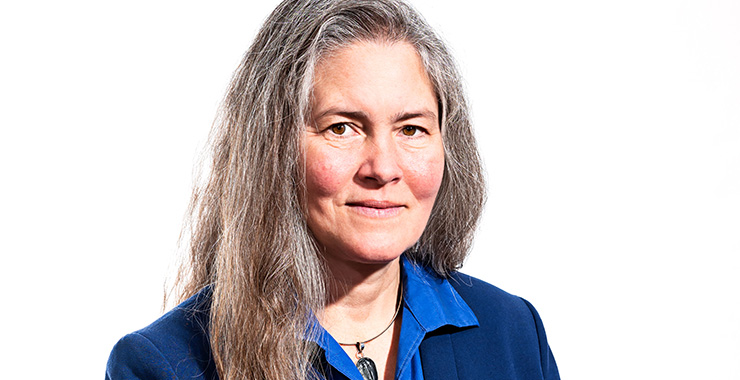
Over the past 25 years, cognitive neuroscientist Laura Helmuth, PhD, has covered a wide range of science stories for publications including National Geographic, Slate, and Smithsonian. For four of those years, she served as health and science editor at The Washington Post, where she led a team of 13 reporters and editors as they tackled complicated stories about the antivaccine movement, measles outbreaks in Minneapolis, and more.
Now as the editor in chief of Scientific American, she aims to further expand the publication’s coverage of psychology as we weather the pandemic, which has upended lives and forced people to deal with extreme levels of adversity. The Monitor spoke with her about how her psychology training guides and enhances her work.
As editor in chief of Scientific American, how have you used your cognitive neuroscience training to bridge the gap between the natural sciences and social sciences?
Having a background in psychology is excellent preparation for any kind of journalism, and definitely for science journalism. Because fundamentally, whether it’s physics or psychology or anthropology, understanding the basic approach of having questions, evaluating evidence, sharing your work with your peers—all those things are common across any field of science. Psychology in particular is so versatile and so open to many levels of analysis. A psychology degree is really good preparation for understanding lots of fields of science.
One of the ways my psychology background is useful is in understanding our audience, and when we look at what subjects people like to read about, they’re really interested in psychology. Especially during the pandemic, we’re seeing a lot of interest in understanding how human behavior, human beliefs, and human biases are having a huge influence on how the virus travels through the world.
In many cases, natural sciences are taken more seriously than social sciences. What are your thoughts on the different impacts of these fields?
It’s a shame that there is this bias, and it’s ill-informed. It’s all a continuum, and frankly, the most interesting work tends to be done at the intersections. Looking across those boundaries is a good way for somebody early in their career to look for interesting questions.
There are a lot of reasons why psychology is such a popular college major, and part of it is that it’s addressing important and interesting questions about the world. Also, the range is just spectacular; you can study everything from synapses and neurotransmitters to neurodegenerative diseases and bonding and misinformation—all these things that have personal or societal relevance.
Psychologists continue to talk about the field’s reproducibility crisis. How do you account for this crisis when deciding which psychology studies to cover?
That’s something that journalists really need to reckon with, and they’re trying to, but it’s a really hard problem. One of the things that I tell classes I speak to or early career researchers I meet is that just because something is published in Science or Nature doesn’t mean that it’s actually true.
The field is getting away from covering single studies. We still use single studies as pegs, but instead of just “Here’s this study in Nature; it said this shocking, amazing thing, the end,” there is a trend toward using one study to show how the field is evolving or how the study is part of a new trend in the field. And science journalists, especially more experienced ones, are also more aware that sometimes the story should be: “Here is this study that is getting a lot of attention, but other experts in the field are very wary of these findings and don’t expect them to replicate.”
How do you think Scientific American has influenced readers’ awareness of psychology?
We run psychology news stories, we run opinion pieces and feature stories, and we have a stand-alone magazine called Mind (which is online only, focusing on psychology), and then we have a regular column written by psychologists called Mind Matters. We’re about to add Mind Matters to our print magazine.
It’s hard to measure impact, but if we look at what stories people read and what stories they share on social media, it seems like psychology is very popular and people really want to understand the research behind psychology.
Are today’s younger researchers more interested in having their research published in popular media or Scientific American versus traditional journals?
There used to be a time where people were embarrassed to write for the public or thought that they would be shunned for it or not taken as seriously. So, there was a phenomenon of early career scientists writing blogs under pseudonyms because they were warned, “You’ll never get tenure, or you’ll never get a job” if, as a postdoc, you write a blog under your own name.
Today, there is more recognition that it’s important to talk to the public, to demystify science—that there is a certain obligation that if you learn something about the world you need to share it. That’s partly a generational shift and partly a growing awareness, certainly during the Trump administration, that scientists need to be part of the public conversation.
What are your goals for psychology coverage moving forward?
Since I’ve started, we’ve been expanding our coverage of social science and psychology. Part of that is because of the pandemic. We’re living through the biggest psychological experiment in human history, with people changing their behaviors, changing their travel patterns, and [changing] how children are educated.
But we’re also increasingly being up front and explicit that part of our mission is to advance social justice. A lot of that is psychological phenomena—understanding how to break down biases, see their repercussions on people’s lives, see the impact of structural racism on health.
And one of the things we specialize in is sheer discovery—understanding how the mind works, how we remember things, how we see and perceive things. There’s a big opportunity that other publications are missing by not covering psychology closely, or by only covering the flashy things. It’s a niche that isn’t very well filled.