


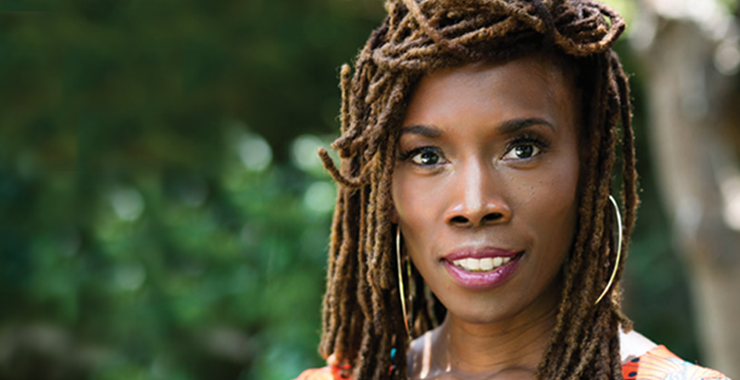
Pepperdine University clinical psychologist Thema S. Bryant, PhD, is here to “bring psychology to the people.” Her vision for APA expands psychology far beyond the academy to empower marginalized communities to heal, to reach people who haven’t had access to therapy, and to mobilize the field to use its full power to address widespread trauma, grief, and oppression, including the trauma of racism.
Sparking a revolution is well within Bryant’s reach. The Duke University-educated psychologist and ordained minister of the African Methodist Episcopal Church is a gifted orator and internationally recognized expert in trauma recovery who has built an enormous, loyal following outside of APA on social media as Dr. Thema and as the host of The Homecoming Podcast about mental health. Her presidential plans include hosting a public-facing summit on practical, culturally informed responses to trauma, grief, and oppression; creating an online culturally informed trauma kit for diverse communities; disseminating knowledge on decolonial and liberation psychology; and developing a documentary that highlights the important work of psychologists of historically excluded identities “so others can break through glass ceilings.” Here’s a quick look at Bryant’s life and other priorities, in her own words.
- Why you chose a career in psychology: I grew up as a pastor’s daughter and saw many people from my community seeking out pastoral counseling from my father. Seeing people supported and encouraged in a safe space planted a seed within me that flourished when I heard about the professional roles of psychologists.
- Best advice you’ve gotten: My mother, Rev. Cecelia Bryant, once told me: “Single-gifted people will often misunderstand multi-gifted people. To them, you will always look scattered. Just be everything you are.”
- What inspires you: The work of expressive artists, my spiritual practices, the wisdom of my ancestors, the passion of many young people, the perseverance of survivors, the commitment of those working to be of service through the field of psychology, and the compassionate courage of other change agents.
- Biggest obstacle you’ve overcome: The three biggest obstacles I continue to overcome are being evacuated from a civil war in Liberia as an adolescent, a sexual assault during my college years, and the intergenerational trauma of gendered racism.
- Music or art that has shaped your life: I love the poetry of Lucille Clifton, Sonia Sanchez, and Audre Lorde. I love music of the African diaspora including gospel, soul, blues, R & B, and reggae. My favorite visual artist is the sculptor Elizabeth Catlett. Throughout my life, I have loved the Alvin Ailey American Dance Theater.
- Favorite places you’ve traveled: My favorite places are West Africa, specifically Liberia, Nigeria, Ghana, Sierra Leone, and Cote D’Ivoire. I am nourished by the rich cultural traditions there, the vibrancy of the communities, and reconnection to my heritage. It also inspires me to see other people of African descent thriving in many diverse fields.
- Where psychology is most needed today: To respond to trauma, grief, and oppression. The need is great and psychology as a field has much to contribute through collaborations across disciplines as well as in respectful cooperation with wise, experienced survivors themselves.