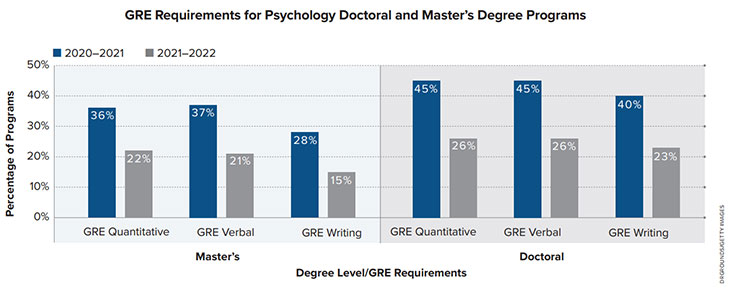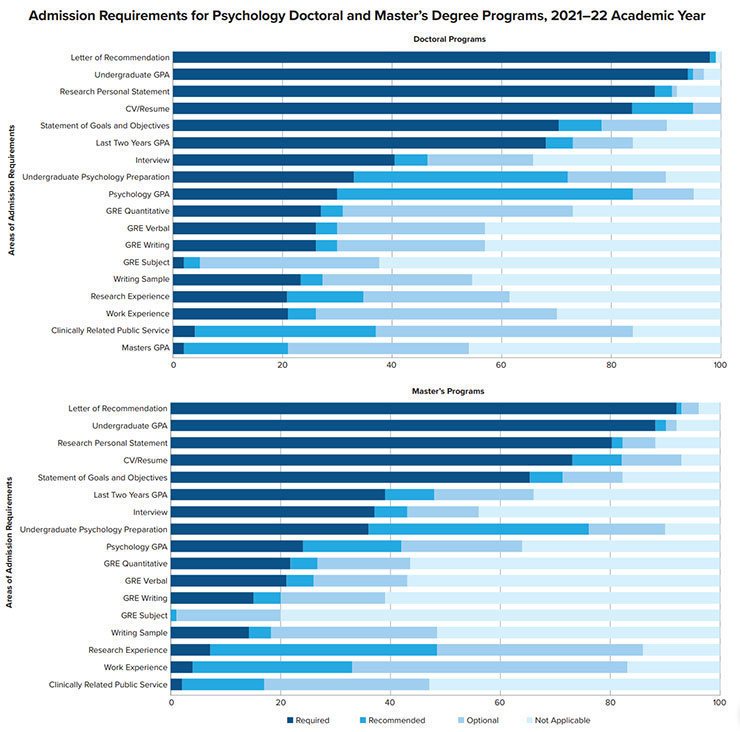
While most of the admission requirements for psychology graduate programs remain unchanged between the 2020–21 and 2021–22 academic years, the percentage of programs requiring GRE scores plunged. The percentage of psychology doctoral programs requiring GRE verbal as well as quantitative scores decreased from 45% to 26%, and those requiring GRE writing scores decreased from 40% to 23%. Psychology master’s programs saw similar decreases.
Graduate programs are relying less on standardized tests like the GREs to evaluate candidates and more on requirements that capture the accumulation of applicants’ performance across a number of years and variety of criteria.
For the 2020 fall semester, more than a third of master’s programs required GRE quantitative and verbal test scores, while 28% required a GRE writing test score. By 2021, less than a quarter required these tests. For doctoral programs, nearly half required the quantitative and verbal GREs for 2020–21; by the following year, only about a quarter did.
Programs’ top admission requirements were letters of recommendation (required by 99% of all doctoral programs and 92% of all master’s programs), a research personal statement (93% and 90%, respectively), and undergraduate GPA (88% and 81%, respectively).