skip to main content
Cover story

Boys are facing key challenges in school. Inside the effort to support their success

An APA task force is spotlighting the specific issues and recommending evidence-based ways to enact swift change

APA Style leaf logo Cite This Article in APA Style
Abrams, Z. (2023, April 1). Boys are facing key challenges in school. Inside the effort to support their success. Monitor on Psychology, 54(3). https://www.apa.org/monitor/2023/04/boys-school-challenges-recommendations

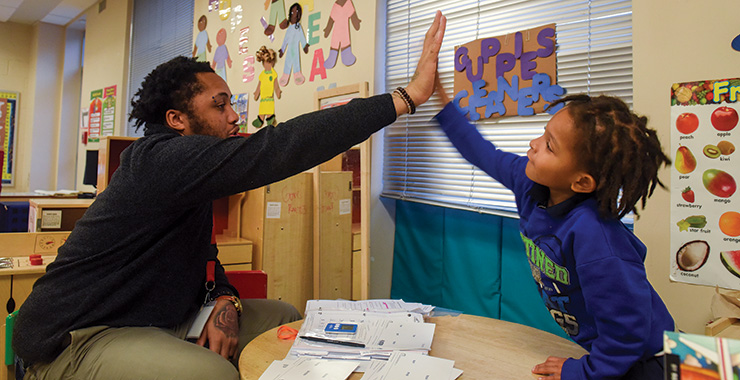
male teacher giving a young male student a high five

At school, by almost every metric, boys of all ages are doing worse than girls. They are disciplined and diagnosed with learning disabilities at higher rates, their grades and test scores are lower, and they’re less likely to graduate from high school (Owens, J., Sociology of Education, Vol. 89, No. 3, 2016opens in new window; Voyer, D., & Voyer, S. D., Psychological Bulletin, Vol. 140, No. 4, 2014opens in new window; “The unreported gender gap in high school graduation rates,” Brookings, 2021opens in new window). These disparities persist at the university level, where female enrollment now outpaces male enrollment by 16% (Undergraduate Enrollment, National Center for Education Statistics, 2022opens in new window).

“The gap between boys and girls is apparent from very early on,” said developmental psychologist Ioakim Boutakidis, PhD, a professor of child and adolescent studies at California State University, Fullerton. “The disparities not only exist across the board—from kindergarten all the way to college—but they are growing over time.”

For boys of color, that gap is even larger. They face suspension and expulsion from school at almost five times the rate of their White male classmates and are even less likely to finish high school or college (“Exploring Boys’ (Mis)Behavior,” Society for the Psychology of Men and Masculinities, 2022).

The implications of these disparities are huge. Doing poorly at school is strongly associated with major challenges later in life, including addiction, mental and physical health problems, and involvement with the criminal justice system—problems that also have ripple effects on society at large. In the United States, getting at least a college degree may be the one remaining, relatively stable ticket to a decent life, Boutakidis said.

Concerned about these long-standing and largely unaddressed issues, APA’s Division 51 (Society for the Psychology of Men and Masculinities) launched the Task Force on Boys in Schoolopens in new window (TFBS) in 2020. The multidisciplinary group of psychologists, sociologists, and educators is midway through an ambitious project: synthesizing the literature on key issues and challenges boys face in school, with recommended solutions, into a series of succinct, peer-reviewed fact sheets that can inform decisions at all levels of the U.S. educational system.

“There’s so much more that can be done to support boys’ success in the classroom,” said clinical psychologist Christopher Reigeluth, PhD, an assistant professor in the Division of Child and Adolescent Psychiatry at Oregon Health and Science University and chair of APA’s Boys in School task force. “As a society, let’s make sure that all kids—boys, girls, and kids of other gender identities—have the message that school is important for them and their future.”

Making the case for boys

Not all boys are struggling academically, but as a group, boys have been falling behind girls for decades. Throughout history, women and girls have been largely barred from attending school, but they’ve made substantial gains in academic performance, high school graduation, and college enrollment and completion over the past half century. Boys and men, on the other hand, have seen slower growth in those areas—and in some cases, decline. (And while not all students identify as cisgender, the research and conversation about boys in school remains linked to that gender binary.)

The reasons for that are rooted in the way schools are set up and how boys are socialized. At the biological level, boys are at higher risk for inattention, hyperactivity, and externalizing behaviors (Tuvblad, C., et al., Journal of Abnormal Child Psychology, Vol. 37, 2009opens in new window). Classrooms, meanwhile, typically require students to sit quietly and self-regulate—what some call the “sit and get” approach to education. When boys struggle with that, getting out of their seat or ignoring a teacher’s instructions, for example, they are often punished for it. Boys, particularly boys of color, are disciplined at much higher rates than girls, starting at ages 4 and 5 (Gilliam, W. S., et al., Yale University Child Study Center, 2016 [PDF, 401KB]opens in new window).

“The fact that children, primarily boys, are being suspended and expelled for these behaviors so early on is incredibly alarming and problematic,” Reigeluth said.

Research shows that boys tend to receive more severe punishment than girls for the same behaviors, especially if they are Black or have a bigger body type, pointing to bias in the application of school policies (Malik, R., Center for American Progress, 2017opens in new window). Those racial disparities in suspensions and expulsions predict higher rates of incarceration, lower college enrollment, and worse overall health (Shollenberger, T. L., UCLA Civil Rights Project, 2013opens in new window).

“We live in a world that doesn’t allow Black boys to be children,” said Joseph Derrick Nelson, PhD, an associate professor of educational studies and chair of the Black Studies Program at Swarthmore College in Pennsylvania and task force cochair. “The fears and anxieties about who they might become as adults contribute to them being viewed and treated as adult Black men, from a very early age.”

Compared with just 10% of female students, 18% of male students are diagnosed with learning disabilities and referred to special education services (Students with Disabilities, National Center for Education Statistics, 2022opens in new window). Like boys who are suspended and expelled, these students often disengage from school and experience worse academic outcomes as a result (“Learning Disabilities,” Society for the Psychology of Men and Masculinities, 2022).

Perhaps the most pervasive—and most entrenched—challenge that plagues boys at school is their gender socialization. As boys grow up, adults and pop-culture messages often push them to project an image of dominance, indifference, and self-sufficiency while hiding vulnerability, curiosity, and the need for intimacy. They see male role models in the media succeeding in athletics, business, and entertainment, but few in academia. They learn that school isn’t “cool”; that it’s better to excel at sports (Chu, J. Y., When Boys Become Boys: Development, Relationships, and Masculinity, NYU Press, 2014opens in new window).

“The very basis of learning is that you have to admit, at least to yourself, that you don’t know something—to ask for help when you need it,” said Judy Y. Chu, EdD, a lecturer in human biology at Stanford University and part of the advisory committee for the TFBS, who studies boys’ gender socialization, relationships, and development. “When boys come to associate that vulnerability with feelings of shame, learning in the classroom—and elsewhere—really suffers.”

By the time boys finish high school, many lack the knowledge and skills required to succeed in higher education. Women now far outpace men in college application, enrollment, and completion (The male college crisis is not just in enrollment, but completion, Brookings, October 8, 2021opens in new window).

Despite these troubling disparities, it can be tough for those studying and advocating on the issue to make the case that boys and men require more attention and resources.

“How do we acknowledge and address the fact that even though men hold more structural power in the U.S.—in Congress, as CEOs, and as billionaires—there are also men and boys who are struggling substantially? How do we help the ones who are struggling, without further ‘padding the pockets’ of those who are doing well?” said Andrew Smiler, PhD, a clinical psychologist based in Winston-Salem, North Carolina, and cochair of the TFBS (Leppert, R., & DeSilver, D., Pew Research Center, January 3, 2023opens in new window; Hinchliffe, E., Fortune, January 12, 2023opens in new window; Distribution of billionaires in the United States in 2020, by gender, Statista, 2020opens in new window).

The task force is hoping to make headway by grounding its recommendations in empirical findings amassed by social scientists and educators over the past few decades. Each one-page fact sheet highlights up to 10 well-established facts about a key issue and then empowers stakeholders at all levels—from students, parents, and teachers to guidance counselors, principals, and policymakers—to enact change.

They have released the fact sheets Exploring Boys’ (Mis)Behavior (PDF, 261KB)opens in new window, Learning Disabilities (PDF, 232KB)opens in new window, and High-Achieving Boys, with Distance Learning and Single-Sex Education soon to follow. Strategic dissemination is a key focus. Superintendents, for example, tend to seek information from professional and trade organizations rather than peer-reviewed journals, according to research by task force member Benterah C. Morton, PhD, an associate professor at the University of South Alabama and an expert in educational leadership (AASA Journal of Scholarship & Practice, Vol. 19, No. 2, 2022opens in new window).

Social media will also be a big part of their strategy, with a special focus on using platforms such as Facebook, Instagram, and TikTok to reach parents, educators, and even boys themselves. Down the line, the fact sheets could even be used to provide justification for revising policies that harm certain groups, such as boys of color.

“This task force is an opportunity for us to have a broader impact—by creating documents that can be used in real ways to address inequities in schools,” Nelson said.


Opportunities for engagement

Many of the task force’s recommendations revolve around better recruitment, training, and support of the people who boys engage with most: teachers. To start, more comprehensive training on the basics of child development, behavior, and gender differences could help teachers see disruptive behavior in a different light.

“When a boy is presenting in a way that seems to be resistant to learning, we should take time to understand what’s going on, rather than immediately disciplining him,” Reigeluth said.

Rather than a behavioral problem, Smiler said, a boy who is acting out or not completing schoolwork could have a learning disability, attention-deficit/hyperactivity disorder, poor vision, a chaotic home life, or feel social pressure about not wanting to appear engaged in school. The Developing Healthy Boys trainingopens in new window, available online for educators and professionals who work with boys, ages 10 and younger, is one framework that teaches educators about the psychology of boys.

Assessing and addressing boys’ needs requires a relational approach to teaching. Nelson developed and tested one such framework focused on Black boys, where teachers employed such strategies as reaching out, establishing common ground, personal advocacy on behalf of boys, and accommodating opposition. The relationships had a positive impact on boys’ learning and academic engagement (Teachers College Record, Vol. 118, No. 6, 2016opens in new window).

“I find relationships to be a window into reimagining who Black boys are,” Nelson said. “If you lead with curiosity, listening, and seeking to understand their experience, you quickly learn that oftentimes they’re the furthest thing from society’s stereotypes and narratives.”

Teachers can use a relational approach to promote a sense of belonging among boys at school. That may involve reaching out privately to a teen to learn more about his individual interests, said task force member Saed Hill, PhD, a counseling psychologist and the assistant director of prevention and masculine engagement at Northwestern University. When one of his students expressed an interest in the TV mystery series Riverdale, it led to a conversation about career paths that involve investigative work.

Linking boys’ education to activism and social justice is another way to improve engagement. For example: How does our understanding of science and technology impact our ability to advocate for change in our communities? It can also be appropriate for educators to talk with boys about their own personal experiences and struggles. Hill has told students about the academic challenges he faced in high school and college, as well as what helped him persist to ultimately earn his doctorate.

“What a lot of boys have reported over the years is that school doesn’t really feel like a place for them to belong,” he said. “It’s a place where they feel like just a number, or even a nuisance.”

Of course, the relational approach gets a major boost when boys see their teachers as role models. Only about 20% of teachers are men (Data about men teachers, MenTeach, 2020opens in new window). Task force members say a critical focus should be recruiting and hiring more male teachers so that all students—including boys—can see themselves represented at school.

“Aside from a physical education coach, I had my first male teacher in high school,” said Morton, who is a former school principal. “That was a whole portion of my career where I didn’t see male teachers leading a class, so it was not an avenue for me to think about.”

Reimagining classrooms

Flexibility in classroom setup and instructional methods can also help boys succeed. Instead of the “sit and get” approach, research suggests that boys tend to benefit from hands-on, interactive activities (Fredericks, J. A., et al., Journal of Research in Science Teaching, Vol. 55, No. 2, 2018opens in new window). That could mean sorting and counting objects in a math class, for example, rather than learning with a pencil and paper.

For boys (and other children) who experience inattention and hyperactivity, building more breaks into the school day for kids to be kids, including recess and movement-based learning in the classroom, can make it easier to stay on track, Reigeluth said.

Social-emotional learning is also an important part of a well-rounded education, including for boys. Frameworks such as the Healthy Gender Development and Young Children (PDF, 998KB)opens in new window protocol, for early childhood programs, and WiseGuyzopens in new window, for middle and high school students, are designed to promote healthy relationships and gender identity development.

Hill stresses the importance of talking to boys and young men about how they interact with their friends. Video game culture, for example, has helped boys connect online, but that doesn’t guarantee meaningful relationships. Educators and mentors can pose questions such as: What topics do you talk about? What defines a healthy friendship?

Another activity he recommends: pairing up male students for interviews to help them practice listening and relationship building. Students can ask each other questions about their favorite vacations, wacky talents they have, sports teams they follow, family members they feel close to, and other topics. Then, each student introduces his peer to the rest of the group.

Schools can also build in opportunities for boys and young men to explore gender roles and masculinity, for instance during wellness classes. Hill prefers the term “restrictive masculinity” to “toxic masculinity” because it better captures the way expectations of men and boys can limit their options for career paths, relationships, and self-expression.

“It can also make the conversation more inviting for boys by not implying that masculinity is inherently toxic,” he said.

Reigeluth recently developed and released the Masculinity Workbook for Teensopens in new window, which schools can use to support adolescent boys in the exploration of their gender identity. Topics include emotional restriction (How do I feel about the message that I shouldn’t disclose my emotions? How has that worked out for me? What do I want to do going forward?), school versus sports (What activities will society pressure me to do? What activities feel innately good?), and more.

Interventions that work

Given the degree of disparity boys face, some advocates are proposing more sweeping changes. “Redshirtingopens in new window” boys, or starting them one year later in kindergarten (different from holding a child back for documented developmental reasons), has become popular in some high-income communities. But psychologists say the practice isn’t yet backed by research. In fact, for boys at highest risk, the opposite approach—giving all children access to affordable, high-quality preschool—could help more.

“The best preschools focus on things like social-emotional regulation: rule following, delaying gratification, sharing, and taking turns,” said Boutakidis, who is also a member of the TFBS.

Another intervention with growing support is single-sex education, particularly for boys of color. Research is still limited, but Nelson is involved with a national effort to evaluate the efficacy of such schools, which some community leaders believe are a possible solution to the bias and disparities boys of color face in U.S. public schools. So far, this research has found that single-sex schools excel in parent and community engagement, as well as racial and gender identity development. They also give boys the opportunity to try extracurricular activities other than sports and music with fewer social ramifications, including things like dance, robotics, and Model U.N.

“The school environment becomes a context where boys can explore and examine, where there’s a lot of possibility, rather than another context in their lives where stereotypes of Black men and boys are imposed,” Nelson said.

Task force members are also hoping to use the fact sheets to help school leaders become data collectors, managers, and understanders, Morton said. That includes empowering administrators to identity what sort of data will be meaningful and beneficial to their campus, as well as how to interpret that data and use it to make collaborative decisions. For example: Which students are disciplined most frequently? Does the same behavior always receive the same response, or are some students treated more harshly than others?

Many feel that offering interventions before and during the K–12 years is the best way to support healthy development and help boys thrive at school. But men in college can benefit from help, too, which is why some higher education institutions are creating “male success centers,” to provide a place of community and support for men on campus.

At Northwestern University, Hill leads NU Men, a 6-week mentoring program where participants deconstruct masculinity as a means of violence prevention. For example: What does it mean to be masculine? What are men expected to do to obtain power (be the breadwinner, initiate sex)?

Hill also oversees Northwestern’s Masculinity, Allyship, Reflection, Solidarity (MARS) peer education group, which examines policy related to gender and violence, combats rape culture, and promotes healthy masculinity on campus. In 2019, members of the group wrote to the Trump administration about proposed changes to Title IX regulations. For example, they argued that live hearings could put survivors of sexual violence at risk of further trauma by requiring them to confront their attackers. Hill also consults with other universities and organizations to help them hire and train their own masculine engagement directors.

Ultimately, to help boys at school, the task force’s plea is simple. Review the evidence, see this gender gap for what it is—an equity issue—and act.

“This is an equity issue, full stop. It’s systemic, it’s consequential, it’s impactful. It’s between groups that we can readily identify, and it cuts across multiple contexts,” Boutakidis said. “If there’s something we can do to address it, we absolutely need to.”

The facts on boys in school

The Task Force on Boys in School, led by APA’s Division 51 (Society for the Psychology of Men and Masculinities), is developing a series of peer-reviewed fact sheets on key issues and challenges boys face in school, along with recommended solutions. The task force is disseminating the fact sheets to educators, administrators, policymakers, parents, and even students themselves.

Published fact sheets

Coming soon

  • Distance Learning
  • Single-Sex Education

Read them at the Division 51 Task Force on Boys in Schoolopens in new window page.

Further reading

Half of the 250 kids expelled from preschool each day are Black boysopens in new window
Novak, S., Scientific American, January 12, 2023

The missing men on campusopens in new window
The Chronicle of Higher Education, 2021

Family disadvantage and the gender gap in behavioral and educational outcomesopens in new window
Autor, D., et al., American Economic Journal: Applied Economics, 2019

The mask you live inopens in new window (educational film)
The Representation Project, 2015

When boys become boys: Development, relationships, and masculinityopens in new window
Chu, J. Y., NYU Press, 2014

Recommended Reading

Speaking of Psychology

Subscribe to APA’s audio podcast series highlighting some of the most important and relevant psychological research being conducted today.

Subscribe to Speaking of Psychology and download via:

Appleopens in new window
Apple podcast logo

Spotifyopens in new window
Spotify logo

You may also like