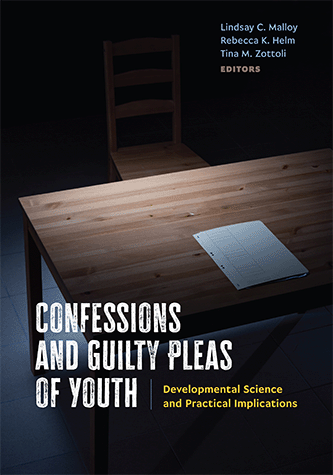
Confessions and Guilty Pleas of Youth
This timely volume provides authoritative, integrated coverage of the developmental science relevant to youth who self-incriminate, with implications for practice and policy.
In recent years there has been a surge in empirical research on confessions and pleas in general, and among youth specifically. Reforms have been proposed, and some have been adopted. However, in many ways youth continue to be treated either the same as adults or with well-intended but misguided procedures based on “common sense” rather than robust developmental science. Growing interest in this topic, coupled with a high volume of scholarship that is not yet reflected in policy, makes the time ripe for this book.
Chapters in the volume demonstrate that developmental science should be front and center when it comes to confessions and guilty pleas of youth, how the legal contexts surrounding confessions and guilty pleas are fraught with risk for youth overall—but especially for those facing systemic disparities—and that there are ways to improve outcomes for youth suspects and defendants. An international group of renowned experts review research and theory, examine current practice and procedure, and provide suggestions for empirically-based reform. A comprehensive, first-of-its kind work, the book links developmental science with applied scholarship and analysis to help inform practice, and to facilitate the development of empirically supported policy and law that takes appropriate account of the developmental capabilities and limitations of youth suspects and defendants.
Intended for researchers, practitioners, and students across a range of fields, including psychology, law, criminal justice, social work, and law enforcement, this book will be a must-read for all who are interested in understanding youth self-incrimination.
Contributors
Series Foreword
Monica K. Miller
Foreword
Michael E. Lamb
Acknowledgments
Understanding Youth Confessions and Guilty Pleas: An Introduction
Lindsay C. Malloy, Tina M. Zottoli, and Rebecca K. Helm
Part I. Developmental and Legal Foundations
- Chapter 1. Legal Foundations for Understanding Confessions and Guilty Pleas of Youth
Christopher M. King, Rachel Bomysoad, Sarah Hitchcock, Sana Vora, Chinwe Ossai, and Savannah Cuellar - Chapter 2. Socioemotional Foundations for Understanding Confessions and Guilty Pleas of Youth
Cortney Simmons, Imani Randolph, Jung Min Lee, and Caitlin Cavanagh - Chapter 3. Neurodevelopmental Foundations for Understanding Confessions and Guilty Pleas of Youth
Jillian Grose-Fifer - Chapter 4. Memory Foundations for Understanding Confessions and Guilty Pleas of Youth
Kamala London and Hera Yang
Part II. Confessions
- Chapter 5. Revisiting Lee Arthur Hester: A Case Study in False Confessions
Steven A. Drizin - Chapter 6. Confessions: History, Research, and Current Directions
Saul M. Kassin - Chapter 7. Youth Vulnerability During Police Questioning: False Confession and the Five-Level Process Model for Assessing Risk
Gisli H. Gudjonsson - Chapter 8. Psycholegal Abilities of Youth and Waiver of Interrogation-Related Rights
Emily Haney-Caron, Kaillee Philleo, and Sydney Baker - Chapter 9. Defining and Determining “Custody” Through a Developmental Lens
Fabiana Alceste and Reece Butler - Chapter 10. Trauma as a Risk Factor for Coerced and False Confessions Among Youth
Lucy Guarnera and Hayley M. D. Cleary - Chapter 11. System Disparities: Racial Criminalization and the Risk of Coerced and False Confessions in Youth
Cynthia J. Najdowski - Chapter 12. (Mis)perceptions of Youth Confessors by Legal Decision-Makers
Margaret C. Stevenson, Kelly C. Burke, and Gabriela S. Rachman
Part III. Guilty Pleas
- Chapter 13. Joseph Buffey: A Case Study in False Guilty Pleas
Vanessa Meterko and Jaime S. Henderson - Chapter 14. Guilty Pleas: History, Research, and Current Directions
Miko M. Wilford and Annabelle Frazier - Chapter 15. Youth Vulnerability in the Guilty Plea Process: Cognitive Immaturity and Suboptimal Decisions
Rebecca K. Helm and Valerie F. Reyna - Chapter 16. Guilty Pleas and the Psycholegal Abilities of Youth
Tina M. Zottoli, Tarika Daftary-Kapur, Kimberly Echevarria, and Aliya J. Birnbaum - Chapter 17. Legal Procedures: Protecting Youth Making Plea Decisions or Exacerbating Vulnerabilities?
Talley Bettens, Allison D. Redlich, and Rebecca K. Helm - Chapter 18. System Disparities: Impact of Racial and Socioeconomic Inequalities on the Plea Process for Youth
Martine Fredrickson and Vanessa A. Edkins
Part IV. Specific Actors and Other Contexts
- Chapter 19. Evaluating Youth Who Confess or Plead Guilty: A Perspective From Clinical Psychologists
Antoinette Kavanaugh and Kathryn Rea Smith - Chapter 20. Practical Guidance for Effective Counseling, Investigation, and Criminal Representation of Youth Who Confess: A Perspective from Practicing Lawyers
Megan G. Crane and Maria Hawilo - Chapter 21. Parents and Appropriate Adults in the Context of Confessions and Guilty Pleas
Jennifer Woolard, Grace Hickman, and Erika Fountain - Chapter 22. Expert Testimony in Cases of Disputed Confessions
Jeffrey Kaplan and Brian L. Cutler - Chapter 23. A “Child First” Approach to Police Interviews of Youth Suspects: Applying the PEACE Model
Martin Vaughan, Rebecca Milne, and Ray Bull - Chapter 24. An International Perspective on Legal Advice for Youth in the Police Station: Strengthening Youth Participation in Criminal Proceedings and Diversion From Court
Vicky Kemp and Cerys Gibson - Chapter 25. Interrogations and Confessions in School Contexts
Mark D. Snow and Lindsay C. Malloy - Chapter 26. Conclusions and Emerging Issues
Lindsay C. Malloy, Rebecca K. Helm, and Tina M. Zottoli
Index
About the Editors
Lindsay C. Malloy, PhD, is a professor of forensic psychology and Research Excellence Chair at Ontario Tech University. Her research addresses questions concerning interrogations, confessions, and eyewitness testimony, especially among vulnerable people; investigative interviewing techniques; and the disclosure of negative or traumatic experiences. Dr. Malloy’s scholarship is widely cited in forensic and developmental research, and has appeared in amicus briefs submitted to the U.S. Supreme Court. She been the recipient of multiple awards and her research has been funded by several agencies. Her TEDx talk, “Why Teens Confess to Crimes They Didn’t Commitopens in new window,” has been viewed over 1.5 million times.
Rebecca K. Helm, PhD, is a professor of law and empirical legal studies, and director of the Evidence Based Justice Lab at the University of Exeter. She is a qualified lawyer in England and Wales, and in New York. Dr. Helm serves as an academic cochair of the Plea Bargaining Institute and runs the United Kingdom Miscarriages of Justice Registry. She is currently a United Kingdom Research and Innovation Fellow; her work has been widely cited in academic research and in multiple court judgments. She was part of a team that was awarded the Economic and Social Research Council Prize for Societal Impact in 2024.
Tina M. Zottoli, PhD, is an associate professor of psychology and director of the Legal Decision Making Lab at Montclair State University. She is a licensed clinical psychologist in New York and serves as cochair of a working group of the Plea Bargaining Institute. Dr. Zottoli’s scholarship focuses on decision making in legal contexts, with emphasis on the legal capacities of adolescent defendants and guilty plea decision making. Her work has garnered national attention and supported the passage of “second-look” legislation in several U.S. states. Her research has been cited in amicus briefs submitted to state and federal courts, including the U.S. Supreme Court.
It is well-documented that when they are interrogated, adolescents are significantly more likely than adults to give false confessions and coerced confessions. This comprehensive guidebook, with contributions from the field’s leading experts, is an indispensable resource for scholars interested in adolescence and the law and for attorneys who represent young defendants. I recommend it with great enthusiasm.
—Laurence Steinberg, PhD, Professor of Psychology and Neuroscience, Temple University, Philadelphia, PA, and coauthor of Rethinking Juvenile Justice
Confessions and Guilty Pleas of Youth is a groundbreaking must-read from the leading experts on youth, development, and the law. Blending cutting-edge science with real world implications, the authors reveal how adolescent immaturity shapes decision making in the justice system—often leading young people to confess or plead guilty without fully understanding the stakes. Both powerful and illuminating, this book redefines what it means to achieve justice for youth.
—Elizabeth Cauffman, PhD, Distinguished Professor of Psychology, Education & Law; Director, Center for Psychology & Law; and Director, Master of Legal & Forensic Psychology, University of California, Irvine
Youth decision making is fundamentally different from that of adults, yet young people in the criminal system are often subjected to the same coercive pressures to confess and plead guilty. This is true for everyone caught in the system’s web, including the innocent. This work contains a compelling and comprehensive collection of science, data, and insights into how youth think, making this a must-read for policymakers and anyone working with youth in the system.
—Lucian E. Dervan, JD, Professor of Law and Director of Criminal Justice Studies, Belmont University College of Law, Nashville, TN, and Founding Director, Plea Bargaining Institute
See Lindsay C. Malloy's presentation slides (PDF, 749KB)opens in new window on Confessions and Guilty Pleas of Youth, presented at the APA Annual Convention 2026.
Watch the author(s) discuss Confessions and Guilty Pleas of Youth.opens in new window Interested in this book? Purchase a copy to continue (or start) the conversation with your clients.