Testifying in Court
Available formats
Also available from
- Doody's Core Title
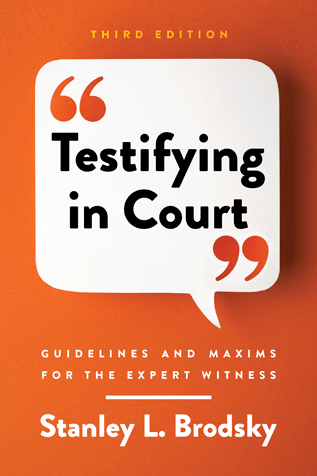
The third edition of this classic resource provides mental health professionals with simple, practical advice for testifying in court.
In this book, Stan Brodsky maintains his witty, conversational style of teaching while modeling ideal testimony. Short chapters blend humorous anecdotes with accessible guidelines drawn from Brodsky’s decades of experience as an expert witness and trainer, and from colleagues in various fields, including medical professionals. Each chapter concludes with a pithy maxim that emphasizes the most important takeaway for readers, making this book an ideal reference that can be consulted just prior to court appearances.
New to this edition are:
- substantial updates and revisions to existing guidelines and case examples;
- new and updated topics, including advice for virtual testimony and revised coverage of culture and diversity in forensic evaluations;
- a clearer organization with chapters grouped by themes such as pretrial preparations, direct examination, and cross‑examination, and;
- an appendix that gathers all the book's maxims together for easy reference.
Acknowledgments
Introduction
Part I. Prior to Testimony
- Chapter 1. Beginning to Think and Act Like an Expert Witness
- Chapter 2. Courtroom as Place Identity
- Chapter 3. Cherry-Picking
- Chapter 4. Culture and Diversity in Forensic Work
- Chapter 5. Flawed Collateral and Psychological Data
- Chapter 6. Intimidation Before Testimony
- Chapter 7. Preparation on the Go
- Chapter 8. Psychotherapists in Court: To Testify or Not to Testify
- Chapter 9. Report Matters
- Chapter 10. Socializing With Attorneys and Other Parties
- Chapter 11. Staying Current
- Chapter 12. To Be an Expert
- Chapter 13. Uninvolved and Inept Attorneys
- Chapter 14. Virtual Testimony
- Chapter 15. What to Wear
Part II. The Skilled Witness
- Chapter 16. Burden of Proof and Degree of Certainty
- Chapter 17. Changing Your Mind
- Chapter 18. Fooled by the Face
- Chapter 19. The Learned Treatise 1: The Writings of Authorities
- Chapter 20. The Learned Treatise 2: What You Have Written
- Chapter 21. Listening Well
- Chapter 22. The Rumpelstiltskin Principle
- Chapter 23. Saying “I Don’t Know” vs. Waffling
- Chapter 24. Using Quiet Times
- Chapter 25. When the Expert Is Not Allowed to Answer
- Chapter 26. Wit-Free Testimony
Part III.Objectivity Challenges
- Chapter 27. Allegiance Effects
- Chapter 28. The Hired Gun
- Chapter 29. Professional Witnesses and Professionalism
Part IV. Direct Examination
- Chapter 30. Beginnings: The Good Direct
- Chapter 31. Brushed-Off Direct
- Chapter 32. Diverging on Direct
- Chapter 33. The Language of Testimony
Part V. Cross-Examination
- Chapter 34. Abrasive and Attacking Cross-Examinations
- Chapter 35. The Abysmal History Gambit
- Chapter 36. The Admit–Deny Response
- Chapter 37. Challenges to Experience 1: Insufficient Experience
- Chapter 38. Challenges to Experience 2: Case-Specific Experience
- Chapter 39. Challenges to Experience 3: The Case Against Experience
- Chapter 40. Credentialing and Qualifications: Common Challenges
- Chapter 41. Disaster Relief
- Chapter 42. DSM-5: The Cautionary Statement
- Chapter 43. The Expert Gaze
- Chapter 44. Looking at the Jury
- Chapter 45. Negative Assertions
- Chapter 46. Perspective Taking
- Chapter 47. Power and Control on the Witness Stand
- Chapter 48. Probes for Guilt and Shame
- Chapter 49. The Push–Pull Technique
- Chapter 50. Set-Ups and Takedowns
- Chapter 51. Surprise Questions
- Chapter 52. Theatrical and Outlandish Attorneys
- Chapter 53. Transformative Moments
- Chapter 54. Vigorous Cross-Examinations, Vigorous Answers
- Chapter 55. Using Your Expertise Against You
Part VI. What Not to Do
- Chapter 56. Feisty Experts
- Chapter 57. Frittering Away Trustworthiness
- Chapter 58. Humor
- Chapter 59. The Lateral Arabesque
- Chapter 60. Meandering Expertise
- Chapter 61. Narcissistic Experts
- Chapter 62. Predictable Answers
- Chapter 63. Recalcitrant and Unprepared: The Case for Consultation
- Chapter 64. Testifying While Sick or Under the Influence
- Chapter 65. Traumatic Experiences on the Stand
- Chapter 66. Implicit Vouching and Winking at the Jury
- Chapter 67. Worst Expert Testimony Ever
Part VII. After Your Testimony
- Chapter 68. Fugue State Testimony
- Chapter 69. Moving On
- Chapter 70. When It Is Over
Appendix. Maxims for Quick Review
References
Index
About the Author
Stanley L. Brodsky, PhD, is a forensic psychologist and consultant and trainer for forensic evaluations and expert testimony.
He has written numerous books and articles about psychology and the law. His 2018 book with Thomas Grisso, The Roots of Modern Psychology and Law: A Narrative History, won the Outstanding Book Award from the American Psychology-Law Society (APLS).
Dr. Brodsky received distinguished achievement awards from the APLS and the International Association of Forensic and Correctional Psychology.
He was visiting fellow at Harvard Medical School and visiting fellow or professor at universities in Australia, New Zealand, India, Israel, and England.
Brodsky’s legendary advice on expert testimony is not just about technique but recognizing your own vulnerabilities and defenses—in short, knowing yourself. If you thought the earlier editions taught you all you needed to know, you’ll be surprised. And it’s served up with Brodsky’s trademark knack for telling illustrative stories that stick with you.
—Thomas Grisso, PhD, ABPP (Forensic), Professor Emeritus, University of Massachusetts Chan Medical School, Worcester
Stan Brodsky has done it again. Testifying in court can be a terrifying experience, and Brodsky has calmed and comforted generations of mental health professionals with practical wisdom and sage advice. This readable book includes realistic hypotheticals; stories of real cases; up-to-date social science; lots of humor; and, as always, the legendary Brodsky Maxims. I recommend this book to anyone headed to court, for the first time or the hundredth.
—Joel A. Dvoskin, PhD, ABPP, Former President, American Psychology-Law Society, and Cofounder, Heroes Active Bystandership Training
Professor Brodsky’s book teaching experts how to testify in court is a classic. This insightful volume is full of practical advice for expert witnesses, in down-to-earth language, illustrated with stories. Experts not only in psychology but across various medical disciplines, whether they are new at testifying or frequently find themselves in court, will find their knowledge enhanced.
—Susan Hatters Friedman, MD, DFAPA, The Phillip Resnick Professor of Forensic Psychiatry, Case Western Reserve University, Cleveland, OH
Don’t call it a comeback. Prior editions haven’t become dated; they just keep evolving. Dr. Brodsky is a peerless source of contemporary guidance on practical aspects of testifying in court.
—Eric Y. Drogin, JD, PhD, ABPP, Harvard Medical School, Boston, MA, and Past President, American Board of Forensic Psychology
A general principle about expert testimony is that, in order to be persuasive, witnesses must not only be knowledgeable about the subject matter that is the focus of their testimony, but they also must be able to hold the audience’s attention when communicating their opinions. The third edition of this volume makes clear Dr. Brodsky can check both boxes when it comes to expert testimony. With a new organization, and new content that comes from his own experience and that of others, Dr. Brodsky has used his always engaging style to improve what is a classic volume.
—Randy K. Otto, PhD, ABPP, Associate Professor, Nova Southeastern University, Davie, FL
Stan Brodsky’s scholarly work and popular writings about expert testimony have guided expert witnesses for generations. This book offers new guidance to coach expert witnesses to be better at what they need to do. It cuts without nonsense and with refreshing immediacy to the core of various issues involved in testifying as an expert.
—Tess M.S. Neal, PhD, Associate Professor of Psychology, Arizona State University, Glendale