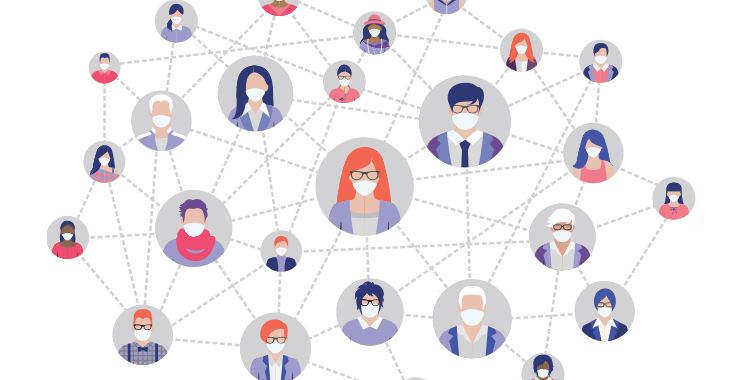
During the Covid-19 pandemic, many of the typical networking opportunities were gradually replaced with a variety of creative new approaches to sharing information and building professional connections. For psychology graduate students and early career psychologists, this change has been particularly daunting, as establishing professional relationships is vital to career progression.
In fact, strong networks help people access information, resources, and support (Kilduff, M., & Brass, D. J., Academy of Management Annals, Vol. 4, No. 1, 2010opens in new window). And networks aren’t just about work: Social support can benefit people in many ways, such as helping with questions or difficult decisions (Porter, C. M., & Woo, S. E., Journal of Management, Vol. 41, No. 5, 2015opens in new window). Networking also contributes to overall career success. A 2016 study of lawyers at a large firm, for example, found that the individuals’ success depended on their ability to network effectively (Casciaro, T., et al., Administrative Science Quarterly, Vol. 59, No. 4, 2016opens in new window). Additionally, almost 80% of professionals see networking as an important factor in their career outcomes, according to a global survey by LinkedInopens in new window.
When Covid-19 hit, however, the traditional methods used to network, like in-person meetups and conferences, were no longer available. “I had to take a quick turn and reevaluate how I network and connect with others,” said Quincy Guinadi, a counseling psychology doctoral intern at the University of St. Thomas in St. Paul, Minnesota.
This is not to say that networking is a thing of the past. Far from it—there are still many ways for students and psychologists to connect with others both virtually and in person and move their careers forward.
So, what are the tips and tricks for networking successfully in this postpandemic world? Guinadi and other graduate students and psychologists shared their insights.
Create online connections
Luckily, in the age of the internet, making online connections is easier than ever. “This virtual space has always existed, but it’s become particularly important in these past couple of years,” said Karen Stamm, PhD, director of the Center for Workforce Studies at APA. “Pre-Covid it used to be geographically based—you had to find someone that you wanted to interview or connect with in your area. But online spaces erase this geographic distance.”
Social media spaces like Twitter and LinkedIn, for example, have seen traffic greatly increase since the beginning of the pandemic because they offer a great way for people to remotely stay in touch with colleagues even when in-person interactions are not possible. Despite its checkered history, which caused some users to ditch the platform, Twitter continues to function as a social and professional hub for many. Currently, the site has around 217 million active users who are sending 500 million tweets per dayopens in new window, a massive increase from prepandemic daysopens in new window. A 2019 literature review on the use of Twitter in educational settings found it a useful tool for creating and supporting professional networks thanks to its high accessibility and real-time format (Malik, A., et al., International Journal of Educational Technology in Higher Education, Vol. 36, 2019opens in new window).
LinkedIn, a professional community of more than 722 million people worldwide, was a networking life raft for many during the pandemic, as economic upheaval, social distancing restrictions, and other factors led many to look for new positions. Conversations on LinkedIn increased by 43% and hours learning new skills rose 80% in the first three months of 2021opens in new window, according to data collected by the platform. Additionally, businesses have spent significantly more time marketing jobs on LinkedIn during the pandemic, making the website a great place to find new career opportunities.
During the pandemic, Instagram became a more useful platform to develop connections because it offers a more casual way to connect with the outside world. “Since 2020, I’ve had a PhD Instagram page where I document my journey of being a PhD student,” said Serena Bradshaw, a third-year counseling psychology doctoral student at Howard University in Washington, D.C. This has helped her stay connected with other psychologists and share details about conferences with others throughout the pandemic. While not all online connections will necessarily become professional contacts, Bradshaw sees value in networking with people in a wide range of disciplines.
All these platforms have provided key social connections during a time of increased isolation. In fact, 90% of Americans said that the internet has been essential or important to them during the coronavirus outbreak, according to a 2021 survey by the Pew Research Center.opens in new window This includes psychologists, who needed to remain in contact with other researchers, colleagues, and patients.
Research also shows that psychologists’ career pathways are not linear and there are many ways to apply a psychology background, said Stamm. An estimated 205,100 individuals with a doctorate or professional degree in psychology worked in 53 different occupation categories as of 2019, according to the APA Center for Workforce Studies data tool. This includes teachers, counselors, medical and health services managers, statisticians, and practicing psychologists. Because of this, connecting online with a wide range of professionals can be very helpful in individuals’ long-term career prospects.
Overall, since the pandemic, social media profiles have been used more and more as virtual business cards and marketing platforms. Make sure your profile is professional and up-to-date and make a conscious effort to expand your networkopens in new window by following others in the field whom you admire. Additionally, comment on other psychologists’ posts, reach out with questions, or offer your own insights when you can.
Attend in-person and virtual conferences
Many psychology conferences are now offering hybrid options for people who do not wish to or can’t attend in-person. This year, these include the Psychology and the Other Conferenceopens in new window, Annual Convention of the Society for Personality and Social Psychologyopens in new window, and the Constructing the Psychological Humanities Annual Spring Conference. Although virtual conferences lack the human connection of seeing people face-to-face, attendees can still view psychologists’ presentations, send messages to other attendees, job hunt, and attend meetings focused on specific research areas.
Virtual conferences can also offer a lot of benefits to graduate students and early career psychologists with regards to cost. Conference registration, travel expenses, lodging, and additional fees are pricey and thus prohibitive for many—particularly members of marginalized groups.
“These online spaces are convenient and offer such a wide reach to areas that may not have otherwise been accessible to folks pre-Covid,” said Guinadi, who is chair of the American Psychological Association of Graduate Students (APAGS)—an organization that represents and advocates for graduate student development and is another great place to create professional connections. Additionally, people with social anxiety, chronic illnesses, or other disabilities may not be able to attend in-person conferences.
“Networking is a very intimidating task,” said Guinadi. “So having more options on how to do it is probably a good thing.”
The APA conventionopens in new window now offers in-person and virtual options. This summer, the in-person convention will be held in Washington, D.C., and it’s worth attending if you can, said Bradshaw, who is a member-at-large for APAGS. It offers a great place to network with a wide range of psychologists and has tons of forums and panels for marginalized groups, including members of the LGBTQ+ community and Black women, Bradshaw said. APA also runs mentoring programsopens in new window where early career scholars can learn from more experienced and established psychologists.
“These spaces are already curated for you,” said Bradshaw. “There are so many little gems you can find where you can connect with other people.”
Connect with state psychological associations
Each state has its own psychology association, which is a great place to meet people in your area and connect on local psychology issues. Many of the events offered by these associations, including online webinars and support groups, are virtual, allowing people to continue building valuable relationships throughout the pandemic.
“This is a really good thing for early career and people new to a state who just want to learn more about psychology,” said Sharon Stein McNamara, EdD, who is the current president of the Minnesota Psychological Associationopens in new window (MPA). Along with accessing a network of psychologists and students, these associations offer meetups and forums on a wide range of topics. At MPA, for example, there are virtual First Friday Forums on issues like LGBTQ+ family building and affirmative care and healing after sexual assault.
State psychological associations also offer groups that students and early career psychologists can get involved in. These include conference and education committees and psychology division groups, such as child psychology and psychoanalytic studies, that hold virtual meetups.
Students and early career psychologists at MPA have played an integral role in the association’s Legislative Committee, which works closely with lobbyists to implement vital legislative agendas, McNamara said. These agendas include the Psychology Interjurisdictional Compactopens in new window, which allows psychologists in participating jurisdictions to practice across state lines. By getting involved, students can learn about the legislative process, meet other psychologists who are passionate about social justice and other issues important to psychologists, and join forces on specific advocacy projects.
“We’re very welcoming and we really encourage and want students to be involved in the association. Students and early career psychologists are also allowed to be voting members of the governing council,” said McNamara. “The early career psychologists are really leading a lot of our work.”
Furthermore, state associations tend to have a variety of online discussion listservs where members can share links to psychology events and job postings. Many also offer reduced membership rates for students and early career psychologists, making it easier for them to join.
Check out APA’s divisions
APA is made up of 54 divisions that represent subdisciplines in psychology or topical areas like aging, ethnic minorities, or trauma. Like the psychology associations, many of these divisions offer online meetups and panels, allowing psychologists to maintain social connections even when the world is shut down.
Joining some of these divisions is how social psychologist Laura Dryjanska, PhD, developed many of her professional connections after moving to the United States from Italy.
“I didn’t have that connection of professors or my university because I got my doctorate in Rome,” said Dryjanska, now an associate professor at Biola University in La Mirada, California, where she researches human trafficking. “So, I joined some divisions that were in line with my interests.” These include APA’s Division 14 (Society for Industrial and Organizational Psychology) and Division 9 (Society for the Psychological Study of Social Issues).
Volunteering in these societies, both before and during the pandemic, has allowed Dryjanska to create a strong network of colleagues, eventually becoming the divisions’ representative for the Committee on Early Career Psychologists. Through this work she connected with another psychologist who asked her to help with a symposium on human trafficking. “It takes a lot of persistence, but make sure to follow through on your commitments and be dependable,” Dryjanska said. This doesn’t necessarily mean meeting in person; it could just involve responding promptly to emails, she said.
Many divisions also have benefits for graduate students, including mentoring and networking opportunities as well as discounted conference dues. Similarly, these societies provide early career psychologists with the chance to cultivate a professional identity and supply professional development grants and awards, free first-year membership, and opportunities for leadership development.
One of the most important things to remember is not to be intimidated, said Dryjanska. “These divisions are made up of such great crowds. It surprised me how supportive people in these divisions are,” she said. “They want to help, so have the guts to ask.”
The hybrid networking model
Is this semiremote form of networking here to stay, or will we will go back to how things were before the pandemic? According to Stamm, the hybrid networking model will continue, and there are many ways to use these changes to your advantage.
“I’m always in favor of the multiprong approach: Use the digital space and also act locally and with the people you already have in your networks, like your intern supervisor or your adviser,” said Stamm. “They are going to be able to help connect you to different job opportunities and your overall career progression.”
It’s important to remember that online and in-person networking have their strengths and weaknesses, Stamm said. “Initial connections with people are sometimes more helpful to do in person, but tools like Zoom mean you don’t have to travel across the country for a single interview.”