
skip to main content

Prescriptive authority gains new momentum

Legislative victories, new training opportunities, and a maturing of the field are giving prescriptive authority a new boost

APA Style leaf logo Cite This Article in APA Style
DeAngelis, T. (2023, June 1). Prescriptive authority gains new momentum. Monitor on Psychology, 54(4). https://www.apa.org/monitor/2023/06/prescriptive-authority-psychologists

illustration of two people standing with pills and a brain floating in the air near their heads

It’s no secret that America is facing a crisis of mental health access and care. As of February, 32.3% of U.S. adultsopens in new window reported symptoms of anxiety or depression, according to the Kaiser Family Foundation, and some 24% of Americans were taking psychiatric medications in 2022, compared with 15.8% in 2019, according to the Centers for Disease Control and Prevention. These burgeoning numbers mean there are fewer practitioners than ever to go around—a problem that existed before the pandemic but has grown significantly worse.

With nearly a quarter of Americans taking psychiatric medications, there is a greater need for providers who know how to properly prescribe these medications, and the current serious shortage of psychiatrists is only expected to grow. Adding to the problem, prescribing often falls to overworked primary-care and family doctors who lack a strong background in mental health. Then there are problems with access, both for people in rural areas and people who can’t afford quality care. Half of rural counties lack even a single psychiatrist, for example, and the most recent estimates find that only 34.5% of psychiatrists accept Medicaid patients (Wen, H., et al., JAMA Psychiatry, Vol. 76, No. 9, 2019opens in new window).

All these issues have propelled a committed group of psychologists to seek prescription privileges (RxP), now known as prescriptive authority—the right to prescribe psychotropic medications with the proper training. The path has not been easy: After strong initial advocacy that led to the passage of RxP legislation in the U.S. territory of Guam (1998), New Mexico (2002), and Louisiana (2004), strong opposition by organized psychiatry and medicine as well as some psychologists meant that a full decade went by without the passage of a single additional bill.

The tide is definitely turning. In 2014, the Illinois legislature passed an RxP bill, followed by bills in Iowa (2016) and Idaho (2017). And on March 3, Colorado Governor Jared Polis signed Colorado’s prescriptive authority bill into law. Meanwhile, several other states are introducing bills, some of which have a good chance of passing in the near future, said APA’s Division 55 (Society for Prescribing Psychology) president David Shearer, PhD, MSCP, ABMP, director of behavioral sciences in the family medicine residency at the Madigan Army Medical Center in Tacoma, Washington.

“We’re seeing a lot more excitement and reengagement in the area,” said Shearer, who prescribes a wide formulary of psychotropic medications to active-duty soldiers, their dependents, and retirees from military service at a family medicine practice within the center.

ADVERTISEMENT

Legislative victories aren’t the only signs of progress. The movement as a whole is maturing in a number of ways, as evidenced by increased provider experience and knowledge, more diverse training opportunities, and more data. What’s more, other medical professions and providers are coming to see the value that prescribing psychologists bring to the health care table—including some that formerly opposed the movement, said clinical psychologist Beth N. Rom-Rymer, PhD, founder, president, and chief executive officer of Rom-Rymer & Associates in Chicago, a consultant to The Chicago School of Professional Psychology (The Chicago School) and a longtime advocate for prescriptive authority.

“Prescribing psychologists are able to provide the kind of care that our populations need,” namely a winning combination of therapeutic expertise and medical knowledge, she said. “And we don’t do this in a vacuum—we always work collaboratively with physicians and other medical staff.”

The movement has been bolstered by recent societal developments as well, including the Covid-19 pandemic and the increased use of telehealth, added Gerardo (Gery) Rodriguez-Menendez, PhD, MSCP, ABPP, chair of the clinical psychopharmacology department at The Chicago School.

“Covid made very clear that there’s a dire need for more mental health services,” Rodriguez-Menendez said. “And the increased popularity of telehealth has given us great ways to increase our ability to reach patients who may have lacked access before.”

What do RxPs add to care?

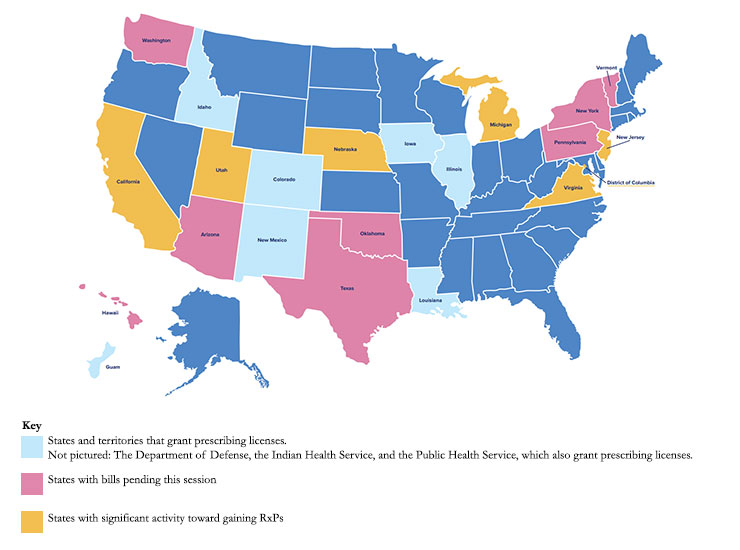
At present, six states plus the U.S. territory of Guam, the Department of Defense (DoD), the Indian Health Service (IHS), and the Public Health Service (USPHS) allow qualified psychologists to prescribe psychotropic medications. (Psychologists who work in the DoD, IHS, and USPHS must be licensed in one of the six states that allow prescriptive authority.) While these settings differ culturally and in their practice requirements, psychologists who prescribe in one or more of them see universal benefits to this form of service, as do the patients and providers they work with.

In a general sense, psychopharmacology training helps psychologists to better understand the “bio” part of the biopsychosocial model, providing the education and training to understand how medical conditions and medications may interact with psychological conditions, explained Derek Phillips, PsyD, MSCP, a clinical neuropsychologist and prescribing psychologist in the department of neurology at Sarah Bush Lincoln Health Center in central Illinois.

In turn, this knowledge allows them to communicate more effectively with physicians and other medical personnel and hence be viewed more fully as integrated members of health care teams, he said.

On the practice front, prescriptive training has the potential to greatly expand access to mental health care in underserved areas, added Anthony Tranchita, PhD, a prescribing psychologist and public health service officer at the IHS Bemidji area office in rural Minnesota who provides telehealth services to Native Americans living on tribal lands in Minnesota, New Mexico, South Dakota, and Wisconsin.

Without him or someone like him, tribal members who need psychotropic medications face long waiting lists and extensive travel times once they finally get in to see someone, Tranchita said. “Patients and providers in these smaller communities really appreciate having a specialist provider who has both knowledge about psychotropic medications and a psychological background,” he said. “Telehealth is an optimal way to deliver these services, because not every reservation or IHS clinic needs a full-time prescriber,” he added.

Happily for patients, prescribing psychologists can also serve as “one-stop shops” for their treatment needs—providing patients with sound, empirically validated psychotherapy, while also having practical knowledge about their medications and how to manage them safely and effectively, said Shearer.

“Not only do patients love not having to find a different prescriber when they’re doing therapy with me,” he said, “but the referral source—usually a primary-care provider—is pleased that they only have to talk with one person about the patient’s behavioral health progress.”

The fact that prescribing psychologists are trained in a judicious form of medication management is another big plus for patients, noted Eric Silk, PhD, MSCP, director of the clinical psychopharmacology program at Idaho State University. “It may sound odd, but a goal of our training is actually to deprescribe—to teach our students to avoid using medications when it isn’t necessary and to understand when medications are being used inappropriately,” he said.

An example is Virginia Page Haviland, PhD, a prescribing psychologist who treats chronic pain patients at the Boise and Nampa branches of Saint Alphonsus Medical Center in Idaho.

Patients who see her often come in with a “laundry list of medications,” usually a combination of opioids, muscle relaxants, sleep medications, and pills for depression and anxiety. “The more medications they’re on, the more sedation and other side effects they experience,” she said. In turn, that situation leads to maladaptive behaviors such as failing to exercise and sleeping too much, which makes their physical pain and emotional health worse. “It’s a vicious cycle that a prescribing psychologist and other health care professionals can help stop by intelligently weaning them off unnecessary medicines and introducing healthier behaviors,” Haviland said.

Her work with these patients also underscores the ongoing importance of her training as a clinical psychologist, Haviland added. She takes time to educate patients about why she and the team are thinking of reducing or changing their medications; she also supports them through the rational deprescribing process.

“I’m able to partner with patients, support them, and make sure they understand the ‘why’ behind what I’m recommending,” she said.

Expanded training opportunities

While prescribing psychologists tend to be passionate about their work, prescriptive training is intense. Licensed psychologists, and in some cases doctoral students, must complete a 2-year master’s degree in clinical psychopharmacology, pass a national standardized exam, and complete hundreds of hours of approved supervised clinical experience on top of standard supervision requirements. While states differ in their clinical experience requirements, the model officially recommended by APA, for example, consists of at least 400 hours of supervised prescribing experience with at least 100 unique patients, as well as an 80-hour supervised practicum on physical assessment.

This is one reason that even in states that offer this license, there is still a scarcity of these providers—only 225 nationwide. But that, too, is poised to change, thanks to increased training opportunities. There are now six sites that provide training for a master of science in clinical psychopharmacology (MSCP): the California School of Professional Psychology at Alliant International University in San Francisco; The Chicago School’s online program; Drake University in Des Moines, Iowa; Fairleigh Dickinson University in Teaneck, New Jersey; Idaho State University in Meridian, Idaho; and New Mexico State University in Las Cruces, New Mexico. Other potential training programs are in the wings as well, including one at Antioch University Seattle and another at Southern Illinois University in Carbondale, Illinois.

These programs are starting to attract greater numbers of students. For instance, more than 80 students are currently enrolled in Fairleigh Dickinson’s MSCP program, compared with 60 or fewer 3 years ago. This increase is likely the result of burgeoning legislative activity around the issue, said Phillips, who is executive director of the program. “The demand has been astronomical—there are waiting lists every semester to get into the program,” he said.

Technology has only added to this growth, enabling students to take many of these programs virtually, said Idaho State’s Silk. During the pandemic, his program had to pivot to online education and telehealth for clinical services, but that turned out to be a plus: The program now offers both synchronous and asynchronous training, enabling more flexibility for working psychologists to pursue the degree.

New training developments promise to further expand the prescribing pipeline. For example, The Chicago School is spearheading a movement that allows graduate students to earn the MSCP along with their 5-year doctoral degree, a training model facilitated by the passage of the 2014 legislation. Students from more than 15 doctoral programs across the country have enrolled in the program.

Students who have this training can look forward to benefits after graduation, advocates also argue. Gaining an MSCP significantly expands job opportunities not only in health care settings—including as chiefs of medical staffs and teams—but in prisons, military bases, community mental health centers, and private practice. What is more, the training has the potential to increase the diversity of providers, and with it to provide culturally appropriate care to more patients, Rodriguez-Menendez said. To this end, more than half the students and 43% of the faculty at The Chicago School represent minority populations, including students who are African American, Latinx, Asian American, and LGBTQI+.

To support this diversity on a practical level, the MSCP program builds in supports to help students earn these degrees, Rodriguez-Menendez said. For example, each student receives a clinical psychopharmacology fellowship of $17,500, cutting the cost of the degree nearly in half. They also understand that the degree brings greater earning potential: Starting salaries for prescribing psychologists in the DoD and IHS are between $125,000 and $130,000, compared with the average midcareer salary for nonprescribing psychologists of $99,600, according to the Bureau of Labor Statisticsopens in new window.

“It might seem counterintuitive that students with heavy financial aid debt would increase their debt loads even further,” Rodriguez-Menendez said, “but students in the program understand the potential career and compensation benefits of receiving this additional education and training.”

Legislative activity

In terms of RxP legislation, long-standing networking is starting to pay off. While advocacy can be a long, slow process—it took Illinois 20 years to pass its prescribing law—recently introduced legislation will probably move a lot faster thanks to the fact that important potential partners are finally seeing the validity of arguments about the value of prescriptive authority, Rom-Rymer noted.

A key example is the National Alliance on Mental Illness (NAMI), the influential grassroots mental health organization. Until 2014, it had vociferously opposed prescriptive authority for psychologists because of its long-standing relationship with psychiatry. But strong networking in Illinois and Washington state has changed that dynamic: After years of working to build relationships with NAMI Illinois, Rom-Rymer is now on its board of directors, where she is publicly supporting the growth of prescriptive authority for Illinois psychologists. And in Washington state, NAMI Washington cosponsored RxP legislation this year, the result of ongoing reciprocal advocacy between that organization and the Washington State Psychological Association, Shearer said.

State legislators are likewise being swayed by the practical aspects of the prescriptive authority argument, Silk noted. Because of the immense need for mental health services in his state—35 of Idaho’s 44 counties are considered rural—legislators there not only passed the bill in 2017, but the state is funding the Idaho State University training program.

There are larger potential growth areas for prescriptive authority, as well. For one, Division 55 is moving to make prescriptive authority a specialty within the American Board of Professional Psychology (ABPP), work that began after APA recognized clinical psychopharmacology as its newest specialty in 2020, said Phillips, who chairs the division’s ABPP committee. Division 55’s proposal has already made it through ABPP’s affiliation committee and is moving to the next step—a vote by the ABPP board of trustees in June 2023. If approved, it will move to the formal application phase and would be implemented upon passage.

Action is happening on the international front as well. Psychologists in at least 15 other countries are now enthusiastically involved in the prescriptive authority movement, said Rom-Rymer, who consults with many of these groups. As evidence of this growth, the first international prescriptive authority conference was held via Zoom in February 2021.

Psychopharmacology legislative activity

States where psychologists can prescribe medication appear in light blue below. The states with pending bills are in pink and those with significant activity toward RxPs are gold. Not pictured are the entities that grant prescribing licenses: the Department of Defense, the Indian Health Service, and the Public Health Service.


Continued opposition, growing support

Despite these gains, organized psychiatry continues to mount strong opposition to prescriptive authority, promoting disinformation that psychologists receive minimal training in the area and that the profession is unsafe, despite facts and data to the contrary. For example, in the 30 years that psychologists have been prescribing in the military, there hasn’t been a single documented adverse event as a result of inappropriate or harmful prescribing, Rodriguez-Menendez said. In addition, The Trust liability insurance for prescribing psychologists is only about $100 higher than it is for nonprescribing psychologists, further highlighting their good safety record, he noted.

That said, it’s also true that psychologists have been practicing for a much shorter time and in far fewer numbers than psychiatrists, a fact that leaves Saint Alphonsus Medical Center psychiatrist Abhilash Desai, MD, unsure of whether to endorse prescriptive authority on a global scale. His experience working with and mentoring Haviland, however, leaves no such uncertainty.

“Dr. Haviland is intelligent, thorough, and conscientious,” he said. “She has a great grasp of all the basics of psychopharmacology—of the medicines and their risks and benefits and all the nuances of successful outcomes,” such as including patients in decision-making and monitoring their progress. In addition, he said, she brings a profound understanding of psychological and social factors into patient care.

“Prescriptive authority is an experiment, but we need to learn from it,” he said. “And we have to show whoever needs to be shown, that a lot of positives are happening because of it.”

Primary-care doctors and family physicians are even more enthusiastic about psychologists’ growing involvement in the area. Keith Petersen, DO, a family medicine physician who works with Shearer in a family medicine practice at the Madigan Army Medical Center, said that when Shearer started working there, “it became pretty clear, pretty quickly that he is an expert in his field.” As a result, the practice asked Shearer to become a core faculty member; he now teaches psychopharmacology to family medicine residents.

In terms of patient care, Shearer provides the kind of comprehensive behavioral health treatment that family and primary care physicians can’t fully provide given the huge need, Petersen added.

“Prescribing psychologists are very well trained, they’re improving access, and they’re very safe providers,” Petersen said. “It would be thrilling if Washington state allowed trained psychologists to prescribe.”

Clinical psychopharmacology programs

It can be difficult for students to find out about MSCP training opportunities. Interested doctoral students can join professional societies such as APA’s Society for Prescribing Psychology (Division 55opens in new window), which offers discounted membership to students (for more information, contact membership chair Nicole Bereolos.

In addition, prospective students can contact the psychopharmacology training programs directly:

Recommended Reading

Speaking of Psychology

Subscribe to APA’s audio podcast series highlighting some of the most important and relevant psychological research being conducted today.

Subscribe to Speaking of Psychology and download via:

Appleopens in new window
Apple podcast logo

Spotifyopens in new window
Spotify logo

You may also like