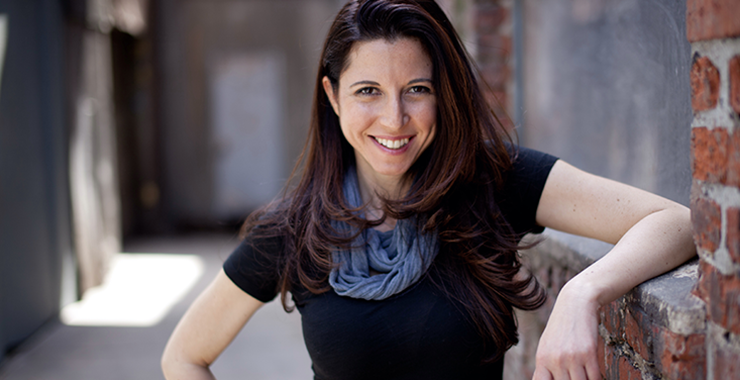
Neuroscientist and clinical psychologist Heather Berlin, PhD, MPH, does what many of her colleagues do: she treats patients and conducts research. But she has broadened her career to carve out time to host TV shows, guest star on podcasts, and interview celebrities.
Berlin, an associate clinical professor of neuroscience and psychiatry at the Icahn School of Medicine at Mount Sinai in New York, has worked with big names including Neil deGrasse Tyson, Bill Nye the Science Guy, Jason Sudeikis, Chelsea Handler, and Deepak Chopra. Her science communication work has taken her all over the world, from meeting people with extraordinary skills for Discovery Channel’s Superhuman Showdown to cocreating and hosting a science-comedy show at the Edinburgh Festival Fringe. Behind the scenes, she also works to incorporate scientific insights into film, television, and popular culture to help normalize mental health issues and educate the public about how the brain works.
The Monitor spoke with Berlin about the power of science communication, what she has learned so far, and what she thinks is the next big thing in neuroscience.
How did you get your start as a public science communicator?
Growing up, I was interested in both science and the arts, including painting and theater. It’s always been a passion of mine to get on a stage and connect with people. But science was my No. 1 passion, so I homed in on that. For years, I was doing basic and clinical research in neuroscience and psychiatry.
At some point in my career, I started giving talks at scientific conferences and events for the public. After one panel discussion, I got a call from a Discovery Channel talent agent. They wanted to fly me to London to audition to host a show called Superhuman Showdown. I got the part, took off work, and went on the road with a film crew for 6 weeks across the United States, Europe, and the Bahamas. I had never shot a TV show before, so I was just learning on the fly.
From there, it was kind of a snowball effect. I hosted a show called Science Goes to the Movies on PBS, where we reviewed films from a scientific perspective. I also got involved behind the scenes with the Science and Entertainment Exchangeopens in new window, a program at the National Academy of Sciences where we work to infuse science into films, television, and mainstream culture.
One thing I’ve learned is that connecting up with celebrities is a great way to get the word out about science and mental health. I’ve worked with Neil deGrasse Tyson on his podcast, StarTalk. One popular StarTalk episodeopens in new window featured Ted Lasso cocreators Jason Sudeikis and Brendan Hunt. We talked about therapy and the psychology behind the show, which was actually inspired by Michael Pollan’s book How to Change Your Mind. I’ve also publicly talked with Olympic skier Lindsey Vonnopens in new window about her mental health struggles.
What do you hope to accomplish through science communication?
When I first got started, there were all these really interesting discoveries happening in the world of neuroscience and mental health, but they were often buried in scientific journals. I wondered: How can we get the word out, both to help people understand how their brain works and to improve awareness and acceptance of mental health and neurological issues? I wanted to do that in a way that didn’t just seem like boring science, but where people feel like it actually pertains to them and can help them in their lives.
How do you integrate your research and clinical work into your science communication efforts?
I was inspired by the British neurologist and writer Oliver Sacks, whom I was fortunate to get to meet a few times. In his communication, he took a humanistic approach and used clinical examples to help people understand phenomena occurring in the brain. So, when I’m speaking to the public, I like to talk about specific patient cases and how these examples demonstrate the impact of the research.
What are you most excited about in neuroscience right now?
Psychedelic psychotherapy is going to change things a lot. I’ve seen it with my own patients, where nothing else has worked—they’ve tried everything—and then they try ketamine treatment for depression or MDMA for posttraumatic stress disorder and we see significant improvements. Next in the pipeline is psilocybin, the psychedelic component in “magic mushrooms,” for the treatment of anxiety and depression. Having worked in psychiatry for many years, I’ve never seen anything that has had such an immediate impact, especially for treatment-resistant patients.
The other thing that is really exciting is new neurotechnology: the development of organoids—basically growing brains in a vat. Researchers are seeing neurons grow and start to communicate with each other, and our field may get to a point where we can even repair damage in the brain. Neural implants that deliver deep brain stimulation are also very promising for treating obsessive-compulsive disorder, depression, and other conditions.
What do you hear most about psychology and neuroscience from the public?
I learn a lot about what people really think and care about from conversations with audience members after my public talks. I did a couple of stints at the Edinburgh Festival Fringe, where I worked with a lot of comedians. Some of the people who seem most outgoing or happiest on the outside struggle the most with things like anxiety and depression. My takeaway is that you never know what another person is going through. Even people who you think have it all together might be suffering internally. Just assume everybody has something challenging going on in their lives and give people some leeway, because their behavior might not be about you.
The other thing that people are really concerned about is treatment. Everyone could use some therapy—that can always be helpful. But people are also curious to learn more about alternative treatments, like psychedelic psychotherapy and neural implants, in cases where the first-line treatments don’t work. My hope is that, in the future, these types of alternative treatments will be affordable and accessible to everyone who needs them.