Precarious manhood
The life span of men is lower in countries where the belief that manhood is “hard won and easily lost” is more widespread, suggests a study in Psychology of Men & Masculinities. Researchers surveyed 33,417 college students from 62 nations regarding their gender beliefs and attitudes. Agreement with statements such as “It is fairly easy for a man to lose his status as a man” and “Some boys do not become men, no matter how old they get” were aggregated to create country-level precarious manhood belief scores. The researchers found that belief in precarious manhood was positively correlated with men’s health risk-taking behaviors, as well as negative health outcomes, such as liver cirrhosis and transportation accidents. Men in countries with high precarious manhood beliefs live an average of 6.69 fewer years and 6.17 fewer healthy years compared with men living in countries with low precarious manhood beliefs. These findings held even after controlling for country-level variations in women’s life expectancy, human development, access to physicians, and gender equality. DOI: 10.1037/men0000407opens in new window
Fake news peer pressure
According to research in the Journal of Experimental Psychology: General, people share fake news so that they are not excluded from their social circles. Researchers examined the interactions among 51,537 dyads of Twitter users—at least one of whom shared a news story from one of 974 fake news sites the researchers had identified—during two different spans of time. Researchers found that if one user in the dyad shared a fake news story but the other did not, their level of interactions fell off over time, regardless of political ideology. However, the effect was stronger for politically right-leaning users. Additional experiments with 178,411 online participants revealed that the social costs were higher for not sharing fake news versus other content and that those who were more concerned about fitting in socially were more likely to share fake news. DOI: 10.1037/xge0001374opens in new window
Men wanting children date younger women
Research in Evolutionary Behavioral Sciences indicates that men’s desires to either have or not have children determine their preferences for their partner’s age. Researchers examined responses from 605,743 single, heterosexual online dating app users between 20 and 50 years old. The participants reported the number of children they had, whether they wished to have children (or more children), and the importance of the age of their prospective partner. The researchers found that men who wanted children (or more children) rated age as more important and preferred younger dating partners than those who did not want children (or more children). In contrast, women’s preferences for partner age showed little association with having or wanting children. DOI: 10.1037/ebs0000274opens in new window
Sound sleep
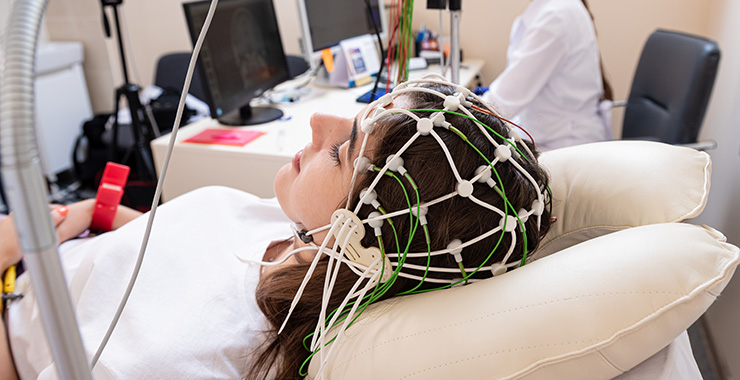
A study in the Journal of Applied Psychology indicates that a device that monitors brain waves and attempts to modify them with auditory tones can improve sleep quality and work outcomes. Researchers tested the effectiveness of a headband-mounted device that measures electroencephalography (EEG) data from a sleeping person and delivers precisely timed auditory tones to enhance the individual’s slow brain wave patterns, thereby inducing deeper sleep. They randomly assigned 81 participants—employees from two organizations in the United States—to the treatment-first condition (sound on) or the control-first condition (sound off). Each leg of the study lasted 10 days, during which participants reported on sleep duration and sleep quality in the morning and work performance measures in the afternoon. The researchers found that the acoustic stimulation improved sleep and positively impacted engagement, performance, and citizenship behaviors (such as helping a coworker) at work the following day. Treatment did not improve counterproductive workplace behavior. Notably, the stimulation did not work for older participants because slow brain wave patterns become less common across the life span, providing fewer opportunities to enhance them. DOI: 10.1037/apl0001077opens in new window
Breath work bests meditation
People who use intentional, cyclic breathing techniques experienced greater improvements in mood as compared with those practicing mindfulness meditation, indicates research in Cell Reports Medicine. Researchers divided 108 participants in the United States into four conditions: meditation, cyclic sighing, box breathing, or cyclic hyperventilation. Participants practiced their assigned technique for 5 minutes every day for 1 month. The researchers collected information on trait anxiety and sleep disturbance at the study’s beginning and end. Participants filled out daily surveys about state anxiety, affect, heart rate, respiration rate, and sleep quality. All four groups experienced significant improvements in mood along with reductions in situational anxiety and negative affect. The cyclic sighing group, however, showed the greatest improvement in mood, while the mindfulness meditation group showed the least. Additionally, the three breath work groups demonstrated more positive physiological changes, including lower respiratory rate, compared with the mindfulness meditation group. DOI: 10.1016/j.xcrm.2022.100895opens in new window
50% more Parkinson’s
Parkinson’s disease is about 50% more prevalent than previously thought, with clusters appearing in certain regions in the United States, according to a study in npj Parkinson’s Disease. Researchers identified Parkinson’s disease incidence in a single year (2012) across five cohorts in the United States and Canada. The five cohorts contained data for 6.7 million person-years of adults 45 and older and 9.3 million person-years of those 65 and older. The reported incidence rate of nearly 90,000 cases annually for people 65 and older is higher than previously reported incidence rates of 40,000–60,000 new cases per year based on smaller studies. Incidence rates increased with age throughout the study. At all ages, incidence was higher in men than women. Clusters of counties with higher Parkinson’s incidence emerged in Illinois, Kentucky, West Virginia, Tennessee, southern California, southeastern Texas, central Pennsylvania, and Florida. DOI: 10.1038/s41531-022-00410-yopens in new window
Depression and cardiovascular disease
According to a study in the Journal of the American Heart Association, young adults experiencing depression are more likely to have cardiovascular disease (CVD) or poor heart health. Researchers examined data from 593,616 adults in the United States who participated in a self-reported, nationally representative survey conducted between 2017 and 2020. The survey included questions about whether they had a depressive disorder, how many poor mental health days they experienced in the past month, and whether they had CVD, as indicated by heart attack, stroke, or chest pain. Compared with participants who reported no poor mental health days in the past 30 days, participants who reported up to 13 such days had a nearly 1.5 times higher risk of having CVD, while those with 14 or more poor mental health days had more than double the risk. In addition, participants with depression had higher odds of experiencing cardiovascular health risk factors, such as high blood pressure and diabetes. DOI: 10.1161/JAHA.122.028332opens in new window
Anxiety can start in the heart
Anxiety can cause the heart to race—and in mice, a racing heart can also cause anxiety. A study published in Nature found that when researchers artificially raised the heart rate of mice, the rodents became less willing to explore their environment in risky situations, a behavior typically indicating anxiousness. Using a brain tissue labeling technique, the researchers then found that the posterior insula cortex brain region was responsible for interpreting signals from the heart. Switching off this brain region in additional experiments reduced the mice’s anxiety, suggesting the brain and body work hand in hand to produce emotional states like anxiety. DOI: 10.1038/s41586-023-05748-8opens in new window
What makes a paper replicable?
According to a study in the Proceedings of the National Academy of Sciences, the replication success of scientific research is linked to research methods, citation impact, and media coverage—but not university prestige or citation numbers. Researchers trained a text-based machine learning algorithm with 388 previously replicated psychology studies. They then used the algorithm to predict the likelihood that a paper would be successfully replicated using a sample of 14,126 studies published since 2000 across six top-tier psychology journals, each representing a different subfield. They found that authors’ cumulative publication number and citation impact were positively related to replication success. However, the prestige of an author’s university and the paper’s citation rate were unrelated to replicability. Furthermore, nonexperimental papers were around 1.3 times more replicable than experiment-based papers. Personality psychology papers were the most replicable, while developmental psychology papers were the least replicable. The former is a field with a relatively smaller number of laboratory experiments, which are difficult to replicate, while the latter field struggles to find sufficient populations to study under controlled conditions. Media attention was negatively related to replication success, perhaps, the researchers suggest, because popular media prefers to report on unusual or unexpected findings. DOI: 10.1073/pnas.2208863120opens in new window
$500,000 is the new $75,000
According to a study in the Proceedings of the National Academy of Sciences, money does appear to buy happiness—at least for most people—up to annual earnings of $500,000. This contradicts a similar study about a decade ago that showed happiness improved with earnings up until about $75,000. Researchers asked 33,391 working adults in the United States with a median household income of $85,000 to report happiness levels at random times throughout the day. They found that, for most people, happiness does improve linearly with earnings, up to $500,000 a year—although few participants earned that much. However, for about 15% of people, additional income failed to improve their sense of well-being once they crossed the $100,000 threshold. Meanwhile, the happiest 30% of participants experienced feelings of well-being that sharply accelerated once their earnings exceeded $100,000. DOI: 10.1073/pnas.2208661120opens in new window
Psychedelics go deeper
According to a study in Science, psychedelic drugs activate a special kind of serotonin receptor inside neurons that promotes the growth of new neural connections, but endogenous serotonin molecules cannot access the internal receptors. Researchers experimented with chemically tweaking psychedelic drugs to alter the ease with which the compounds could cross into neurons. They found that the compounds’ ability to enter neurons was correlated with their ability to spur the growth of new neural connections. Unlike psychedelics, serotonin made by the brain is too polar to cross the membranes that surround neurons. Thus, it does not initiate the growth of new neural connections, suggesting that the molecule may not be the endogenous ligand for the intracellular receptors. The researchers believe their findings may inform the discovery of new drugs for depression and other disorders. DOI: 10.1126/science.adf0435opens in new window
What are the biggest relationship red flags?
The answer: being apathetic or being “gross,” according to undergraduates. In a study in Personality and Individual Differences, researchers reanalyzed previously collected data from a sample of 285 undergraduates in the United States. Participants rated 49 possibly deal-breaking traits of potential mates for short-term and long-term relationships. Based on statistical criteria, relationship warning signs were grouped into six categories: addicted, apathetic, clingy, gross, promiscuous, and unmotivated. For long-term relationships, both men and women rated being apathetic as the biggest deal-breaker, followed (in order) by being gross, clingy, addicted, unmotivated, and promiscuous. Men rated all of the red flags—except being gross—as greater deal-breakers in long-term relationships than in short-term ones. Women responded with similar ratings—except being promiscuous, which they rated a deal-breaker regardless of relationship length. Older women perceived being gross and unmotivated as slightly bigger deal-breakers than did younger women. There were no age-related differences for men. DOI: 10.1016/j.paid.2022.112048opens in new window
The bounds of compassion
Young children are willing to help others in distress unless a personal reward is at stake, suggests research in Royal Society Open Science. Researchers asked 285 4- and 5-year-olds in Australia to complete a puzzle game to earn a sticker as a reward. The children played alongside puppets or adults, who were deliberately given inadequate puzzle pieces to complete the task and who vocalized emotional distress about being unable to receive a sticker. Whenever the children had extra pieces, they always shared. However, when they had just enough pieces to complete their own puzzle, the children did not share, whether they were paired with the puppet or the adult, and even when they were explicitly told they could share or that they were on the same team as the puppet or adult. Children were more likely to share puzzle pieces only if they had already been given a sticker upon immediately completing the task and hence were not at risk of losing their reward. DOI: 10.1098/rsos.221448opens in new window
ECT, lithium, and clozapine
According to research in Nature Communications, electroconvulsive therapy (ECT), lithium, and clozapine may reduce suicide rates in adolescent men with severe mental illness. Researchers analyzed registry data from 21 Swedish regions between 2016 and 2020. During this period, 200 individuals ages 15 to 19 and 432 individuals ages 20 to 24 died by suicide in these regions. Excess suicide rate in this study was measured by comparing suicide levels among 15- to 19-year-olds and 20- to 24-year-olds in the same region. Regions with comparatively lower excess suicide rates among 15- to 19-year-olds had higher usage of ECT, lithium, and clozapine in the treatment of younger patients. No correlation between suicide rate and region was observed for young women. The findings are consistent with results observed in adults. DOI: 10.1038/s41467-023-36973-4opens in new window