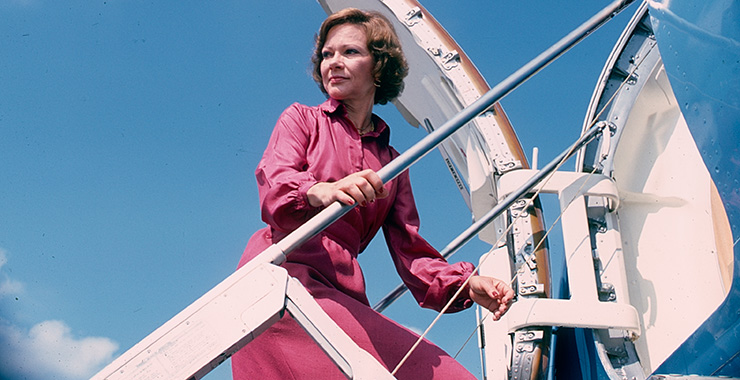
Unlike many mental health advocates, Rosalynn Carter didn’t have a family member who struggled with mental illness. Instead, the former first lady, who died Nov. 19, 2023, at age 96, began learning about people’s challenges on the road, when her husband Jimmy Carter was campaigning to be Georgia governor in 1966 and 1970.
One of the people she met was a woman who worked the night shift at a cotton mill and then returned home to care for her daughter with a mental illness. The woman was exhausted trying to manage both responsibilities, she told Carter.
The woman’s story and others like it spoke deeply to Carter, propelling her to become a lifelong champion for people with mental illness and their families. She did that through policy and educational efforts with the goals of reducing stigma, increasing public awareness, and creating better systems of care for people with mental illness and their families. These efforts were not just aspirational, they had serious clout: Carter testified and lobbied for progressive legislation that later passed, including the Mental Health Systems Act of 1980 and the Mental Health Parity and Addiction Equity Act of 2008. She created influential, ongoing national organizations such as The Carter Center’s Mental Health Task Force and the Rosalynn Carter Institute for Caregivers. She wrote books on improving mental health care systems and supporting caregivers, and even launched an international fellowship to educate and support journalists covering mental health issues to do so with more depth, accuracy, and compassion (see How Rosalynn Carter made change for more).
Carter was a trailblazer in at least two key ways, said former APA president Nadine J. Kaslow, PhD, ABPP, who has served on the Mental Health Task Force since 2001 and worked closely with Carter on a regular basis. The first was placing the consumer front and center. “She really listened to people who had experiences with mental illness and to their top priorities for what would make a better mental health care system,” said Kaslow.
The second was her knowledge that real change takes time, particularly with a difficult issue like mental illness. “She understood that you had to be in there for the long haul, that you had to build bridges and coalitions,” said Kaslow.
Carter was also ahead of her time in recognizing caregiver needs, noted former APA president Carol Goodheart, PhD, who presented on a cancer expert panel convened by Carter and awarded Carter an APA Presidential Citation in 2010 for her decades of work to improve mental health services and support caregivers.
“She was a person who had genuine empathy and wanted to take action to help others,” Goodheart said.
Many other APA leaders have been part of Carter’s network of experts. These include, among others, former APA presidents Dorothy W. Cantor, PsyD, who served for many years on the Institute for Caregivers board; Susan H. McDaniel, PhD, ABPP, who gave a talk at a family caregiving seminar at The Carter Center that later became part of a book; and Jennifer F. Kelly, PhD, ABPP, who served on the board of Project Interconnections (now called 3 Keys), an Atlanta-based organization Carter helped organize that finds housing and services for people who are homeless and have serious mental illnesses.
While visiting The Carter Center in 2017 to award Carter another APA Presidential Citation, former APA president Antonio E. Puente, PhD, noticed the qualities that many say made Carter so effective.
“It was plain to see her simplicity, integrity, generosity, and gentleness as a human being, and the clarity and persistence in her vision for those affected by mental illness,” he said.