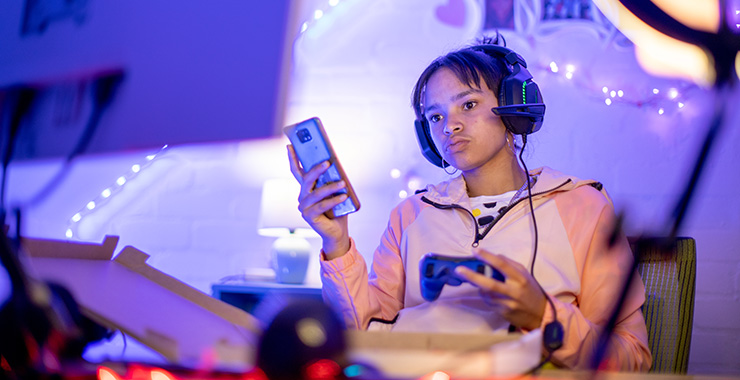
Dan’s interest in video games started as many do: at age 5, playing educational games. By age 8, his parents—a working couple in rural Switzerland—tried to cap his PlayStation use to an hour a day.
As a teen, though, Dan, a pseudonym used in a 2021 case study, was spending upwards of 12 hours daily playing mostly first-person shooter games. He rarely saw peers outside of school and lost an apprenticeship because of perpetual tardiness and fatigue (Niedermoser, D. W., et al., International Journal of Environmental Research and Public Health, Vol. 18, No. 4, 2021opens in new window).
It wasn’t until his next job stipulated psychotherapy that Dan and his parents began to view, and treat, his habit as an addiction. According to the study authors, who saw him at their private psychiatric practice, the approach worked: After 8 months of weekly cognitive behavioral therapy, Dan had reduced his gaming time to about 1.5 hours a day and, uniquely, hadn’t “shifted” his addiction to another vice, like pornography viewing or tobacco use, the authors say. Dan’s depression and insomnia—which were severe and moderately severe, respectively, at the start of therapy—receded, too.
Dan’s story—boy overcomes gaming disorder, a condition that the World Health Organizationopens in new window added to the International Classification of Diseases (ICD-11) in 2018—is presented in the researchers’ paper as a success. “In this case,” they wrote, “the patient could keep and probably successfully finish his apprenticeship. This is of major importance for his later prospects to live a self-determined and independent life.”
But not all mental health professionals would tell stories like Dan’s the same way. Some might point to Dan’s often absent parents as the root of the issue and so the first place to intervene, while others might see Dan’s case as a missed opportunity to nurture a young person’s passion and sense of competence. Until arriving in therapy, Dan thought of gaming not as a problem but as a path to wealth and fame. And some psychologists bristle at the term gaming “disorder” or “addiction,” which they see as more about politics than science. “A problematic diagnosis may promulgate policy efforts that restrict free speech and minors’ rights, without appreciable positive impacts,” a group of psychologists wrote in a 2018 APA Division 46 (Society for Media Psychology and Technology) statement expressing concern over the WHO’s classification.
Despite the concept’s controversy, some people’s gaming habits are significantly conflicting with multiple areas of their life, which calls for clinical attention. Many of them, however, are finding balance with psychologists’ interventions—or in some cases, simply time, said Zsolt Demetrovics, PhDopens in new window, chair of the Centre of Excellence in Responsible Gaming at the University of Gibraltar.
“The nature of development of most addictive disorders is progressing to worse, and that’s not clearly the situation in the case of video games,” he said. While more longitudinal research is needed, “there are signs of a much higher proportion of spontaneous recovery or just normalization of gaming after a more problematic period of gaming than in the case of other disorders.”
[Related: Developing games that build skills and promote well-being]