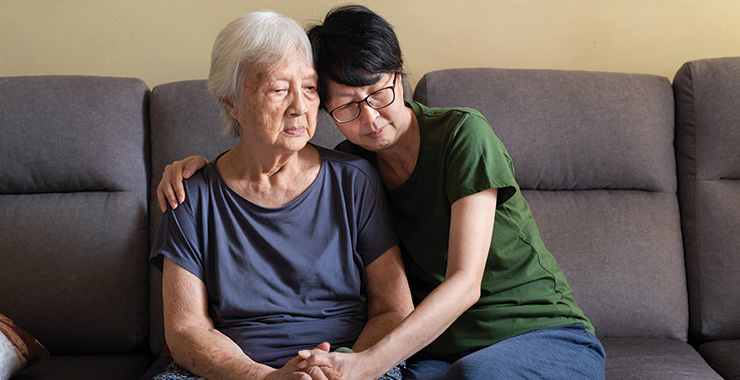
As dementia progresses, adult children may also struggle with the sense of feeling forgotten once the parent no longer recognizes them, said Kristie Wood, PhD, a palliative care postdoctoral research fellow at the Colorado University Anschutz Medical School in Aurora. Prior to her own ongoing research, Wood said, there had been “no qualitative research on the effects of being forgotten.”
In one study, Wood interviewed 12 adult caregivers of mothers with late-stage dementia. Despite their knowledge about dementia, some study participants shared that their mother’s lack of recognition made them feel invalidated, according to her findings (Journal of Pain and Symptom Management, Vol. 67, No. 5, 2024opens in new window).
“They would say, ‘I just feel like if I were more important to her, or I had done more, then she would remember me,’” Wood recounted. They also told Wood that she was the first person to ask about these feelings, enabling them to share “how earth-shattering it was” to feel forgotten.
Therapists can work with patients to name and better understand the underlying stressor, the essential ambiguity of ambiguous loss, Boss said. Together they can think through ways to process the duality of what’s happening—to strive to hold two opposing thoughts in mind.
As one example, Boss said, a daughter whose mother has dementia can learn to think, “She’s here and she’s also gone. She knows me and she doesn’t know me.”
Given the inherent isolation involved, therapists should encourage adult caregivers to bring someone with them to their appointments, whether that’s a sibling, a neighbor, or a member of their faith group, Boss said. In that way, they can begin to build their own community of support to tap outside of therapy sessions. For that reason, peer gatherings such as an Alzheimer’s support group can be highly beneficial, she said.
Midlife adults will feel sadness as well, as they watch dementia pull their elderly parents further and further away cognitively, Boss said. But it’s the underlying ambiguous loss that causes this grief, which she describes as “frozen” grief.
“With death, grief is not frozen,” she said. “It’s still sad. But you can let your body and mind and heart grieve because your loss is verified. With ambiguous loss, you’re stuck. You’re stuck in a limbo of not knowing.”