At issue
The criminalization of homelessness through city camping bans


Supreme Court rules that public property camping bans do not violate the Eighth Amendment’s constitutional protections against cruel and unusual punishment
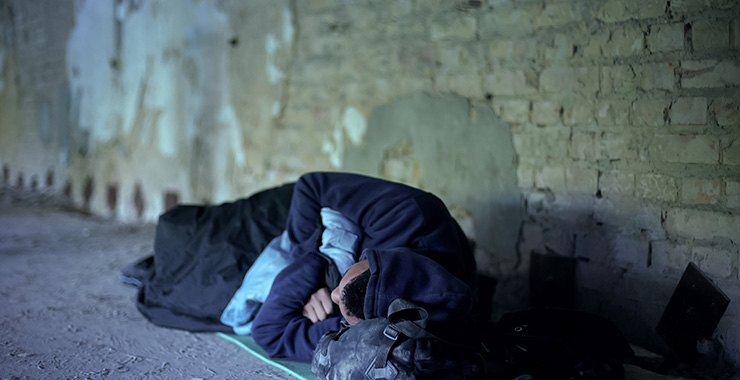
In City of Grants Pass, Oregon v. Johnson (2024), the U.S. Supreme Court upheld an Oregon city ordinance prohibiting people who are homeless from using blankets, pillows, or cardboard boxes for protection within city limits. This type of ordinance is often described as a camping ban, banning sleeping outdoors anywhere except designated areas. The justices also noted that public property camping bans do not violate the Eighth Amendment’s constitutional protections against cruel and unusual punishment.
According to news reports, Grants Pass has no public shelters for unhoused individuals and families. These ordinances are not unique to Oregon but have grown in major metropolitan cities throughout the United States. According to a 2019 report from the National Homelessness Law Center, 72% of the 187 cities surveyed had at least one law enforcing public camping bans, a 92% increase from 2006. Cities across the globe have noticed an increase in homelessness over the past 5 years. According to the National Alliance to End Homelessness, more than 580,000 individuals experienced homelessness in the United States in 2022.
The City of Grants Pass, Oregon decision further facilitates the criminalization of homelessness, poverty, and mental illness. Justice Sonia Sotomayor’s dissenting opinion notes, “the majority [opinion] focuses almost exclusively on the needs of governments and leaves the most vulnerable in our society with an impossible choice: Either stay awake or be arrested.” Enforcement of camping bans might exacerbate the circumstances leading to arrest. A 2022 article by Krista Craven, PhD, and colleagues in the Journal of Community Psychology (Vol. 50, No. 4)opens in new window describes the experiences of unhoused individuals in Greensboro, North Carolina. Many participants reported being harassed by law enforcement, including with harsh or excessive force. They also reported contact with law enforcement for sleeping, loitering, or sitting/lying down in public that led to citations or arrests. The authors pointed out that access to legal counsel for unhoused individuals who violate city ordinances is not guaranteed in many states, which may contribute to the cycle of incarceration observed in those who are unhoused.
Access to housing and safe living conditions is a fundamental human right. Moreover, Justice Sotomayor states in her dissent, “Sleep is a biological necessity, not a crime.” According to the APA Resolution on Ending Homelessness adopted in 2021, the APA reaffirmed its commitment to advancing research and practice to ending homelessness. Advocates can continue educating policymakers and the public to highlight the structural and systemic issues contributing to homelessness and advocating for support services and resources. For example, several U.S. cities have developed homeless courts aimed at providing unhoused individuals with access to resources and the ability to remove their current or pending charges (and potentially prior convictions) from the record.
Cities like Indianapolis and Los Angeles have piloted universal basic income programs that grant individuals unconditional monthly cash payments regardless of their housing or work status. Results from Denver’s initial 1-year pilot programopens in new window of 800 participants found that recipients reported improved feelings of financial well-being, and 45% of the original unhoused participants lived in their own house or apartment by the end of the pilot program.
More research is needed on the individual and societal implications and sustainability of universal basic income programs. There are better solutions to ending homelessness than continuing to contribute to the criminal legal system.
Subscribe to APA’s audio podcast series highlighting some of the most important and relevant psychological research being conducted today.
Subscribe to Speaking of Psychology and download via: