skip to main content

How psychological science can advance racial equity

Psychologists, with their deep understanding of human behavior and diversity science, are in a prime position to dismantle systemic barriers and promote justice

APA Style leaf logo Cite This Article in APA Style
Key, A. P. (2024, November 1). How psychological science can advance racial equity. Monitor on Psychology, 55(8). https://www.apa.org/monitor/2024/11/psychological-science-racial-equity

man and woman having a conversation

Key points

  • The field of psychology has historically contributed to systemic racism, but efforts are being made to address past shortcomings.
  • Psychological science offers unique insights and tools to advance racial equity by leveraging rigorous research and evidence-based practices.
  • Building inclusive and diverse environments requires intentional efforts and ongoing commitment.

The pursuit of racial equity is not just a moral imperative; it is a complex challenge that spans all aspects of society, including professional fields. Historically, the field of psychology has contributed to systemic racism by providing evidence that upheld and sometimes justified prevailing racial systems. However, the field now stands at a pivotal moment, uniquely equipped with the tools and knowledge necessary to drive meaningful change.

In recognition of this, APA has taken steps to address its past shortcomings. In October 2021, the organization apologized for its role in perpetuating systemic racism and committed to more than 50 actions designed to foster a more equitable and inclusive discipline. This commitment underscores the crucial role that psychological science must play in the broader effort to achieve racial equity.

Psychologists, with their deep understanding of human behavior and diversity science, are in a prime position to dismantle systemic barriers and promote justice. By leveraging psychological science and evidence-based practices, psychologists can help promote a more just society. Psychological research can also equip professionals in diverse workplace settings with knowledge and resources to advocate for and advance racial equity in their organization. The integration of psychological insights into equity, diversity, and inclusion (EDI) initiatives is essential—for advancing racial equity and ensuring that psychology itself continues to evolve and contribute to fairness for all.

Making the case for equity

Maryam Jernigan-Noesi, PhD, a licensed counseling psychologist and CEO of Jernigan & Associates, Inc., a psychology and educational consulting firm, said psychological science makes us more aware of racism’s impact at the individual, institutional, and systemic levels. This awareness is a crucial first step in creating greater equity.

“Psychological science allows us to understand the ways in which we can and should be approaching equity in systems. Understanding attitudes and beliefs that may lead to biases and discriminatory policies allows us to create interventions to disrupt these outcomes,” she said.

Applied science tells us that within organizations, the status quo often feels comfortable and familiar. But psychological science shows that working toward racial equity offers significant benefits that drive organizational success and employee well-being.

Studies find that deep-level diversity—differences in knowledge, skills, and values—positively impacts team creativity and innovation, especially in supportive environments. This research suggests that equitable practices, which cultivate an inclusive and supportive atmosphere, can unlock the full potential of diverse teams, leading to ideas and solutions that might otherwise remain untapped (Wang, J., et al., Academy of Management Proceedings, Vol. 2017, No. 1, 2017opens in new window).

Promoting racial equity can also diminish implicit biases and stereotyping. Psychological science reveals that targeted interventions, particularly ones that go against racial stereotypes, lessen implicit racial preferences and contribute to a fairer and more inclusive organizational culture (Lai, C. K., et al., Journal of Experimental Psychology, Vol. 143, No. 4, 2014opens in new window).

And equity is closely linked to employee well-being and engagement. APA’s 2023 Work in America survey highlighted that workplaces prioritizing emotional and psychological well-being see improvements in employee satisfaction and engagement. Creating equitable environments where employees feel supported and valued leads to a more motivated and productive workforce, reducing turnover and enhancing organizational stability.

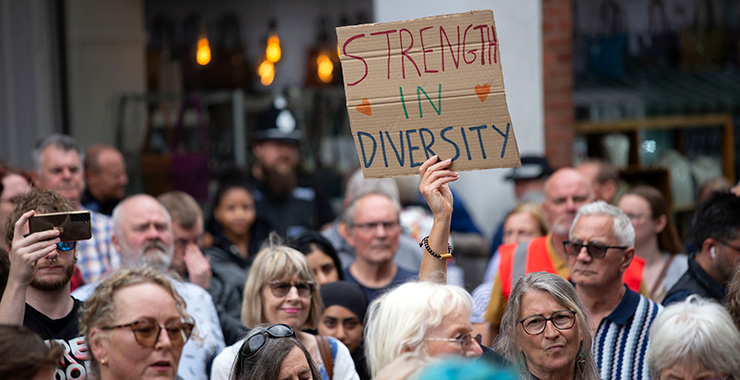
crowd of people with someone holding up a cardboard sign

Building inclusive environments

The health care field continues to face challenges in achieving racial and ethnic representation. According to the Association of American Medical Colleges, White people represent most active physicians at 56%, while Asians account for 17%, Hispanics 6%, and Black or African Americans 5%. The picture is even more stark in the field of psychology. APA reports that 81% of psychologists are White, with only 8% identifying as Hispanic, 3% as Asian, and 5% as Black or African American.

Creating an inclusive and diverse professional environment requires more than surface-level interventions. A recent study explored strategies for increasing racial and ethnic diversity in academic health science institutions, with a focus on psychological well-being (Alegría, M., et al., JAMA Health Forum, Vol. 5, No. 2, 2024opens in new window). Researchers used a mixed-methods approach to uncover practices that promote equity in recruitment, retention, and promotion. Through surveys and in-depth interviews, researchers addressed mental health challenges faced by people from underrepresented racial and ethnic minoritized (URM) groups, including the impact of perceived racism on their psychological well-being. The study emphasized the importance of emotional and social support systems, as well as mentorship, in creating inclusive environments that nurture the mental and emotional health of URM faculty.

Many organizations use diversity training programs to create more inclusive workplaces, but research shows these programs have limitations. They often fail to achieve meaningful change because they are not integrated into organizational practices, said Alexandra Kalev, PhD, an associate professor of sociology and chair of the Department of Sociology and Anthropology at Tel Aviv University, and coauthor of Getting to Diversity: What Works and What Doesn’topens in new window.

“Diversity training sessions are short, usually lasting from 2 hours to 2 days, tops. In terms of a learning perspective, it’s not a good learning tool, especially when it comes to biases that are ingrained since the day we’re born,” she explained.

Short-term training can backfire by making biases more prominent in the minds of participants. This emphasis can inadvertently reinforce the very stereotypes the training aims to diminish (Dobbin, F., & Kalev, A., Anthropology Now, Vol. 10, No. 2, 2018opens in new window). Prodiversity messages can also seem threatening to White employees, who may anticipate unfair treatment or discrimination against their group. This perception can result in resistance against diversity initiatives and affect their support for these programs (Dover, T. L., et al., Journal of Experimental Social Psychology, Vol. 62, 2016opens in new window).

To foster genuine inclusivity, Kalev advocates for more systemic approaches. She points to strategies that engage managers in problem-solving and as active leaders of change, exposure to different groups, and social accountability. Encouraging managers to participate in voluntary diversity initiatives such as college recruitment programs and mentoring can help them see themselves as diversity champions. This approach can also lead to increased representation of marginalized groups in management roles.

Expanding contact among diverse groups, such as through self-managed teams and cross-training, also helps break down stereotypes and promote equitable hiring and promotion. These practices encourage diverse groups to work toward common goals, reducing bias (Kende, J., et al., Social Psychological and Personality Science, Vol. 9, No. 8, 2017opens in new window).

Susan Fiske, PhD, a social psychologist and professor emerita at Princeton University who studies contact theory, said, “When we’re interdependent, we have to coordinate. We have to go beyond our stereotypes of each other’s groups and make sense of the things that don’t fit our expectations.”

There is ongoing debate in the field of psychology about how well intergroup contact works, but proponents agree that certain parameters have to be in place to promote equitable communication. “It has to be under the right conditions,” Fiske said. “You can’t bring in one group from on high visiting another group on low and say they’re going to get along. [Contact] has to be meaningful.”


Understanding lived experiences

The lived experiences of communities of color can offer valuable insights for allies and coping strategies for people of color. Last year, a committee of experts in social and industrial and organizational psychology, diversity science, and other fields released the report Advancing Antiracism, Diversity, Equity, and Inclusion in STEMM Organizationsopens in new window. It consolidates current research on antiracism, diversity, equity, and inclusion (ADEI) in science, technology, engineering, mathematics, and medicine (STEMM) organizations and offers advice to stakeholders on integrating ADEI into their existing systems.

The report includes interviews with Black STEMM professionals who shared their experiences of bias and racism. It also details the cognitive, emotional, and physiological consequences of bias for historically marginalized groups in STEMM and explores coping strategies such as code-switching (adjusting behavior to fit the dominant culture) and resilience (adapting and bouncing back from adversity).

The report encourages stakeholders to address racial bias both individually and systemically, create inclusive environments, foster peer relationships, and advocate for systemic change to effectively integrate ADEI into their organizations.

diverse group of people taking a selfie

Help for people of color

A promising coping strategy is self-affirmation, or short, positive statements either regularly said aloud to oneself or written and placed in highly visible locations. Laura Morgan Roberts, PhD, an organizational psychologist and associate professor of business administration at the University of Virginia’s Darden School of Business, emphasized the importance of this strategy in addressing discriminatory behaviors. “Self-affirmation interventions can help mitigate stereotype threat by stabilizing individuals’ sense of self,” Roberts explained.

Self-affirmation works by allowing people to reflect on their core values and personal strengths, which can buffer against negative stereotypes and biases. This reflective process helps maintain a positive self-image even in challenging or threatening situations (Tabibnia, G., Neuroscience & Biobehavioral Reviews, Vol. 115, 2020opens in new window).

Self-affirmation could also help lessen prejudice and improve relations among different groups. Researchers found that when people feel their self-worth is threatened, they may react with prejudice, but asserting self-worth can make one less defensive and more open-minded. This approach works for both personal identity threats (like negative feedback) and social identity threats (like group criticism) (Badea, C., & Sherman, D. K., Current Directions in Psychological Science, Vol. 28, No. 1, 2019opens in new window).

Roberts said this and other theories from psychological science consider the impact of our thoughts, interactions, and treatment of others “and keeps the human experience front and center.”

How psychologists can move the needle

One specific area in which psychologists play a critical role is in addressing and correcting health disparities. “Our training allows us to address mental health issues that often exacerbate physical health disparities,” said clinical psychologist Idia Thurston, PhD, professor of health sciences and applied psychology and associate director of the Institute for Health Equity and Social Justice Research at Northeastern University in Boston.

She explained how psychologists can advocate for comprehensive, equitable health care solutions by forging strong partnerships with health care providers, community organizations, and policymakers. As a pediatric psychologist, Thurston has also learned a lot from the legal, health, and sociology fields. These collaborations are vital in creating effective and culturally responsive care models. “It’s going to require working across multiple disciplines to push this needle,” she said, stressing the need for innovative partnerships to address systemic issues and ensure holistic solutions (Proctor, R. W., et al., American Psychologist, Vol. 74, No. 3, 2019).

Thurston also called on psychologists to engage in advocacy, influencing health policies that promote equity (Cohen, K. R., et al., Canadian Psychology / Psychologie canadienne, Vol. 53, No. 3, 2012opens in new window). She pointed out that psychologists’ skills lend themselves well to advocacy work, although this avenue is often underemphasized in traditional training.

Thurston would also like to see health equity topics integrated into psychology training programs but said it will take systemic change to make this happen.

[Related: Assessing equity, diversity, and inclusion]

Research shows systemic racism affects both patients and staff in health care settings, emphasizing the need for antiracist practices. A 2023 study that explored how racism is experienced and perceived in a children’s psychiatric inpatient unit recommended steps such as structured self-reflection, program evaluation, and open conversations to address and dismantle racism in psychiatric settings (Asuzu, K., et al., Journal of Psychiatric and Mental Health Nursing, Vol. 30, No. 3, 2023opens in new window). Educating future psychologists on these issues ensures the next generation is well prepared to continue the fight for equitable health care.

Best practices for allies

Advancing equity is an effort that requires genuine commitment and actionable steps from allies. A 2023 study examined the ways in which White counseling psychologists can incorporate racial allyship in research, training, clinical, and advocacy work (Hinger, C. L., et al., Journal of Counseling Psychology, Vol. 70, No. 6, 2023opens in new window).

Researchers facilitated focus groups comprising college students of color. They found that building trust is foundational to successful allyship. Allies must show compassion and remain open-minded, avoiding judgment and the pitfalls of a savior complex. Recognizing both the shared humanity and the cultural differences of people of color fosters a deeper connection and mutual respect. And respecting boundaries and acknowledging the limits of one’s own understanding are critical steps allies can take to build and sustain trust.

Engaging in antiracist action is another crucial aspect. Allies are encouraged to stand up against racism and racial discrimination, even when doing so involves personal sacrifice. Leveraging their privilege, they can amplify the voices of people of color and expose racial harm. Sharing resources, whether professional opportunities or inclusive spaces, helps correct the historical and contemporary disparities faced by communities of color.

The study also highlights the importance of developing critical awareness in effective allyship. Allies must understand their own cultural identities and the privileges they hold. By continuously educating themselves on issues of racism and privilege, they can better support colleagues and communities of color. Allies should actively work to challenge ingrained racist beliefs and behaviors, both in themselves and within their networks.

Designing research that matters

Here are some steps that psychologists can take to make their research more equitable and inclusive:

APA’s Inclusive Language Guide helps ensure that research is free from bias and stereotypes. By following these recommendations, scientists can write reports that are not only scientifically rigorous but also culturally sensitive, respecting and reflecting the diverse experiences of all communities.

Further reading

Qualitative research methods in organizational psychology
Dolder, E., et al., In Willig, C., & Stainton-Rogers, W. (Eds.), The SAGE handbook of qualitative research methods in psychology, Sage Publications, 2017

Implicit and explicit prejudice and interracial interactionopens in new window
Dovidio J. F., et al., Journal of Personality and Social Psychology, 2002

Research as resistance: Naming and dismantling the master narrative of “good” scienceopens in new window
Rogers, L. O., et al., American Psychologist, 2024

Epistemic exclusion: A theory for understanding racism in faculty research evaluationsopens in new window
Settles, I. H., et al., American Psychologist, 2024

Recommended Reading

Speaking of Psychology

Subscribe to APA’s audio podcast series highlighting some of the most important and relevant psychological research being conducted today.

Subscribe to Speaking of Psychology and download via:

Appleopens in new window
Apple podcast logo

Spotifyopens in new window
Spotify logo

You may also like