skip to main content
Conversation

Yalda T. Uhls studies how media affects kids’ mental health

A developmental psychologist unites researchers, entertainment industry professionals, and young people to shape media that helps youth thrive

APA Style leaf logo Cite This Article in APA Style
Medaris, A. (2025, January 1). Yalda T. Uhls studies how media affects kids’ mental health. Monitor on Psychology, 56(1). https://www.apa.org/monitor/2025/01/yalda-uhls-media-mental-health

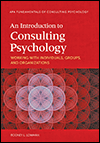
Dr. Uhl

Growing up the daughter of scientist-professors, Yalda T. Uhls, PhD, was allowed to watch only 1 hour of TV a week. Naturally, she went on to build a robust career in media—first as a Hollywood film executive and then as a developmental psychologist studying how media affects kids’ mental health.

“I always say I paid my parents back because I’ve been obsessed with media my whole life,” said Uhls, a first-generation Iranian American. “It’s typical: You keep your child away from something, and that’s all they want to go to.”

Now the founder and CEO of the nonprofit Center for Scholars and Storytellers (CSS) at the University of California, Los Angeles (UCLA), Uhls is channeling that obsession to validate and nurture young people’s mental health. She launched the center in 2019 to unite the entertainment industry, psychology researchers, and youth to focus on developing stories that promote the health and well-being of children and adolescents.

Among its many initiatives, CSS facilitates research-driven workshops for companies (including film, TV, and gaming) looking to create more authentic and inclusive content. CSS also develops tip sheets for media creatives and conducts original research on such topics as how supplementary “wraparound content” for TV shows to deepen engagement can support youth well-being.

“We work with young people to try to help these creators and companies think about their impact and integrate research and insights into their storytelling in a way that feels right to them,” Uhls said. The results have been wide-reaching: In 2023 alone, the center completed six major studies, and its report Teens and Screensopens in new window made headlines in 32 countries across four continents.

Uhls talked to the Monitor about why she left film to pursue developmental psychology and how psychological research improves storytelling.

What sort of stories spoke to you when you worked in film?

The first movie that I got made was Mi Familia (“My Family”), an intergenerational story of Mexican American immigrants starring Edward James Olmos and Jimmy Smits. At the time, I connected it to my immigrant experience, but [mostly] I was young and fighting for something I was passionate about.

I ended up getting fired from that studio because my boss didn’t like the script. But that movie got into the Sundance Film Festival, it played at the White House, and it was nominated just recently to be in the National Film Registry.

So now I point to it very proudly as something that I did early on in my career showing that I cared about representation, that I cared about places that weren’t normally presented in regular media. At that point, there was a lot less diversity in film and television. The gatekeepers were overwhelmingly male and overwhelmingly White.

Why did you leave entertainment to study psychology?

My last executive job was as a senior vice president at MGM, but at that point, I realized that the movies I liked were not the movies the studios were going to make. I got pregnant and decided to take a break. Once I had children, I ended up becoming obsessed with child development and interested in exploring a career in research. Once at UCLA, I started studying how media impacts the social-emotional learning of tweens and teens.

I thought I was throwing away my Hollywood career, but I ended up bringing my past forward to my graduate school work. Because my job in film had been to think about how to create a compelling story, I applied that skill set to my research.

Two studies I did for my dissertation earned attention from the international press. One showed that while kids’ TV shows were all about kids wanting to be famous, young viewers didn’t actually value fame that much, and it won the National Dissertation Prize from the Society for Research in Child Development. The other one found that kids who spent 5 days in an outdoor nature camp with no screens got better at reading emotions in other people’s faces than kids who stayed in school for those 5 days.

Because telling stories with science and sharing science with people who could use it is something I’ve always cared about, I also brought a strong ability to translate research to my developmental psychology career.

How did the Center for Scholars and Storytellers come together?

I started my PhD program 2 years after the iPhone was launched, so I was one of the early scientists studying how digital and social media impacts youth, and there was so much interest from parents and the public.

There was all this incredible research out there that would be helpful for the people who create stories for youth. I also realized that academics sit in one silo, storytellers sit in another silo, and adolescents aren’t really listened to. I was in a position to bridge these three worlds.

So, I launched the center as a bootstrap concept. Initially, it was just me, unpaid. I had volunteers and students. Today, it’s 12 full-time employees, and we work with YouTube, Disney, Warner Bros., Activision, and other media companies. We are in all these spaces where young people use media to learn and play and grow.

What are some of the center’s biggest successes?

One of the first initiatives we worked on was thinking about how storytellers should evolve the way they represent boys and men. We created a tip sheet that we released in 2020, and people loved it. One writer told me, “I’m taking it out when I’m pitching stories to different companies.”

This year, I met with PBS Kids, and they showed me a new show, Tiny Time Travel, with two boy characters. They were friends with girls, they were friends with each other, and they were vulnerable and talked about their emotions. They weren’t just playing Mortal Kombat. I thought it seemed a lot like our tip sheet, and when I asked who the writer was, I learned it was that writer.

PBS Kids was so excited, they brought me in to share this research and tip sheet with all their producers.

We also have an intensive youth internship program called Youth Media Representation where we train teens how to do their own research and share it with storytellers so that storytellers can integrate the lived experiences of adolescents into their content.

One group of students looked at relationships on screen and asked teens what kind of relationships they wanted to see. They found that teens don’t want to see relationships only focused on heterosexual sex. They wanted to see more platonic relationships, and more asexual relationships.

We wanted to see if that would hold nationwide with a larger sample of 1,500 teens and found that teens across the country agreed: They did not want to see as much sex; they wanted to see more platonic friendships and relationships, same-sex relationships and friendships, and 40% said they wanted to see asexual relationships.

That study went viralopens in new window—32 countries reported on it, Jimmy Kimmel poked fun at the findings, and The Onion parodied it. Our headline was “Nomance, not romance.” That was a great example of listening to the youth we worked with, letting them explore what they were interested in, and then sharing that research widely. We just released the 2024 version of this study and found similar results.

Recommended Reading

Speaking of Psychology

Subscribe to APA’s audio podcast series highlighting some of the most important and relevant psychological research being conducted today.

Subscribe to Speaking of Psychology and download via:

Appleopens in new window
Apple podcast logo

Spotifyopens in new window
Spotify logo

You may also like