skip to main content

Unsung heroes on the cancer journey

Psychologists help caregivers process anxiety, depression, and anticipatory grief
APA Style leaf logo Cite This Article in APA Style
Huff, C. (2025, March 1). Unsung heroes on the cancer journey. Monitor on Psychology, 56(2). https://www.apa.org/monitor/2025/03/mental-health-cancer-caregivers

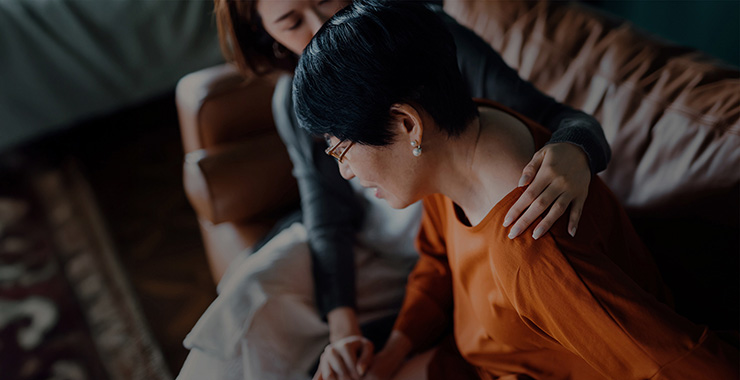
woman comforting another woman

Key points

  • Cancer caregivers are disproportionately women, providing an average of 33 hours per week of often complex medical and nursing tasks.
  • Along with perhaps coping with their own anxiety and depression, these caregivers may be processing their own anticipatory grief.
  • Therapists can teach caregivers how to mitigate stress responses through mindfulness techniques and building their sense of meaning and purpose.

Behind the 2 million Americans diagnosed each year with cancer stands a hidden and sometimes overwhelmed population: their caregivers.

These caregivers, disproportionately women, are closely tied to the cancer patient—as a spouse, an adult child, a parent, a close friend—and often lack prior medical expertise. Along with their loved ones, they have been thrust into an intense medical crisis where the stakes are potentially life-threatening.

“Caregivers witness suffering from the sidelines; they often feel powerless,” said Allison Applebaum, PhD, a professor at and director of the Center for Caregiving at the Icahn School of Medicine at Mount Sinai in New York City. “They are given enormous responsibilities. They are often tasked with serving as a champion for patients and doing everything under their control to help patients get the care that they need while also grappling with understandable fears of patient mortality.”

Moreover, she added, “Many caregivers will live for years in this dual reality of trying to make the most of a present time with an awareness that a loved one with an advanced cancer likely is not going to be alive in 10 years.”

New cancer diagnoses have continued to increase over the past 2 decades, from 1.4 million in 2004 to an estimated 2 million by 2024, driven primarily by an increasing and aging U.S. population. One analysis found that as many as 6 million U.S. adults provide care for a loved one with cancer, nearly 60% of them female, with related responsibilities that consume about 33 hours weekly on average (Kent, E. E., et al., Seminars in Oncology Nursing, Vol. 35, No 4, 2019opens in new window). The prevalence of mental health symptoms among caregivers is significant, with 42% describing symptoms of depression and nearly 47% reporting anxiety, according to a systematic review involving 30 studies (Geng, H., et al., Medicine, Vol. 97, No. 39, 2018opens in new window). Various factors, including being female, the caregiver’s sleep quality, and the duration of caregiving, among others, were associated with caregiver depression. Sometimes, the strain can become overwhelming. Suicide attempts run 28% higher among individuals whose spouses have cancer, and suicide deaths are 47% higher compared with adults whose spouses are cancer-free (Liu, Q., et al., JAMA Oncology, Vol. 10, No. 10, 2024opens in new window).

The skills and responsibilities required of caregivers have only increased, as more medical care is provided in the home, said Applebaum, who recently authored Stand By Meopens in new window about caregiving, including her role in her father’s care. Nearly half describe performing complex medical and nursing tasks without any prior preparation (Cancer Caregiving in the U.S.: An Intense, Episodic, and Challenging Care Experience, National Alliance for Caregiving, 2016opens in new window). If these caregivers aren’t adequately supported, they will be less able to help their ill loved ones, Applebaum said.

Along with the emotional impact, caregivers frequently face financial costs. One analysis showed that 8% of cancer caregivers take off at least 2 months from work following their loved one’s diagnosis (de Moor, J. S., et al., Journal of Cancer Survivorship, Vol. 11, 2017opens in new window). More commonly, they juggle caregiving around jobs, parenting, and other responsibilities without any compensation. A recent AARP survey found that more than 7 in 10 voters did back more supportive caregiving policies, such as paid family leave and a tax credit of up to $5,000 (U.S. Voters’ Views on Support for Family Caregivers, AARP Research, 2023opens in new window).

But at this point, there is scant infrastructure to identify caregivers and get them the mental health support they need, caregiving researchers and psychologists said. When caregivers do seek out therapy, psychologists can assist them in various ways, from teaching mindfulness and other strategies to ease anxiety to fostering a broader sense of resilience and finding meaning and purpose at such a difficult time, said Yasmin Asvat, PhD, a clinical psychologist in the Supportive Oncology program at RUSH MD Anderson Cancer Center in Chicago.

If the patient’s prognosis worsens, therapists can assist caregivers as they support their loved ones through the transition from active treatment to palliative and hospice care while managing their own anticipatory grief, Asvat said. “We are working to help our caregivers recognize that this is really, really hard,” she said. “And you can do hard things; you can survive hard things; you can navigate hard things.”


Strain on cancer caregivers

Caregivers may also be required to suddenly assume many of the logistics of daily life previously handled by their loved one, whether that’s additional parenting responsibilities or figuring out who will mow the lawn, said Maija Reblin, PhD, a social and health psychologist and co-program leader of cancer population sciences at the University of Vermont Cancer Center in Burlington. “Oftentimes cancer diagnoses come out of the blue, and so the caregiving role also comes out of the blue.”

Peter Gee’s husband had initially experienced a few symptoms, including insufferable headaches and insomnia. Then Jeff Helfgott started suddenly vomiting one day in late 2018. The couple first headed to urgent care and then to the emergency room, where physicians ordered a CT scan. “That’s when they noticed the mass in his brain,” Gee said.

That November day began Gee’s nearly 2-year caregiving journey, supporting his 56-year-old spouse through surgery and other treatment for an aggressive form of brain cancer while holding down his job at a nonprofit organization to retain the couple’s health insurance. “Jeff thought he was going to be part of the 5% that would make it past 5 years,” Gee recalled. “And I thought it was the apocalypse that was happening and that the world was ending.”

In some scenarios, the medical crisis tightens the bonds between caregivers and patients, Reblin said. “You are brought sometimes closer together—it brings into focus what’s important, and that can be really beneficial,” she said. In others, she said, “There’s this crucible effect of whatever is going on in that relationship, this intensifies it. If you have a shaky relationship, it’s probably going to be a little bit shakier.”

Mental health symptoms may also differ. When researchers assessed caregiver-patient dyads following a patient’s diagnosis with an incurable cancer, caregivers reported more symptoms of anxiety, while patients were more likely to describe depressive symptoms (Jacobs, J. M., et al., Annals of Behavioral Medicine, Vol. 51, No. 4, 2017opens in new window). In addition, caregivers have described becoming more physically worn down as cancer treatment stretches on, with difficulties ranging from fatigue to loss of appetite to weight loss (Stenberg, U., et al., Psycho-Oncology, Vol. 19, No. 10, 2010opens in new window).

They also may skimp on their own preventive health care needs, Reblin said. “They are not doing their mammogram. They are not getting their teeth cleaned. They are not checking out that weird lump.”

Cultural considerations

For caregivers, daily challenges can be shaped by broader logistical and cultural factors, such as where they live and their family heritage. Reblin, who has been developing a web-based app and other caregiving support tools, describes the burden as particularly daunting for caregivers who live in rural areas (Supportive Care in Cancer, Vol. 30, 2022opens in new window). For those whose driving abilities are affected, transportation to appointments and other medical care can be more difficult, she said. They may lack access to other nearby resources—everything from food delivery to the availability of home health nurses.

Plus, a steely sense of independence can become further isolating, Reblin said. “What we’ve seen is, ‘I don’t like to ask for help. We’ve been doing this on our own; we’re off the grid; we can do this. I’ve got a truck that works fine.’ But that only goes so far.”

The approach to caregiving is also “culturally embedded,” said Ranak Trivedi, PhD, a clinical health psychologist and an associate professor in the Department of Psychiatry and Behavioral Sciences at Stanford University, who is leading research involving South Asian breast cancer survivors and their caregiversopens in new window. In South Asian culture, there’s a collectivist mindset in which people typically rally around someone when they develop a health crisis, she said. But a cancer diagnosis may carry a fair degree of stigma, particularly if it involves female organs, such as breast or ovarian, she added.

Trivedi, who has interviewed U.S. breast cancer patients and caregivers of Indian heritage, said this stigma may influence who caregivers will share news about the diagnosis with across an extended family—some of whom may live in the United States and others elsewhere—thus amplifying that sense of isolation. “There are these layers of secrecy, right? It’s really delicately titrated. Who finds out? When do they find out?”

In addition, because of mental health stigma in Asian cultures, therapy is not common, Trivedi explained. “So, if somebody finds that there’s an Indian caregiver in the clinic, then they should rejoice,” she said. “Because a lot of the battle has already been won. They’re recognizing that mental health is something that they need to focus on.”

Improving support

During the pandemic, individuals were called upon to rapidly assume the care of critically ill loved ones at home, highlighting the importance of caregiving, Applebaum and other psychologists note. They also cite encouraging steps on the legislative front. In 2018, the Recognize, Assist, Include, Support, and Engage (RAISE) Family Caregivers Act was passed to create the nation’s first national family caregiver strategy. Also in recent years, AARP has advocated for passage of the Caregiver Advise, Record, Enable (CARE) Act. The law, which has been approved by more than 40 state legislatures, requires that a caregiver’s name be listed in the patient’s medical record and that the caregiver is also provided instruction about medications, injections, and other medical tasks that will be performed at home.

Still, cancer caregivers continue to fall through the cracks, with most clinicians focused primarily or exclusively on the patient, Applebaum said. She and colleagues conducted a survey of 238 U.S. cancer centers and found that three-quarters reported having at least one caregiver program that provided training on medical/nursing tasks or mental health support. But half of those programs were limited only to information and referral services (Odom, J. N., et al., JAMA Network Open, Vol. 6, No. 10, 2023opens in new window).

To gain a window into a caregiver’s distress, psychologists can use a screening tool such as the National Comprehensive Cancer Network’s Distress Thermometeropens in new window or the Zarit Burden Interview, said Erin Kent, PhD, an associate professor and associate chair for research in the department of health policy and management at the Gillings School of Global Public Health at the University of North Carolina at Chapel Hill. These tools are more often used in research settings but can also be incorporated into therapy, identifying areas of caregiver distress and unmet needs to tailor treatment, Applebaum added.

Caregivers’ ability to cope with the stress of their newfound role rests in part on their degree of resilience, said Asvat, the RUSH clinical psychologist. Resilience may be shaped by external factors, some of which are beyond their control, such as whether they have ties to a supportive community, whether they have access to paid leave and their loved one has affordable health care, or their own personality makeup and coping style, she said. “Oftentimes through that interaction between personality factors and environmental influences, we can develop these personalities that can thrive under stress or thrive under pressure,” Asvat said.

Caregiver resilience can be bolstered through a combination of cognitive behavioral therapy and mindfulness techniques, said Asvat, citing a systematic review looking at resilience interventions (Joyce, S., et al., BMJ Open, Vol. 8, 2018opens in new window). Therapists can help patients learn deep breathing techniques and other approaches to better regulate the body’s stress response so that “caregivers feel like they can influence how their body is feeling at any given moment,” she said.

If their loved one’s cancer advances, psychologists can support caregivers through this difficult transition, particularly if their hopes and goals diverge from the patient’s, Asvat said. For instance, the caregiver may advocate for their loved one to pursue one more line of treatment, when the patient prefers to spend their remaining time free of medical care.

Therapists can also help caregivers recognize that resisting the transition to end-of-life and hospice care may be connected to anticipatory grief and work with them to reframe their role during this final phase of caregiving, Asvat said.

In that reframed role, she said, the caregiver is helping their loved one “maintain a sense of agency and autonomy over this process. Letting them know that respecting their choice is central to you and matters to you. And that you will do the work of managing your anticipatory grief.”

Finding meaning

In her clinical practice, Applebaum has repeatedly witnessed opportunities for positive growth along this difficult journey. “I have lost count of the number of caregivers who have said to me, ‘Dr. Applebaum, I have found my voice because of caregiving. I used to be so shy and so meek.’ Or caregivers who said to me, ‘I had no idea I was so strong—I could not have imagined actually going through this.’”

Caregivers can find meaning even when their relationship with the patient was strained prior to their illness, Applebaum said. “They’ve said to me, ‘The relationship didn’t improve. But I will always know that I took care of her. And when she’s gone, I’m not going to live with regrets.’”

In 2014, Applebaum and her colleagues at Memorial Sloan Kettering Cancer Center in New York City, where she was then based, adapted Meaning-Centered Psychotherapy—developed by William Breitbart, MD, to assist patients with advanced cancer—into a psychosocial intervention to assist caregivers to remain connected to meaning and purpose (Translational Behavioral Medicine, Vol. 12, No. 8, 2022opens in new window).

The Meaning-Centered Psychotherapy for Cancer Caregivers approach, Applebaum stressed, “never negates suffering” related to caregiving, whether that may be anticipatory grief or the difficulties involved with putting one’s life on hold. Over the course of seven sessions, caregivers complete readings and homework exercises, which guide discussions in subsequent sessions. Some of the themes include focusing on one’s identity before and after becoming a caregiver, identifying attitudinal and creative sources of meaning, and how to tap those sources of meaning moving forward.

Clinicians referred Gee to this approach after his husband’s brain cancer emerged in another part of the brain. “I knew that the first tumor would grow back,” he said. “I didn’t think a second tumor would pop up someplace else. I just lost it.”

As Gee worked through the sessions, he began to envision what his life might look like after Helfgott died. Influenced by the clinicians that he had met, Gee considered changing careers and going to nursing school, which he initially discounted as a crazy idea. “But the modality gives you permission to totally think outside the box.” And his husband, he said, immediately embraced the idea. Gee started on his nursing degree shortly after Helfgott died in 2020.

For too long, the heavy lift of assisting these cancer caregivers has been viewed as too costly and overwhelming to address, Kent said. “Once you start looking into it, it’s overwhelmingly obvious how big of a problem it is—no one can argue against the need.”

But Kent and other caregiving experts point to legislative initiatives and therapeutic advances as encouraging signs, an early but long overdue shift that therapists can highlight and build upon in their own practices. “We’re getting to the point,” Kent said, “where there’s so much recognition of the problem now that it’s coming to a critical mass of evidence to do something about it.”

Further reading

Caregiving resources
APA

Documentation of caregivers as a standard of careopens in new window
Applebaum, A. J., et al., Journal of Clinical Oncology, 2021

Family caregiver distressopens in new window
Gallagher-Thompson, D., et al., Hogrefe Publishing Corp., 2023

Meaning-centered psychotherapy for cancer caregiversopens in new window
Applebaum, A. J., & Breitbart, W. S., Oxford University Press, 2024

Recommended Reading

Speaking of Psychology

Subscribe to APA’s audio podcast series highlighting some of the most important and relevant psychological research being conducted today.

Subscribe to Speaking of Psychology and download via:

Appleopens in new window
Apple podcast logo

Spotifyopens in new window
Spotify logo

You may also like