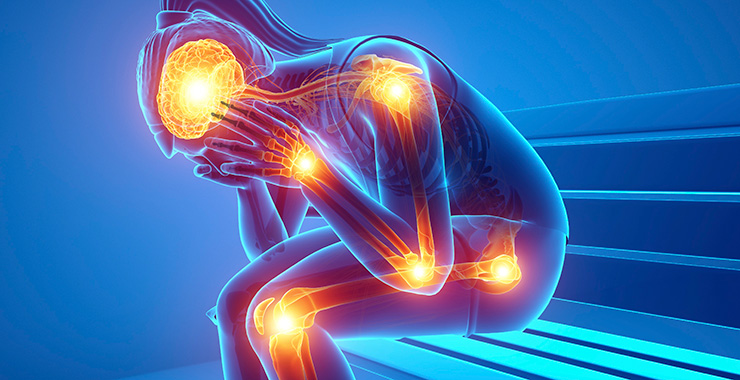

Chronic pain is widespread. More than 1 in 5 American adults experience pain on most days or every day (Yong, R., et al., PAIN, Vol. 163, No. 2, 2022opens in new window). It is expensive, too: A National Academy of Medicine report estimated that chronic pain costs the U.S. economy between $560 billion and $630 billion annually ( Relieving Pain in America: A Blueprint for Transforming Prevention, Care, Education, and Research , National Academies Press, 2011opens in new window ).
A new APA clinical practice guideline for treating chronic musculoskeletal pain highlights the best current evidence for psychological and behavioral treatments for these pervasive conditions. But a lack of sufficient high-quality research on interventions also has psychologists and their colleagues from related disciplines calling for new, rigorous investigations into how to tackle chronic pain.
Chronic musculoskeletal pain is a broad umbrella, covering any pain related to the muscles, joints, and bones, whether linked to a known injury or not.
While some interventions, such as cognitive behavioral therapy and exercise, have strong evidence for improving some types of musculoskeletal pain, the panel that developed the new APA Clinical Practice Guideline for Psychological and Other Nonpharmacological Treatment of Chronic Musculoskeletal Pain in Adults (PDF, 2MB)opens in new window could not recommend other widely used interventions due to insufficient evidence. These interventions may work well, said panel chair Ravi Prasad, PhD, a licensed clinical psychologist and director of behavioral health in the department of anesthesiology and pain medicine at the University of California, Davis School of Medicine, but the research on which the guideline is based contained studies that were often limited by their sample size, lack of sufficient comparison groups, or lack of functional outcome measurements, such as pain’s impact on daily life.
“We were, quite frankly, surprised not to see strong support for many of the therapies that we see our patients benefiting from, at least anecdotally,” Prasad said. “It’s not that there’s a lack of research in these areas; rather, the quality of evidence rating for many of the studies was low.”
For that reason, Prasad and members of the panel—a multidisciplinary group including specialists from psychology, medicine, social work, and nursing, as well as individuals with lived experience—emphasized that clinicians and patients should share decision-making in pain treatment. Patients may benefit from multipronged approaches that simply have not been researched, said Penney Cowan, a panel member and patient advocate who has lived experience with chronic pain. “When you’re living with pain, it’s not one thing that’s going to help you,” she said. “It’s [a] number of different treatments and therapies combined.”
Often, patients are offered surgical solutions that are not necessarily proven to be any more effective than noninvasive treatments, said Daniel Bruns, PsyD, a pain psychologist in Greeley, Colorado, and a member of the guideline panel who has helped to develop medical treatment guidelines for pain for other organizations. The prescribing of opioid medications for chronic pain has also fueled the opioid epidemic, he added, making the development of alternative, evidence-based treatments even more essential.
Ultimately, the panel based the guideline on three systematic reviews that drew from up-to-date research. These included a review of studies on nonpharmaceutical interventions by the Agency for Healthcare Research and Quality (Skelly, A. C., et al., Noninvasive Nonpharmacological Treatment for Chronic Pain: A Systematic Review Update, 2020opens in new window), another on self-management interventions for widespread chronic pain (Geraghty, A. W. A., et al., PLOS ONE, Vol. 16, No. 7, 2021opens in new window), and a third on psychological interventions for chronic pain, excluding headache (Williams, A. C., et al., Cochrane Database of Systematic Reviews, 2020opens in new window).
The evidence for combating pain
Multiple organizations have put out guidelines regarding chronic pain, but the new APA guideline focuses specifically on chronic musculoskeletal pain, the most common chronic pain condition. That was in an attempt to provide clear guidance, homing in on a specific patient population.
“Evidence-based medicine is an increasingly specific process,” Bruns said. “As the science progresses, you try to become more and more focused on particular populations, particular conditions.”
The guideline also focuses specifically on adults and on nonpharmacological treatments, which play a major role in the treatment of musculoskeletal pain. Psychological treatments are among the most promising for chronic pain: In earlier guideline development for the American College of Occupational and Environmental Medicine, Bruns and his colleagues found that of the 15% of treatments supported by evidence, many were psychological.
To create the guideline, the APA panel conducted a scoping review of the literature to identify which reviews to use. It focused on two major outcomes: physical functioning and performance, which includes activities of daily living, impairment, disability, pain-related interference, changes in strength or stamina, and range of motion, and mental health and emotional functioning, which includes anxiety, depression, anger, and pain coping (e.g., fear avoidance, pain catastrophizing, acceptance of pain). In addition, the panel looked at health-related quality of life, pain intensity, patient self-efficacy, patient global impression of change, employment status and disability benefits, and adverse events.
It was important to the panel to focus on studies that looked at functional outcomes, not just physical goals like range of motion, said Kathryn Mueller, MD, MPH, an occupational preventative medicine physician at the University of Colorado School of Medicine and member of the panel. “Historically, medical research has focused on physical outcomes only,” Mueller said. “So, if I can move my back, I’m cured. But maybe I’m not, because I’ve had to change my lifestyle so much that I can’t do the things I want to do.”
Studies that ask patients how they are functioning in different domains—family, work, and recreation, for example—are more informative because they get at meaningful improvements in a person’s life, Mueller added. Functional outcome tools “help the provider start to understand what the patient’s needs are and what is concerning to them,” she said.
Recommended treatments
The guideline panel then organized its recommendations into first and second line based on the strength of the evidence, the balance of benefits versus harms, patients’ values and preferences, and applicability. The guideline is not a practice standard and does not cover all possible effective treatments—only those researched with high-quality methodology with an eye toward functional outcomes.
For people with chronic musculoskeletal pain, the guideline recommends cognitive behavioral therapy (CBT) over treatment as usual or other active interventions. “We’ve known for a while that CBT is effective in treating chronic pain, so having it as a first-line recommendation really makes a lot of sense,” said panel member Cindy McGeary, PhD, ABPP, a licensed clinical psychologist and associate professor in the department of psychiatry at the University of Texas Health Science Center at San Antonio. “CBT includes a lot of different components, such as psychoeducation, relaxation training, cognitive restructuring, and pain action plans, to name a few.”
The panel also found strong evidence to recommend multicomponent self-management interventions over no treatment or usual care. Multicomponent self-management can include a broad range of interventions, often including patient education, physical components such as stretching and movement, and psychological treatment focused on the patient’s feelings, cognitions, and behaviors in response to pain. Interventions might also encourage self-compassion and walk patients through stress-management tools such as relaxation exercises or meditation.
For chronic low back pain, the guideline panel recommends exercise for short-term pain management and psychological therapy for short-, intermediate-, and long-term pain management. Psychological therapy for low back pain can include CBT, progressive muscle relaxation,opens in new window and operant therapyopens in new window, which uses positive reinforcement to help patients meet targets for healthy behaviors such as exercise.
Finally, for patients with osteoarthritis knee pain, the panel found strong evidence for a professionally designed, tailored exercise program, since avoiding exercise can worsen knee pain over time.
The panel also offers second-line recommendations for interventions where the evidence was weaker or dependent on the patient’s situation and preferences. For low back pain, there was some evidence for spinal manipulation and mindfulness-based stress reduction over usual care, attention control (efforts to ignore the pain), and other interventions. The panel also suggests exercise over yoga for low back pain because yoga has a slightly higher risk of harm than exercise; however, if the patient prefers yoga, the panel notes that those risks are low. For shorter-term pain management of low back pain, in one study the panel found tentative evidence for the efficacy of acupuncture. For short and intermediate relief from chronic low back pain, the panel also suggests multidisciplinary or interdisciplinary rehabilitation.
For chronic neck pain, the panel suggests acupuncture, noting that while it was found to improve outcomes over sham treatments, placebo, or usual care in the short and intermediate term, the strength of the evidence was low. Finally, the panel concludes that providers could suggest exercise for patients with osteoarthritis hip pain, though, again, the quality of evidence is low and the benefits small.
The panelists encourage treatment providers to share in decision-making as well as to screen for patients’ psychiatric, psychological, and behavioral histories. Also important, they emphasize, is considering how easy or difficult it is for patients to access treatment, which might be impacted by things such as where they are located—in urban or rural areas—or their gender identity, sexual orientation, socioeconomic status, racial or ethnic identities, and disability status. Providers may also need to modify treatments based on some of these factors.
The guideline also notes that the optimal type of care for chronic musculoskeletal pain is interdisciplinary, wherein an array of health care providers communicate with each other and focus on a shared treatment goal. But the guideline also acknowledges that most pain care is delivered by a multidisciplinary team, a group of providers who treat the same patient from their specific areas of expertise but not necessarily in a coordinated fashion. Systems that allow for sharing treatment notes across specialties and otherwise ease communication can help combat this barrier to ideal care.
A call for more and better research
One of the panel’s most surprising findings was how many commonly prescribed chronic musculoskeletal pain treatments failed to meet the APA guidelines’ standards for recommendation, Prasad said. One oft-used therapy is acceptance and commitment therapy (ACT), which encourages patients to accept their thoughts and emotions about pain and work toward not letting those reactions stop them from making the changes that may help them cope. While a few large studies have found that ACT may hold promise for treating chronic pain, the overall evidence is not strong enough to make a recommendation, the panel determined (Luciano, J. V., et al., PAIN, Vol. 155, No. 4, 2014opens in new window; McCracken, L. M., et al., The Journal of Pain, Vol. 14, No. 11, 2013opens in new window). This does not mean that ACT does not work, the panel emphasized, but that more formal research is needed before the therapy can be recommended.
Other treatments with insufficient evidence include self-management or behavioral therapy for chronic musculoskeletal pain, low-level laser therapy, massage, Qi Gong, Tai Chi, acupuncture, and pain coping skills training for osteoarthritis knee pain. (See the guideline for the full listopens in new window.)
The panel urges providers to consider factors like comorbidities and available resources when suggesting these therapies to patients.
But the lack of evidence for possibly beneficial treatments led the guideline panel to include a call for new studies on all chronic musculoskeletal pain treatments. Prasad said the panel felt the need to point to what is missing: robust comparisons and studies focused on functional pain outcomes that strike a balance between internal and external validity.
Studies in the area generally lack standardization, panel members added. There is no one definition of “usual care,” for example, making it hard to determine what type of treatments an intervention is being compared to. There is also a big disconnect between real-world care for chronic pain, which is typically based on a combination of treatments, and clinical studies, which tend to pull out a single treatment and compare it to one or two comparison treatments, said Cowan, who advocates for more patient input into clinical trials. Moreover, studies of a specific intervention do not always use the same comparative treatments, making it difficult to evaluate effectiveness across studies. Hence, future research needs to take these factors into account and investigate interventions more comprehensively, Cowan said.
“Let’s look at all of it together,” she said, “so we finally have the evidence to say, ‘It’s this combination of treatments and therapies that are going to give the best possibility of a person living with pain to actually become a person again and get out of that patient role.’”