skip to main content
News

Aviation incidents amplify fear of flying, but therapy helps people reclaim the skies

Patients with aviophobia respond well to exposure therapy and cognitive behavioral treatment 

APA Style leaf logo Cite This Article in APA Style
Huff, C. (2025, September 1). Aviation incidents amplify fear of flying, but therapy helps people reclaim the skies. Monitor on Psychology, 56(6). https://www.apa.org/monitor/2025/09/aviophobia-fear-flying

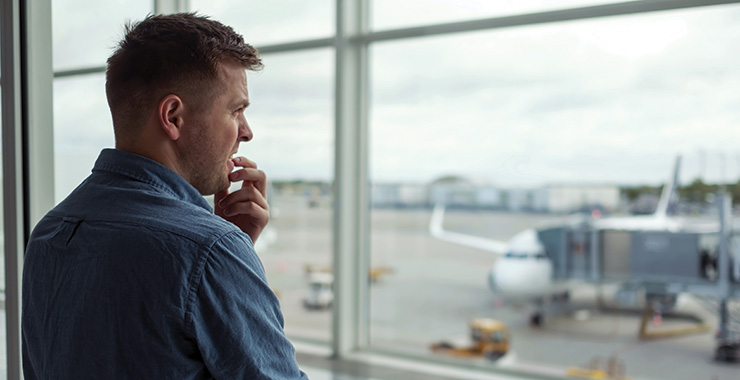
man looking worried at an airport

Key points

  • With exposure and cognitive behavioral treatment, roughly 75% of patients can successfully board their first post-treatment flight, according to one study.
  • Psychologists are using exposure therapy, including talking through anxiety-producing scenarios, to help patients ease their fear of flying.
  • Screening questionnaires can assist with diagnosis, as well as help psychologists develop a fear hierarchy in pursuit of exposure therapy.

In January, a regional airplane on its final approach to Ronald Reagan National Airport collided with a helicopter, killing 67 people. The following month, an airplane flipped onto its back after landing in Toronto. Then in June, a London-bound 787 crashed in India shortly after takeoff, killing all but one of the 242 people aboard. Meanwhile, headlines continue to detail shortages of air traffic controllers at Newark Airport and elsewhere in the United States.

By spring, two-thirds of U.S. adults reported heightened nervesopens in new window, according to a Harris Poll of 2,092 adults. One in 4 described themselves as far more fearful about flying in the wake of these incidents.

While nervous flyers are not uncommon, the diagnostic criteria for aviophobia require that individuals have persistent and excessive fears that often lead to avoidance behaviors, including skipping flying entirely. The common anxiety disorder does not necessarily stem from an unsettling flight experience per se, as it can involve claustrophobia or other fears. But media coverage of worrisome airplane incidents can worsen fears in those already living with aviophobia, according to experts.

To amplify the situation, these recent flying incidents follow an unusually lengthy stretch in the United States without any major airline crashes, said Capt. Tom Bunn, LCSW, a pilot and social worker who launched SOAR, a program to help fearful flyers, more than 4 decades ago.

“Suddenly there’s a change, and people aren’t used to it,” he said. “Meanwhile, our way of getting news has changed, so that when there’s an aviation story and you click on it, you are going to get more aviation stories.”

Studies indicate that as many as 40% of people say they fear flying, though a lower percentage likely fits the formal diagnostic criteria for aviophobia (Clark, G. I., & Rock, A. J., Frontiers in Psychology, Vol. 7, 2016opens in new window). Like fear of heights or spiders and other situational phobias, fear of flying is disproportionate to the danger involved, may involve intense anxiety or panic attacks, and must persist for at least 6 months. Those with the disorder may highly limit or avoid flying entirely for long periods of time, which can lead to difficulties in their personal relationships, career goals, and travel plans.

Making the correct diagnosis is critical, according to clinicians who treat the disorder, because what initially seems to be aviophobia may be rooted in another primary diagnosis, such as agoraphobia. Fortunately, the phobia is highly treatable using exposure therapy along with mindfulness, meditation, and other cognitive behavioral approaches that can help patients better ride out their sometimes overwhelming anxiety. In a study of aviophobia, for example, roughly three-fourths of patients completed their first post-treatment flight, often referred to as the graduation flight, and nearly that many were still flying a year later (Rothbaum, B. O., et al., Behavior Therapy, Vol. 37, No. 1, 2006opens in new window).

Too often, though, people do not seek out the treatment help they need, said clinical psychologist Stephanie Cherestal, PhD, of Weill Cornell Medicine in New York City, who has conducted research involving aviophobia. Without therapy, people may avoid flying altogether, while others are “endurers,” as she described them. These endurers “are equally afraid,” she said. “But endurers might use certain strategies”—such as medications, alcohol, or prayer—“to essentially white-knuckle their way through the flight,” she said.

Diverse types of fears

It is not surprising that people in general can be afraid to step onto an airplane, said John Hart, PhD, a clinical psychologist who works with fearful flyers treated through a Houston-based programopens in new window. “I don’t think humans evolved to fly around at 40,000 feet in tubes of steel,” he said. Even for people who are not afraid of flying, he said, plane crashes are “in the back of their minds.”

And flying has become more stressful, even before recent airplane mishaps, with heightened security procedures and other logistics, said Jonathan Bricker, PhD, a clinical psychologist at the University of Washington in Seattle, who treats fearful flyers. To gain a better snapshot, Bricker developed an air travel stress scale to gauge the various components of flying-related anxiety and stress (Journal of Counseling Psychology, Vol. 52, No. 4, 2005).

For some fearful individuals, their anxieties are more constructed around the potential terror of the crash-related process itself rather than a fear of dying, Hart said. Turbulence also can be anxiety-producing, and climate change has boosted that likelihood, with severe clear-air turbulence up by 55%, according to a recent analysis (Prosser, M. C., et al., Geophysical Research Letters, Vol. 50, No. 11, 2023opens in new window).

More commonly, Hart said, aviophobia involves other fears: lack of control; claustrophobia in a confined space; having a panic attack or appearing notably anxious in front of other passengers. Nearly two-thirds of individuals who fear flying will meet the criteria for another anxiety disorder during their lifetime (Depla, M. F., et al., Social Psychiatry and Psychiatric Epidemiology, Vol. 43, 2008opens in new window). Before Joe Sulewski sought treatment at SOAR, he would closely monitor turbulence reports before flying, and he experienced anticipatory anxiety a few days prior to boarding the plane. He closely followed the news coverage of turbulent flights and imagined the physically overwhelming experience of those inside the plane. “For me, it’s the violence of being in that shaking,” the 56-year-old software engineer said. “Imagine you’re the salt in the saltshaker. I don’t want to be the salt in the saltshaker.”

Fearful flyers can develop the phobia despite never having boarded a plane, added Cherestal, who has treated fearful flyers and has studied remote virtual reality exposure therapy (Translational Issues in Psychological Science, Vol. 7, No. 3, 2021). In other circumstances, a traumatic flying experience may trigger or worsen their symptoms, whether from a very turbulent flight or experiencing nausea on board, she said.

But people also may fly without angst for years until they experience an accumulation of major and minor traumas involving a lack of control or not feeling safe, said Bunn. Then the phobia can flare, seemingly out of nowhere. “It doesn’t require a bad flight—the problem is a series of traumas,” he said.

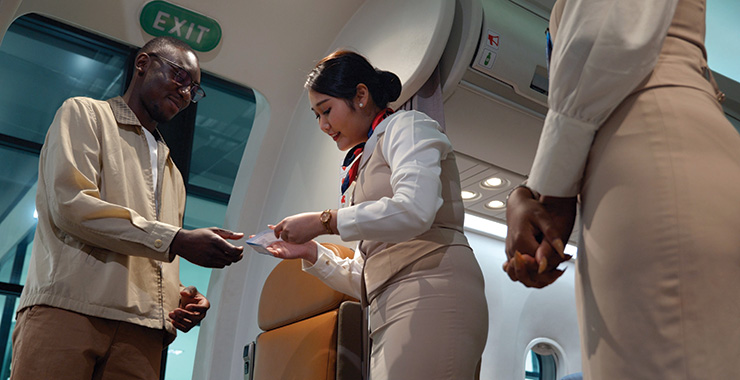
boarding a plane

Proper diagnosis

Importantly, what appears to be fear of flying may have another primary cause, with aviophobia as one example, Bricker said. For that reason, mental health clinicians need to assess patients to be sure they are making the correct diagnosis. For example, a patient whose primary diagnosis is actually panic disorder with agoraphobia is not necessarily afraid to fly; they are afraid of having a panic attack on the plane. “The plane is just the place where you have the panic attack,” Bricker said.

There are a number of validated screening tools that can help with diagnosis, such as the Flight Anxiety Situations questionnaire and the Flight Anxiety Modality questionnaire (Van Gerwen, L. J., et al., Psychological Assessment, Vol. 11, No. 2, 1999). The situations questionnaire, for instance, helps clinicians determine the extent to which someone is coping with generalized flight anxiety, anticipatory anxiety, or anxiety during the flight itself.

The questionnaires can also help therapists develop a fear hierarchy in the pursuit of exposure therapy, exposing patients to their fears in a controlled and gradual manner, Bricker said. They flesh out not just the patient’s symptoms but also some of the triggers involved, whether that is turbulence, strange sounds, or related to specific stages of flight, such as boarding or takeoff, he said.

Exposure therapy is then paired during treatment with assisting the patient to develop and hone various cognitive behavioral skills, such as practicing meditation and mindfulness or learning to reframe intrusive thoughts, Bricker said. “Before they get on a plane, they want to be armed with a set of skills.”

Ideally, following treatment, a therapist should accompany the patient on a flight at least once, Bricker said. But virtual reality can provide a viable alternative if that is not feasible or someone cannot access a therapist, he said, noting that rigorous trials are still needed to determine the treatment’s efficacy. Bunn was far more critical about virtual reality exposure therapy, saying that studies have not sufficiently compared outcomes before and after the treatment.

Mental health clinicians can still assist fearful flyers in the office in another way, by helping them to develop and think through how they would react to specific flying scenarios, Bricker said. The therapist may guide the patient in describing an anxiety-producing scenario: for example, having a panic attack during turbulence. Bricker recommends that therapists ask probing questions to help patients make the angst-producing scenario as detailed as possible.

Then the therapist reads that scenario in the office or via teletherapy, and the patient can practice mindfulness, an acceptance perspective, or whatever other techniques they have learned during prior therapeutic work, Bricker said. Record the scenario. “Then your homework for them,” he said, “is to leave the office and practice hearing that story.”

Hart, in his therapeutic work, reminds patients that the more they struggle against flying anxiety, the more anxious they will become. If they lean on alcohol or a prescription medication to get through the flight, such crutches will interfere with their ability to manage their anxiety and distress more consciously, he said.

The goal is to “develop a willingness to experience the anxiety rather than trying to get rid of it,” Hart said. “Not only is it OK to be anxious, but you’re learning to tolerate your anxiety, and you’re actually making progress when you are anxious.” The more someone learns they can handle even excess anxiety, ideally the less anxiety they will experience each time they fly, he said. 

After effective therapy, fearful flyers should be ready to first visit the airport and later take a “graduation flight,” ideally 30 minutes or less in the air, Bricker said. If they cannot, he said, “they have to be willing to eat the ticket.”

More commonly, though, by the time they reach cruising altitude, “they’re feeling pretty good,” Bricker said. “That first 30-minute flight is a major mastery experience for them—it’s a huge confidence builder.” But it is also important for people to keep up their exposure to flying and increase the length of flights to build upon the cognitive coping skills they have developed, said Bricker and other experts.

Facing fears and flying anyway

Joe Sulewski, the software engineer who was particularly afraid of turbulence, first signed up for Bunn’s program about 5 years ago. But he had little reason to fly after that, and by late last year, he knew he needed help again because he was going to have to start traveling for his job.

During his recent treatment, which included therapy with Bunn, Sulewski realized that at least part of his fears stemmed from a sense of feeling trapped once the plane’s door closed. So, rather than thinking about the potentially turbulent, claustrophobic journey ahead, he learned to focus on the excitement of being at his destination.

Sulewski, who describes himself as very data-centric, also began to track turbulence-related data, measuring various g-forces to assess the gravitational force, using an app on his phone. “I started to be able to quantify [the turbulence] as a value, and not as an emotional response,” he said, as he recognized that seemingly strong turbulence did not carry as much force as he thought.

He has flown a handful of times since then, including overseas. He still checks the turbulence reports in advance. But his anxiety has notably eased. He now often joins weekly group counseling calls through SOAR to continue his progress as well as to provide support to newer clients.

Sadly, though, too many people either suffer in silence or avoid flying entirely because of the grip of this phobia, Bricker said.

“Because aviophobia is not valued the same as other disorders, it creates a lot of shame for people who have it,” he said. “They don’t realize that there are very effective options to help them.” 

Further reading

Fear of flying, stress and epileptic-like symptomsopens in new window
Laker, M. K., et al., Neuropsychiatric Disease and Treatment, 2024

Key factors behind various specific phobia subtypesopens in new window
Zsido, A. N., et al., Scientific Reports, 2023

Virtual reality in the diagnostic and therapy for mental disorders: A systematic reviewopens in new window
Wiebe, A., et al., Clinical Psychology Review, 2022

Recommended Reading

Speaking of Psychology

Subscribe to APA’s audio podcast series highlighting some of the most important and relevant psychological research being conducted today.

Subscribe to Speaking of Psychology and download via:

Appleopens in new window
Apple podcast logo

Spotifyopens in new window
Spotify logo

Related and recent