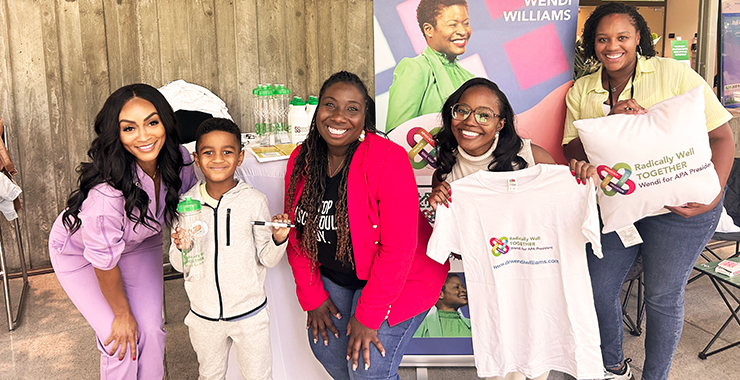
As I begin my term as APA president, I have focused on what serves the association, the discipline, the science, and the public to whom our work is accountable.
I ran on a platform of radical wellness, emphasizing psychologists’ shared fate in intersecting systems of power and oppression and their impact on our health and vitality. Wellness, which used to be connected to our core notions of ourselves, has been turned into a business—something you must buy rather than reckon with the contexts of harm that shape people’s lives.
Eight months before his passing, Dr. Martin Luther King Jr. addressed APA at its 1967 convention. Like King, I use the term “radical” to mean “reaching for the root” cause of a problem, and I also believe as he did that there are “some things in our world to which we should never be adjusted...if we are to be people of good will.”
Psychologists have the capacity to be people of good will. As Dr. Carolyn R. Payton asserted in her 1984 essay “Who Must Do the Hard Things?”opens in new window in American Psychologist, psychologists “decided to study psychology because we saw it as a means of contributing to the welfare of the human race.” Penning this essay nearly 20 years after King’s address, Payton grappled with a perennial debate in our field: to take a stand or safely stand by in times of tumult. She wrote:
I would suggest that it is absurd for us not to make our stand clear on matters of injustice, that failure to do so does grave image damage to us in the public’s eye, and that to continue to ignore damage done by social injustices that are readily apparent through use of our sense organs and consciences severely weakens our credibility.
Payton was no stranger to hard things, having served as director of the Peace Corps from 1977 to 1978, where she fought to ensure that the organization remained faithful to its mission despite efforts to utilize it for unintended geopolitical purposes. In her essay, she assessed the tension and opportunity to lead with purpose and clarity, grounded in our science to advance a vision for the world, conscious of its power and the courage to leverage it, especially when inconvenient, for the common good. She implied that psychologists must do the hard things—we can even do impossible things when we care.
Over the year ahead, I will work alongside many of you as we each endeavor to do hard and seemingly impossible things from our respective corners. With you, I remain committed to addressing the root causes of harm and centering radical wellness in all we do—Radically Well, Together!