skip to main content
Career

How psychologists help patients heal from infidelity

As apps, social media, and AI make affairs easier to pursue and harder to define, psychologists with this expertise are in demand

APA Style leaf logo Cite This Article in APA Style
Medaris, A. (2026, July 1). How psychologists help patients heal from infidelity. Monitor on Psychology, 57(5). https://www.apa.org/monitor/2026/07-08/psychologists-help-heal-infidelity

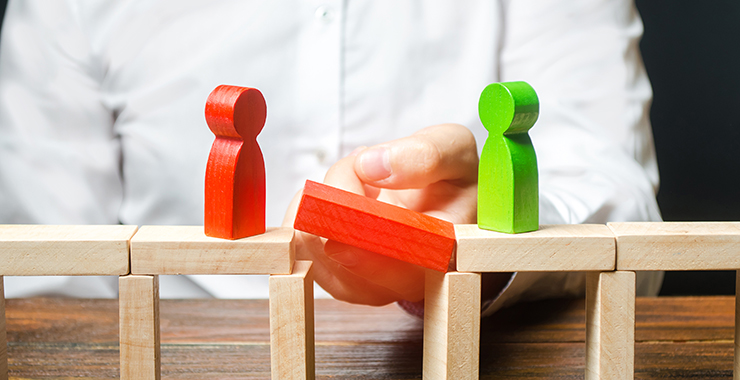
figurines on either side of a block

According to the U.S. Bureau of Labor Statisticsopens in new window, demand for marriage and family therapists is expected to grow 13% in the next decade, much faster than the 3% average for all occupations. And when it comes to practitioners with expertise in infidelity specifically, Galena Rhoades, PhD, a private practitioner in Denver who directs the University of Denver’s Institute for Relationship Science, said she only has a “small Rolodex” of well-equipped therapists to refer patients to when her cheating caseload is full. “We see high numbers of couples experiencing infidelity, and there are great approaches to working with them,” she said, “[but] there really aren’t a lot of people who have that training and experience.”

It’s difficult to know whether straying beyond a primary relationship has actually become more prevalent over the years, or whether it has become easier. Sure, there are more ways to stray—dating apps make the next hookup just a swipe away, websites like OnlyFans make porn more interactive, and AI makes robots often feel more compassionate and flirtatious than real-life lovers. But Americans are also reporting having less sex overall, according to a report by the Institute for Family Studies, and there seems to be fewer monogamous relationships to be unfaithful in. One 2023 YouGov survey of 1,000 American adults found that nearly half (45%) of respondents described their ideal relationship as something other than “completely monogamous.”

Regardless of how widespread infidelity actually is, one 2025 survey from the conservative think tank American Enterprise Institute found that 57% of young women and 44% of young men at least think infidelity is “common” or “extremely common.”

“In today’s world, it just takes a click of the button to connect. Is cheating when you have intercourse with somebody, or is it when you are secretly chatting? There are so many degrees of crossing the line,” said Janis Spring, PhD, a best-selling author and clinical psychologist with a private practice in Westport, Connecticut, specializing in intimacy, trust, and forgiveness. “[But] in terms of the trauma, the devastation felt by the hurt partner, I don’t think anything has really changed,” Spring added.

Psychologists, then, have an important role to play in helping people in all kinds of relationships navigate how they define, prevent, and recover from infidelity. Here’s what to know if you want to become one of them.

The causes and consequences of cheating

What constitutes cheating? Definitions vary and evolve. In one narrative review of the research, two therapists summarized the various definitions of infidelity as “any type of secret emotional, sexual or romantic behavior that violates the exclusivity that romantic relationships have by definition” (Rokach, A., & Chan, S. H., International Journal of Environmental Research and Public Health, Vol. 20, No. 5, 2023opens in new window).

Other research shows that while people are more likely to consider physical indiscretions infidelity than emotional or digital ones, the definition largely comes down to how committed partners understand it for themselves—and how overstepping those boundaries makes them feel (Schneider, S., Emotions and Society, advance online publication, 2025opens in new window).

In partnerships where there’s no extreme or coercive control, Spring boils it down to this: “If your partner were in the room witnessing what you are doing, and they were feeling extremely uncomfortable, you might consider that you’re doing something wrong. In other words, see it through their eyes.”

However infidelity is defined, there is a vast range of reasons why people cheat and just as many reactions that can follow. In a 2019 study, social-personality psychologist Dylan Selterman, PhD, and colleagues found that motivations can generally be grouped into two buckets: those involving the relationship at hand (like being angry with your partner or feeling disconnected from them) and those unrelated to the relationship (like wanting sexual variety or giving into temptation while under the influence) (Journal of Sex Research, Vol. 56, No. 3, 2019opens in new window).

Those driving factors, in turn, help predict what happens next, the researchers found. “When people cheat as a function of some kind of relationship deficits, they are more likely to confess their affairs to their partners and also more likely to break up [with the partner],” said Selterman, who serves as the director of research and resource development at the nonprofit Heterodox Academy. In contrast, said Selterman, when people cheat for other reasons, they are more likely to keep it a secret and ultimately try to stay with the original partner. One message to clinical psychologists, then, is that “there are lots of different motivations for infidelity, not all of which are a sign of something bad in the relationship,” Selterman said.

Similarly, in his 2023 study looking at Ashley Madison users, Selterman and others found that people who actively sought out affairs weren’t primarily doing so because they were unhappy with their relationships (Archives of Sexual Behavior, Vol. 52, 2023opens in new window). And in fact, the affairs didn’t seem to have a strong negative impact on their unions or make the straying partners feel particularly remorseful. And while those findings could be discouraging to faithful partners (“I did everything ‘right’ and my loved one still cheated on me”), Selterman proposes a different viewpoint: “My partner had an affair, but that doesn’t mean our relationship is doomed.”

Affairs are hardly harmless, however. The betrayal can lead to emotional dysregulation for both victims and perpetrators, bringing up feelings including anger, insecurity, shame, guilt, jealousy, and sadness. Research has also shown that, in addition to relationship dissolution, being cheated on can lead to depressive symptoms and lower self-esteem (Rokach, A., & Chan, S. H., International Journal of Environmental Research and Public Health, Vol. 20, No. 5, 2023opens in new window). One 2024 study found that people who had been betrayed had poorer physical health years later, even if they had strong social support from other healthy relationships. The result was particularly salient for low-income and ethnic minority study subjects (Hoy, E. Q. W., & Oh, V. Y. S., Journal of Social and Personal Relationships, Vol. 41, No. 12, 2024opens in new window).

“When you discover your partner has been unfaithful, you don’t just lose your partner,” Spring said. “You don’t just lose the idea of what you thought you shared with this person. You lose something more basic and essential. You [can] lose yourself.”

And sadly, some of Rhoades’s work finds that patterns can perpetuate. In one study, her team found that people who cheated in their last relationship were more likely to cheat in their next one—and people who were betrayed in their last relationship were more likely to get similarly hurt in the next one. “We often see that within relationships, couples get stuck in certain dynamics or patterns, but to see that happening across relationships is interesting,” Rhoades said. “Hopefully, it’s the case that good things also get repeated across relationships.”

It’s complicated

Working with people who cheat and those they’ve betrayed isn’t like other mental health and relationship complications, experts say. If couples therapy is more active than individual therapy—with a dynamic playing out in real time rather than just being talked about—then couples therapy involving infidelity is even more intense than couples therapy without it. With an affair, there’s a crisis. There’s urgency.

“When couples [without infidelity as a presenting issue] come to therapy in my practice, oftentimes they’ve been facing conflict and a lack of connection for quite some time,” Rhoades said. “And with infidelity, that may be the case, but there has also been an event that has sparked them coming to therapy.” Rhoades has found that like a rock-bottom moment motivating someone with substance use disorder to turn their life around, a relationship transgression can “give us the opportunity to make greater change.”

Spring said her work is also rewarding because she attracts a self-selected population that wants to make that change. By contrast, if someone cheats and their partner ends the relationship, that pair isn’t showing up in her clinic. In general, “the couples who are calling me—one person has fallen off the beam, they’ve gotten involved with somebody else, and they don’t want to be with that other person. They love their partner, and they want to make good at home,” Spring said. “So it’s a highly motivated and directed group of people.”

That doesn’t mean helping them move forward is easy, straightforward, or one size fits all. Sometimes partners repair the rupture and get stronger. Sometimes they decide to part ways. Sometimes—typically only if sexual temptation or mismatched sex drive is addressed before a transgression occurs—they explore altering their relationship agreement, like considering an open relationship or some other system by which both partners’ needs can be addressed.

“Some couples have managed to navigate [conflict] not by breaking up but by saying, ‘I’m going to pursue sex outside the marriage in a way that is open and discussed and cocreated rather than by me sneaking around with the pool boy,’” said Matt Zakreski, PsyD, a clinical psychologist in New Jersey who specializes in working with neurodiverse and queer patients, including on issues related to infidelity. It all comes down to “clear, compassionate communication,” he said.

There are multiple reputable ways therapists can guide patients toward healing. When compared with treatment-as-usual approaches including methods like eclectic/integrative therapy, emotion-focused therapy, psychodynamic therapy, systems-based therapy, and trauma-informed therapy, the Gottman method has been shown to significantly improve relationship satisfaction for both partners and to reduce the unfaithful partner’s propensity toward leaving the relationship entirely (Irvine, T. J., et al., The Family Journal, Vol. 32, No. 1, 2023opens in new window). Developed by psychologists John Gottman, PhD, and Julie Gottman, PhD, the protocol involves reviving trust through three phases: atone (including allowing the person who cheated to take responsibility), attune (including addressing relationship problems that preceded the betrayal), and attach (including helping the pair reattach in loving ways).

Another approach, developed by psychologists Kristina Coop Gordon, PhD, Donald H. Baucom, PhD, and Douglas K. Snyder, PhD, also involves three stages but views the affair’s impact through the lens of trauma (Journal of Cognitive Psychotherapy, Vol. 20, No. 4, 2006opens in new window). Guided by this protocol, therapists first help partners “contain the damage,” Rhoades said, such as by ensuring the relationship with the affair partner has ended, then work through what led to the infidelity to begin with, and finally come to a decision about how they want their future relationship to look—if they decide to stay together at all. The framework, which can also be applied in individual therapy, recognizes that “betrayal can often lead to feelings and experiences that look like PTSD that may require some attention and treatment on its own,” Rhoades said.

Spring offers yet another approach, specifically for people who’ve been cheated on. Despite research generally showing a link between forgiveness and relationship satisfaction, her 2004 book, How Can I Forgive You? The Courage to Forgive, the Freedom Not To, remains “radical,” she said, because it gives those who’ve been hurt the option not to forgive (Braithwaite, S. R., et al., Journal of Family Psychology, Vol. 25, No. 4, 2011opens in new window). “Genuine forgiveness must be earned by the unfaithful partner, but if that person isn’t willing to understand the pain they’ve caused you and take the steps to earn your trust and forgiveness, then forgiveness is a cheap gift and it means nothing,” said Spring, who published an updated edition of the book with Michael Spring in 2022 (Harper Paperbacks). “So, you can heal yourself without forgiving.”

No matter the method psychologists call upon when working with people dealing with infidelity, it’s important that they take on a stance of curiosity, Zakreski said. “We don’t sit from a place of judgment; we sit from a place of trying to understand what’s going on,” he said. Doing that, he added, “helps our clients move forward in a more empowered way.”


Building skills

Just like there’s no one profile of a cheater, there is no single way to move through the aftermath. Likewise, there is no universal answer to whether partners stay or go.

Given the complexity of these situations, psychologists benefit from additional training in this area. Currently, however, there is no singular training or referral pipeline for psychologists who want to carve out a specialty in the space.

“It’s so hard in this field because we often just get self-referrals,” Rhoades said. After all, most people in or seeking therapy for infidelity are tight-lipped about the situation, which makes word-of-mouth referrals rarer than, say, therapy for a less-stigmatized issue like anxiety. “While specialized training can support providers in doing this work,” Rhoades added, “there’s not really an established referral network that clinicians can plug into to build referrals in that area.”

It comes down to skills practice, which may come before you think you’re ready. In that case, Zakreski said, do what his mentor told him to do when anything shows up in therapy that you’re not sure how to deal with. “People come to us and they bare their souls,” he says, “and when you can say to them from a place of authenticity—‘I don’t know how to solve this, but I’m going to be here with you and we’ll figure it out together’—sometimes that’s actually more effective than having the ‘right’ answer.” 

Further training

Couples therapy for licensed psychologists

For psychologists who wish to undertake postdoctoral training in couples therapy, there are a number of options.

  • APA Division 43 (Society for Couple and Family Psychology) encourages licensed psychologists to seek postgraduate instruction and possibly board certification from the American Board of Couple and Family Psychology.
  • Gottman Institute’s online course “Treating Affairs and Trauma” provides clinicians with an “unbiased roadmap to compassionately serve” and give hope to patients after a relationship collapse.
  • The American Association for Marriage and Family Therapy’s continuing-education programming includes access to the latest insights from the Systemic Family Therapy Conference.
  • The Ackerman Institute for the Family offers “innovative clinical services, state-of-the-art training programs, cutting-edge research initiatives, and professional leadership” around couple and family therapy.

Recommended Reading

Speaking of Psychology

Subscribe to APA’s audio podcast series highlighting some of the most important and relevant psychological research being conducted today.

Subscribe to Speaking of Psychology and download via:

Appleopens in new window
Apple podcast logo

Spotifyopens in new window
Spotify logo

Related and recent