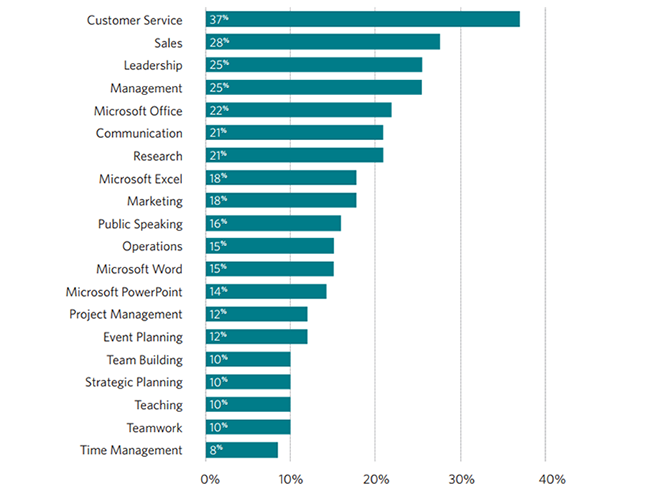
Undergraduate psychology education develops a wide set of skills that are required for nearly all jobs. Top skills possessed by psychology bachelor’s degree holders include customer service (37%), sales (28%), leadership (25%), and management (25%; Lightcast, 2026a). Many of these skills are broad in their definitions and may draw on a combination of several related skills. For example, customer service is a skill that goes beyond fielding complaints and fulfilling requests; it involves communicating to understand needs, responding to questions and concerns, and solving problems (Lightcast, 2026b). Customer service is also a component of service-orientation skills (Naufel, K. Z., et al., 2018), which focus on showing empathy, being centered on the customer, and working within communities. Similarly, sales is a skill that involves a combination of other skills, such as persuasive communication, problem-solving, creativity, and being adaptable (Lightcast, 2026c).
Emphasizing the skills taught in undergraduate psychology programs can better prepare students to communicate the value of their skills to employers. Psychology educators can also align existing student learning outcomes and curricular goals with workforce needs and explicitly provide language describing the underlying skills developed through psychology education.