
skip to main content
Datapoint

Graduate psychology program trends in funding, cohorts, and stipends

Nearly half of programs made at least one financial or cohort size reduction

APA Style leaf logo Cite This Article in APA Style
Williams, W. R., Stamm, K., & Orsillo, S. (2026, September 1). Datapoint: Graduate psychology program trends in funding, cohorts, and stipends. Monitor on Psychology, 57(6). https://www.apa.org/monitor/2026/09/graduate-program-funding-cohorts-stipends

jar of change plus a mini graduation hat

Although funding for graduate psychology programs remains one of the field’s most pressing concerns, recent survey data collected from program directors suggest a more nuanced picture. Between the 2024–2025 and 2025–2026 academic years, a narrow majority of programs (53%) reported admitting the same number of students. In each individual category, most programs maintained similar financial support, including tuition (82%), stipends (74%), or additional funding (66%). When considered collectively, however, nearly half (48%) of programs reported making at least one financial or cohort size reduction.

Among graduate programs reporting changes, the pattern was mixed. Approximately 1 in 5 programs increased cohort size (21%) or stipends (20%), whereas similar proportions of programs decreased cohort size (26%) or additional funding (26%).

Taken together, these data suggest some stability in cohort size and funding for psychology graduate students but also early signs of strain. Although most programs have held steady in individual areas, nearly half have made at least one reduction. The mix of increases and decreases points to uneven adjustments rather than a clear field-wide trend. Even modest declines in financial support or enrollment could further weaken pathways into the profession that are already expected to fall short of future demand. At the same time, pockets of growth suggest that some programs are finding ways to adapt that may offer insight into how others can offset these pressures. Continued monitoring is important to determine whether these patterns represent short-term variability or early signs of broader structural changes. 
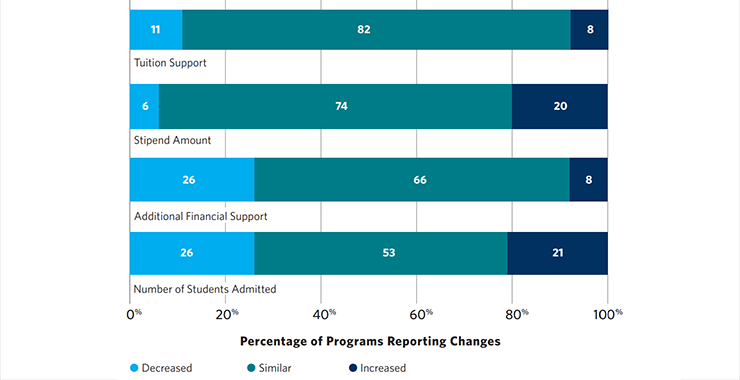
Percentage of Graduate Psychology Programs Reporting Changes to Cohort Size and Student Financial Support Between the 2024–2025 and 2025–2026 Academic Years

datapoint graph

View a full-size version of the graph

Want more information? See the Center for Workforce Studies (CWS) interactive data tools or contact CWS.

Sources

Source: American Psychological Association. (2025). APA 2025 Graduate Psychology Education Rapid Response Survey [unpublished special analysis].

Note: The authors wish to thank the psychology training councils for their valuable feedback on the survey and support in dissemination. The survey was distributed through several psychology training councils in September 2025 to gather information from graduate psychology program directors from master’s and doctoral programs in any psychology subfield. Most respondents (N = 210) were at public institutions (67%), located in the South/Mid-Atlantic (36%), in doctoral programs (93%), and in health service psychology programs (75%). Percentages may not sum to 100% because of rounding.

Recommended Reading

Speaking of Psychology

Subscribe to APA’s audio podcast series highlighting some of the most important and relevant psychological research being conducted today.

Subscribe to Speaking of Psychology and download via:

Appleopens in new window
Apple podcast logo

Spotifyopens in new window
Spotify logo

Related and recent