

January 2006 | Monitor on Psychology
Vol. 37 No. 1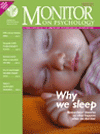
On the Cover: Why we sleep
-
Why we sleep
Like hunger and thirst, sleep is a basic biological drive we can't ignore.
-
To sleep, perchance to twitch
Active sleep, and its characteristic muscle spasms, may help the nervous system map the body.
-
Wild findings on animal sleep
Do the similarities of sleep across the animal world indicate a universal function or just convergent evolution?
-
Brain, heal thyself
Researchers are finding that sleep may provide a crucial time for the brain to perform biochemical housekeeping.
-
Let's sleep on it
A good night's sleep may be the key to effective learning, says recent research.

SCIENCE WATCH
Psychological research on whether people can apply their knowledge of specific objects to broader categories during screening tasks may have implications for aviation security.
IN BRIEF
- APA convention to remain in New Orleans
- Science and math aptitude is unrelated to gender, study suggests
- TV interviewers' behaviors may influence viewers' opinions
- Psychologist calls for more funding to study trauma
- TOPSS updates its high school psychology curriculum standards
- Researchers discuss drug abuse-HIV link at Capitol Hill briefing
- Children's expressiveness linked to family and culture
- Revised codes, higher payments for testing services in 2006
- New program helps students with disabilities access APA books
- Psychological Services expands publication schedule
- Briefing highlights ethnic-minority children's mental heath needs
- APA announces Katrina grant recipients

ETHICS ROUNDS
Ethical complexities when therapist-spouses refer clients to one another call for a thoughtful process to protect our clients from harm.

Features
APA's new policy on granting rights to reuse published material will ensure that electronic versions of books and journals match the print originals.
A large federal epidemiological survey offers new insights into alcohol abuse–and an opportunity for psychologists to further investigate alcoholism and related disorders.
A new autism center–headed by a psychologist–is bringing together a diverse array of researchers at the University of Missouri–Columbia.
At the helm of the Public Interest Directorate, Gwendolyn Puryear Keita aims to increase psychology's prominence.
Universities increasingly offer mentoring programs that link new faculty with more experienced colleagues.
A newly released APA draft manual aims to transform the way health professionals approach health care.
Psychological assessment enjoys new respect, applications and approaches.
Volunteer psychologists and other providers are helping relatives of National Guard and Army Reserve troops in Afghanistan and Iraq cope with the wars' effects.
Weiss Fund recipient David A. Sbarra investigates how couples navigate chronic pain conditions.

A CLOSER LOOK
APA's Div. 2 is expanding access to its teaching resources through electronic books.

PUBLIC POLICY UPDATE
The U.S. countryside offers burgeoning opportunities for psychologists and interns.

CORRECTIONS
COLUMNS
From the CEO
Judicial Notebook
President's Column
Professional Point
Speaking of Education