Thank you, Helen Thompson Woolley, PhD.
Her seminal research at the turn of the 20th century was essential to challenge the sexist reasoning once used to deny women the right to vote. Tests she conducted on both men and women’s motor, memory and association skills found that men excelled on some tasks and women on others — a finding that disputed the widely held view that women were biologically inferior to men (Thompson, H.B., University of Chicago Pressopens in new window, 1903). At the time, even leading psychologists William James, MD, and G. Stanley Hall, PhD, endorsed such sexist views.
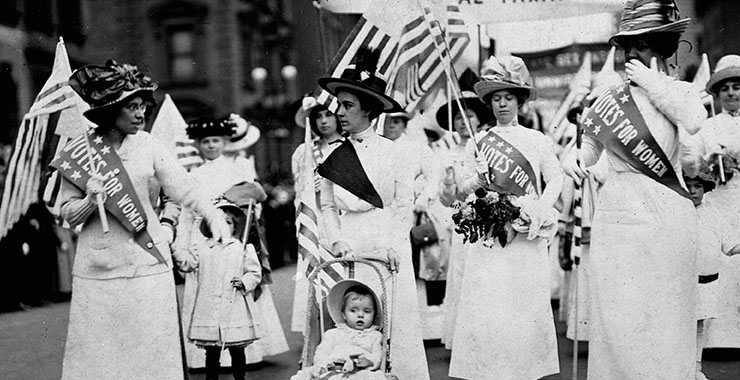
Wooley’s voice was among the cadre of women scientists who helped shift that narrative and promote women’s suffrage, culminating in the ratification of the 19th Amendment — which bars sex discrimination at the polls — on Aug. 18, 1920.
This year, psychologists are commemorating the centennial of the landmark law with a series of initiatives, including voter registration campaigns, a short film contest and guidelines for hosting inclusive historical celebrations.
They’re also using the anniversary of women’s suffrage to direct attention to ongoing challenges such as voter suppression of marginalized groups in American society and women’s continued fight for equality in the workplace.
“Women gained the right to vote 100 years ago, but we’re still trying to reach parity in pay and promotions,” says Shari Miles-Cohen, PhD, senior director of the APA’s Women’s Programs Office. “Commemorating this anniversary is a way for us to get energized and to recognize how much power we actually have — especially when we work collectively to make change.”
History and herstory
At the turn of the century, early women psychologists campaigned for suffrage both directly — by participating in marches and organizing efforts — and indirectly, through research that challenged the sexist reasoning used to deny women the vote.
These women, who were often barred from scientific societies, higher education and teaching positions, “saw the vote as another very important public sphere where women just simply weren’t allowed to exist,” says Cathy Faye, PhD, past president of APA’s Div. 26 (Society for the History of Psychology) and assistant director of the Cummings Center for the History of Psychologyopens in new window at the University of Akron.
In addition to Woolley’s work, prominent psychologist and suffragist Leta Stetter Hollingworth, PhD, conducted groundbreaking research that challenged two sexist assumptions: the periodic function, which held that women’s psychological and mental abilities decreased during menstruation, and the variability hypothesis, which stated that men exhibited more biological variation than women and were thus more likely to achieve excellence. She found no evidence for either (Montague, H. & Hollingworth, L.S., American Journal of Sociologyopens in new window, Vol. 20, 1914; Hollingworth, L.S., Teachers College, Columbia University: Contributions to Educationopens in new window, No. 69, 1914).
Hollingworth integrated her science into her activism efforts, which included delivering public speeches, leading letter writing campaigns and publishing accounts of her research in The New York Times and radical women’s rights newspapers.
“These women who had managed to occupy traditionally male spaces were speaking out and saying, ‘I’m not an exceptional woman. When women are given opportunity, they can do what I’ve done,’” says Faye. “That was a very powerful message.”
State and division commemorations
To commemorate the contributions of psychology to the women’s suffrage movement, several APA divisions and groups, as well as a number of state, provincial and territorial psychological associations (SPTAs), are hosting a range of programs and events.
The Massachusetts Psychological Association (MPA), for example, is organizing its 100th anniversary commemoration around the message that women’s rights are fundamental to mental and physical health. In partnership with several other professional organizations, MPA will sponsor continuing-education programming on women’s health and equality as well as a statewide short film contest for high school students on topics such as “Why Equal Rights for Women and Girls are Important for Mental Health” and “Why I Am a Suffragists’ Wildest Dream.”
“We want to draw a strong connection between women’s rights and their mental and physical health,” says Karen Postal, PhD, ABPP-CN, clinical instructor at Harvard Medical School and MPA past president.
The celebration will culminate in a block party, complete with a short film showcase and keynote speakers from the fields of psychology, medicine, law, social work and teaching. MPA will also share the resources and materials it creates with other SPTAs interested in holding centennial celebrations.
As planning for such events gets underway, APA’s Committee on Women in Psychology (CWP) is working to ensure that commemorations of the law accurately reflect the experience of all women in the U.S. at the time.
“It’s important to acknowledge that the 19th Amendment essentially ratified the right to vote for middle- and upper-class white women,” says Miles-Cohen, noting that women of color and other marginalized groups were not welcomed into the suffrage movement.
To support event leaders, CWP is creating a guide to best practices for hosting an inclusive celebration of the 19th Amendment and other historical milestones. For example, organizers are encouraged to recognize the historical roles of women of color, women with disabilities and those identifying as sexual and gender minorities.
In that vein, MPA’s commemoration aims to deliver a collective telling of women’s diverse experiences, operating with the slogan, “1920 started some of us on the road to equal voting rights. One hundred years later, all women are marching forward together.”
APA’s Div. 35 (Society for the Psychology of Women) is using the centennial as an opportunity to rearticulate women’s civic rights and responsibilities in today’s political climate. They are working to develop a social media campaign aimed at getting women to the polls, as well as a series of formal conversations about ongoing voter suppression efforts. They are also hoping to encourage more women psychologists to run for office.
Psychologists continue to play an important role in empowering Americans to cast their vote, says Wendi Williams, PhD, president-elect of Div. 35 and dean of the school of education at Mills College in Oakland, California.
“We know that when people have a voice, their psychological health improves,” she says. “That’s what voting is. There’s something about casting your vote and knowing it counted that is more than just a symbolic act.”