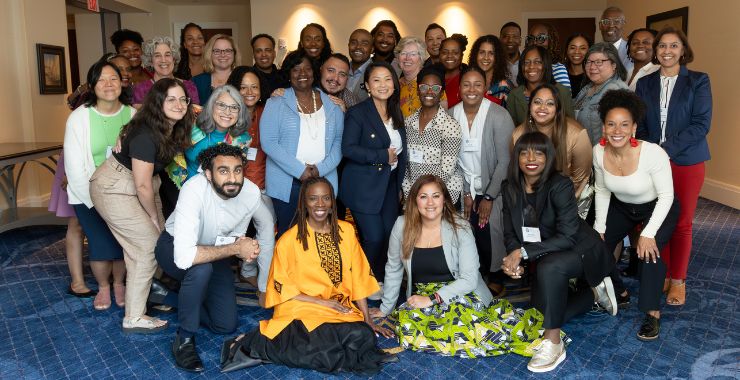
The think tank, held at the Gaylord National Resort and Convention Center in National Harbor, Maryland, addressed equity in health and diversity in knowledge production or scholarship through presentations and work sessions. There are three other areas of work in the Racial Equity Action Plan—APA’s staff and broader psychology workforce, training of psychologists, and education from kindergarten through graduate school—which will be addressed in future phases.
According to the Centers for Disease Control and Preventionopens in new window, racial and ethnic minority groups continue to experience poorer health outcomes and higher rates of illness and death, when compared to White communities, largely because of centuries of racism and racist structural systems.
Clinical psychologist Jennifer F. Kelly, PhD, said she initiated the health equity proposal when she was APA president in 2021 based largely on her experience seeing her clients of color struggling to navigate the health care system during the pandemic.
Participant Christopher King, PhD, MHSc, FACHE, dean of the Georgetown University School of Health said: “We know in America our health care delivery system is very biomedically focused, and we need to shift to one that’s biopsychosocially focused. That means there is a place for psychology if we’re trying to improve the health of individuals, if we’re trying to improve the health of communities and populations.”
Participants divided into groups to discuss health and scholarship. The health equity groups made several recommendations, including:
- Commissioning a comprehensive audit of psychology training programs to determine where a focus on health equity might fit and then incorporating it into the programs.
- Partnering with communities to help design curriculum and coursework with biological, psychological, and social foundation to promote the health and well-being of the communities.
- Expanding strategic transdisciplinary partnerships beyond health service providers, reaching out to school boards, accrediting bodies, NGOs, associations, and state, regional, and local governments.
A 2021 paper coauthored by APA Chief Science Officer Mitch Prinstein titled Upending Racism in Psychological Science: Strategies to Change How Science is Conducted, Reported, Reviewed, and Disseminated (Buchanan et. al, 2021)opens in new window said the BIPOC population is “significantly underrepresented” among journal authors, reviewers, and editors, 90% of whom are White. It points out that the work of BIPOC scholars is 12 times more likely to be rejected than accepted.
Moreover, it said that White scholars are much more likely to be published in “higher impact outlets” than BIPOC ones.
“Within psychology, whether it’s epistemologically, the way that the advisor-mentee relationship works, labs work, submissions work, there’s still a lot of racial discrimination,” said doctoral candidate Salmān A. Safīr, MA. “This is the first step to turning that around.”
The scholarship groups recommended:
- Establishing a rating system like the H-index that would measure the inclusion of diversity into papers.
- Reviewing and revising curriculum and training to ensure that more science generated by scholars of color is incorporated.
- Promoting psychological research careers to school children as young as kindergarten, helping them envision themselves as scientists.
“We want psychology to be top of mind, [for young people to know] that it makes a difference in the world,” said Erica H. Wise, PhD, clinical professor emerita in the Department of Psychology and Neuroscience at the University of North Carolina, Chapel Hill. “We want little ones to see this as a viable career choice.”
Think tank organizers said that change takes time, and understanding the long-term nature of the commitment is crucial. As APA progresses on its path toward racial equity, organization leaders invite psychologists, professionals, and stakeholders from all backgrounds to join the movement.
“We are the ones we’ve been waiting for. Our parents said, ‘If not us, who? If not now, when?’” APA President Thema S. Bryant, PhD, said. “When you show up, the room has to shift. If it didn’t, what’s the point of you being here?”