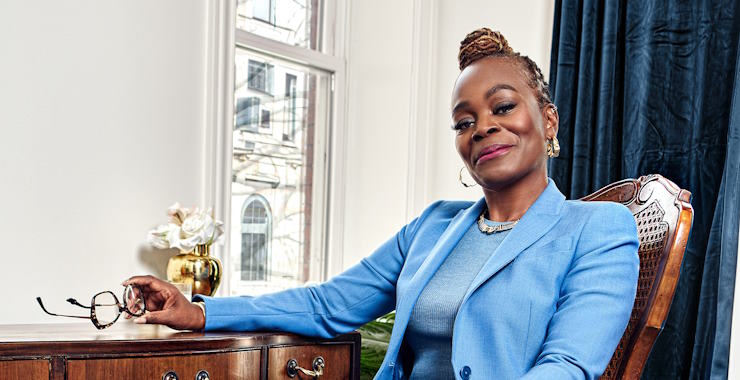
On what was, at first, just a regular day in late May, Alfiee Breland-Nobleopens in new window, PhD, learned that she was one of 12 global leaders selected by philanthropist Melinda French Gates to receive a $20 million grant in support of women and girls.
Breland-Noble, who goes by “Dr. Alfiee,” is a psychologist in Virginia and founder of the AAKOMA Project, a nonprofit dedicated to the mental health of youth of color. She’s widely recognized as a voice and face of psychology in the popular media, and has worked with powerhouses ranging from Lady Gaga to U.S. Surgeon General Vivek Murthy.
Still, she didn’t see this news coming. “I remember getting the email late in the evening and opening it, and my jaw was on the floor,” Dr. Alfiee said. “I was completely overwhelmed and floored.” But French Gates chose people including Dr. Alfiee because she admires their work and trusts them to distribute the funds as they see fit, she wrote in a New York Times op-ed.
It’s all evidence that Dr. Alfiee’s parents were right. “They used to tell me all the time: When you do good work, somebody is going to pay attention—and sometimes you don't even know who is paying attention,” she said. “I am evidence of that because I had no idea that Melinda French Gates was paying attention to me.”
Dr. Alfiee, who also created the Couched in Color podcast, talked to the Monitor about how she got to where she is—and how this new support will further her work.
What is the AAKOMA Project?
We are all about the mental health of youth and young adults of color with a clear focus on intersectional identities. As people in the queer community have said, none of us is free until we're all free. My parents are boomers of the civil rights generation, and that was a rallying cry then too—we all must get free together.
In the AAKOMA Project, we're about three pillars: raising consciousness, empowering people, and changing the system of mental health so that all young people have the opportunity to rise and thrive as the best versions of themselves.
For example, we have a youth leadership group that we call Team AAKOMA. Its members, who apply to be a part of the team, are a diverse set of teens and young adults who create mental health content and disseminate evidence-based research to the field and their peers.
I just got an email from one of the young people today, who is amazing and happens to be Haitian American. She's doing a summer research internship in mental health at Wash U. So that kind of thing—setting our young people up to be able to do that—that’s what we're about and that's what the field is missing.
How did it come about?
I spent close to 20 years in academic medicine, and one of the things I always felt was lacking among mental health researchers and scientists were the centering and elevation of the mental health needs of marginalized young people.
So, in AAKOMA, it’s like we are putting up a big tent for everybody to be able to fit under. Everybody who's been marginalized, everybody who's left out of these conversations, everybody who doesn't see themselves in scientific data, in traditional interventions for mental health, and in conversations about mental health.
That was hard to do within the structure of academia. So, I decided, let's try it in the nonprofit space. It’s been one of the best decisions I ever made.
How will you use this award?
My goal is to ensure that those funds are distributed effectively and efficiently to support and amplify the work of people who are out there, boots on the ground, globally. If there's a theme to my thinking about this, it really is about equity. Who's out there trying to build an equitable future? We also know that Melinda French Gates’ goal is empowering girls and women, so those are two grounding forces for me.
As far as the AAKOMA Project, my goal is to ensure that, wherever our funds come from, all of that goes towards ensuring that our people are well cared for within the organization. Because they are the people who help care for those folks outside the organization, the people we want to reach through our mission and vision.
Programming is equally important, but if you don't have the people in place, if you don't have the structures in place, you can't do the programming.
What's most misunderstood about the mental health of marginalized youth?
There was a recent study in JAMA Psychiatry about youth mental health, and there were no Asian American young people, no Native American young people, no Arab, Middle East or North African kids in the sample. That made my heart hurt.
That's one of the things that I wish more people knew: If we're going to talk about youth mental health, it's important for us to talk about all youth—youth of all racial ethnic backgrounds, youth with visible disabilities or invisible disabilities, young people who are part of the queer community—all those young people have to be centered in these conversations.
So often, the myth that we allow ourselves to buy into writ large as a field is that if you just do “representative samples,” where a tiny portion of the sample is kids of color, we can take that data and say, “We know how to solve for X, Y, and Z in the mental health space.”
We can't solve the youth mental health crisis that way, and that's what I wish was very different. And that’s the problem that we try to solve for at the AAKOMA Project.
What's most encouraging about this younger generation?
When we talked to 3,000 young people with equitable representation across five racial ethnic groups, 78% said they have at least one person in their life who loves them.
If we don't ask that question, we end up with these ideas—not backed by any kind of science—that our young people of racially diverse backgrounds don't have anybody in their corner. Most of them are saying that they do. So that's one positive, and that’s something we can build on.
77% of the young people in our sample also say they have at least one person they trust. That’s important because how do you have conversations about mental health or help seeking for mental health if you don't trust anybody?
What's most discouraging?
In our sample again, over 50% of our young people of color are experiencing depression and anxiety, and 20% reported exposure to racial trauma “often” or “very often” in their lifetime. The fact that that proportion of our young people is not just saying “yes, it happens to me,” but that it happens regularly, just breaks my heart.
On top of that, when you look at the sources of racial trauma, a good portion of our young people say it’s coming from watching, reading, or being exposed to the news. They also say it’s coming from sources like their peers or their teachers or parents and caregivers.
Those data then become markers to tell us where we should intervene. And for me, that's the gift to the field.
What else do you want your colleagues to know?
I would love for diverse young people in the field to know that there's tremendous value, even if it's not easy, in following your vision. You have a vision that was given to you, and we have gifts and talents to help move us toward the vision. And ultimately, the goal is to figure out what that vision is and to just keep walking toward it.