


skip to main content

APA 2025: Psychologists find a sense of possibility in challenging times

APA Style leaf logo Cite This Article in APA Style
Pappas, S. (2025, August 19). APA 2025: Psychologists find a sense of possibility in challenging times. https://www.apa.org/news/apa/2025/convention-highlights

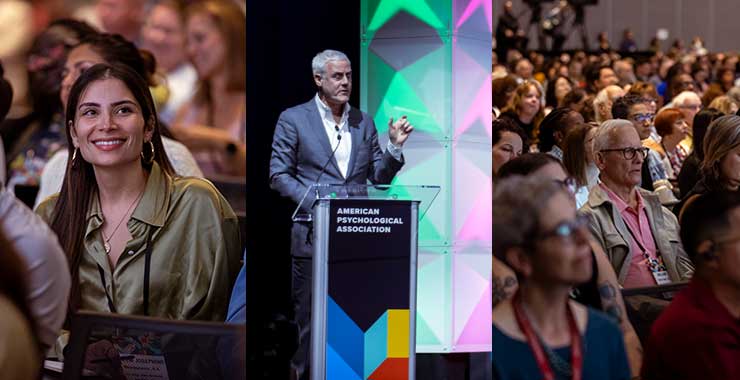
Collage of conference in Denver, Colorado

Denver — Psychologists are bringing their expertise to bear in a time of upheaval, spotlighting the importance of centering humanity, psychological research, and mental health in tackling the hardest issues of the day.

At APA 2025, thousands of psychologists gathered in downtown Denver to share ideas, communicate new findings, and learn how to make a difference despite seemingly intractable problems such as toxic polarization and worsening youth mental health.

“Even in these challenging times, even when the world feels heavy with uncertainty, there is still this incredible energy around psychology,” said Debra Kawahara, PhD, 2025 APA President. “There is still this sense of possibility about what we can accomplish.”

Under the theme of “power, perspective, and possibility,” clinicians, academics, and other experts discussed ways to support individuals and a healthy society alike. Conversations ranged from practical advice around AI in clinics and classrooms to big-picture ways to help support children and youth, to efforts to move forward on equity, diversity, and inclusion (EDI) in a hostile political environment.

“I don’t think there’s been a more important time for us to be psychologists,” said APA CEO Arthur C. Evans Jr., PhD. “Look at the challenges we’re facing, from artificial intelligence and its impact to a youth mental health crisis that was exacerbated by the pandemic, to the geopolitical issues dominating our news feeds every day.”
Psychology’s solutions for toxic polarization

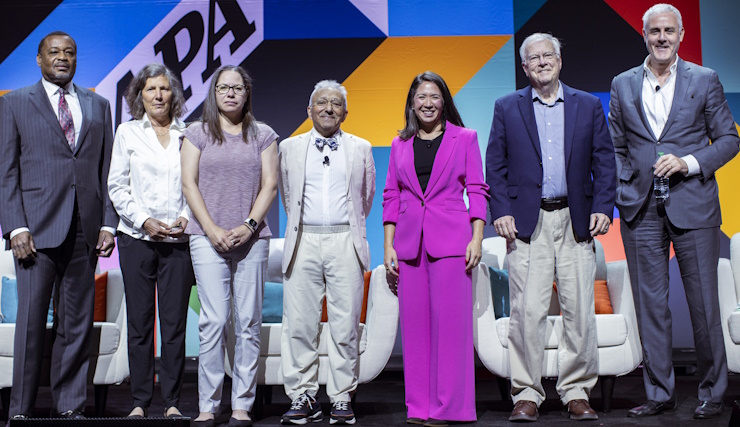
Division and distrust are reshaping nearly every part of society—from politics and public discourse to our personal relationships—but psychologists offered a way forward. At Friday’s Main Stage, “Burned Bridges and Broken Trust,” experts shared the science exploring the roots of polarization, the breakdown of trust, and how identity and othering can fuel division, plus promising research to help unravel the tensions impacting America’s future as a multicultural democracy and real-world strategies for rebuilding connection—online and offline. Speakers included Jennifer Freyd, PhD, The Center for Institutional Courage, Lilliana Mason, PhD, University of Maryland, Bill Doherty, PhD, Braver Angels, Peter T. Coleman, PhD, Columbia University, Fathali Moghaddam, PhD, Georgetown University, and moderator Sara Blanchard, What Do You Mean By That? 

Attendees heard an evidence-based vision of how psychology can help us move forward in a time of unprecedented change. “Committing to moral action means not colluding with perpetrators or tyrants. It means courageously choosing what is moral over what is expedient,” Jennifer Joy Freyd, PhD, professor emerit of psychology at the University of Oregon and founder of the Center for Institutional Courage.

Speakers for the Main Stage, “Burned Bridges and Broken Trust: Psychology’s Solutions for a Troubled Time

How to harness the power of AI—ethically

Another topic strongly impacting psychologists is the increasing prevalence of AI in everyday life. Allison Funicelli and Cara Staus, both assistant vice presidents at Risk Management Group, told a standing-room-only crowd how clinicians can integrate AI assistants into clinical practice safely and ethically.

“There’s no free pass because you used technology,” Staus said. “If you are the one utilizing it, you have the responsibility to make sure it is upholding the same ethics as the traditional practice of psychology.”

The pair advised thorough documentation and transparency with patients is key to using AI ethically. AI should also be integrated with human oversight and accountability, Staus said.

Psychology faculty are also grappling with ways to use AI in the classroom—and trying to understand how students are engaging with it.

Joseph Slade, of the Oregon State University Center for Teaching and Learning, said that students’ use of generative AI tools to answer online exams, write essays, and more raises the question of how to craft assignments students are completing on their own. Slade and his colleagues are experimenting with assignments based around CustomGPTs, which use OpenAI’s language models, but allow instructors to make custom dialogues so the chatbot can ask students questions and react to their responses. The team is also experimenting with AI avatars of themselves to deliver information or “talk” with students, walking them through a Q and A assignment.

Most students use AI to gather course-related information and as a study aide, according to Janel Cavazos, PhD, an associate professor of psychology at the University of Oklahoma who has surveyed introductory psychology undergraduate students on their use of and attitudes toward AI. Students were widely aware using AI to generate answers on assignments was unethical, though some reported doing so anyway, particularly when they weren’t interested in the subject matter at hand. Overall, Cavazos found 75% of students reported cheating—and not with ChatGPT. In other words, Cavazos said, it might be more important to address cheating generally than AI use specifically.

The temptation to offload work to AI isn’t limited to students, suggested Sarah Baldeo, MBA, a PhD candidate at Middlesex University in the U.K. who focuses on the neuroscience of AI use. “The human brain is the biggest super-computer in the world. It’s also the laziest,” she said. “For good reason, it’s designed to conserve resources.”

Emerging research shows overreliance on AI is correlated with reductions in prefrontal cortex activity associated with working memory, future self-cognition, and long-term decision-making, Baldeo said. She urged researchers and tech experts to develop tools that could add “friction” to the use of AI, generating prompts that re-engage critical thinking.

More support desperately needed for youth

Discussions around AI and other tech made it clear that youth today are growing up in an altered landscape. In a Main Stage session on youth mental health, APA unveiled new videos developed in partnership with Google/YouTube with evidence-based guidance for parents on helping youth develop healthy video viewing habits. The videos will play during YouTube ad breaks and highlight evidence-based advice for parents on how to encourage their kids to think critically about the videos they are watching and to balance screen time with other activities. They’ll also direct parents to an APA guide on healthy viewing.

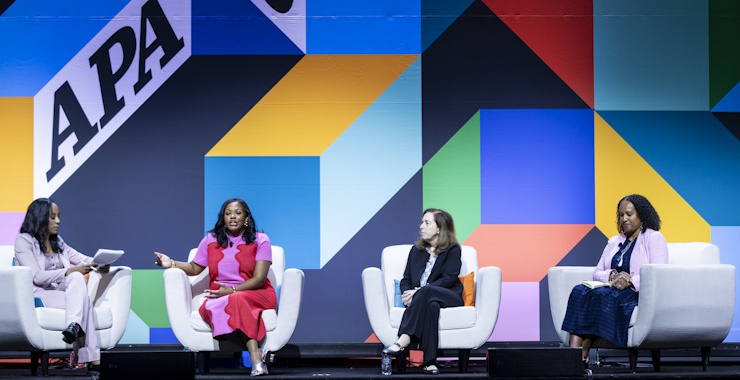
Panel discussion on youth mental health at APA 2025

This advice guides parents toward asking open-ended questions around what teens are viewing and seeing online.

David Yeager, PhD, a professor of psychology at the University of Texas, Austin, said too often, adults want to “grownsplain” to young people, lecturing them on what they should do and how they should behave. Or they’ll skew toward overprotection, trying to remove sources of stress. Instead, Yeager said, parents, teachers, and other authority figures should aim for a “mentor mindset” that combines high standards with support.

A major source of stress for young people comes from being in environments that value compliance and control, said Janine Jones, PhD, a professor of school psychology at the University of California, Santa Barbara. “Another one of those barriers to emotional safety is when youth are having their identities undermined,” Jones said.

Identity and community can be a powerful asset for marginalized groups, said Iheoma Iruka, PhD, a professor of maternal and child health at the University of North Carolina Frank Porter Graham Child Development Institute. In collaboration with Gallup, Iruka and her colleagues surveyed 587 Black adults with children under the age of 7 and found only about a third felt strongly connected in their communities. Of those who did feel socially connected though, 75% reported being able to maintain resilience in the face of racism compared to 63% without a strong sense of belonging.

“This is not a child-only problem, but a family and community problem,” Iruka said.

Related and recent