Kim Mills: Dogs have long been portrayed as humanity's lovable best friends, and anyone who has a dog knows that they're pretty smart, but are they smarter than other animals? What about in comparison to our close evolutionary cousin, the chimpanzee? There's at least one thing dogs can do that chimps can't. Point your finger at a hidden treat and a dog will immediately follow your cue. Human toddlers can do this, but adult chimpanzees cannot.
What does psychology learn from researching this special skill, and what can studying dogs' evolutionary journey from wild wolves to domesticated pets teach us about humanity's history? Welcome to Speaking of Psychology, the flagship podcast of the American Psychological Association that explores the connections between psychological science and everyday life. I'm Kim Mills.
[music]
Our guest today is Dr. Brian Hare, a professor of evolutionary anthropology, psychology, and neuroscience at Duke University. Dr. Hare also founded and co-directs the Duke Canine Cognition Center. Together with his wife and research partner Vanessa Woods, he recently published a book called "Survival of the Friendliest", which lays out a theory of domestication on a broader scale.
They argue that humans, just like dogs, are domesticated animals, bred for friendliness. Domestication causes distinct temperamental, physical, and cognitive changes that are as apparent in humans as they are in dogs, and domestication may be the key to our species evolutionary success and the reason that homo sapiens survived long after other early human species went extinct. Welcome to Speaking of Psychology, Dr. Hare.
Dr. Brian Hare: Kim, thank you so much.
Mills: Let's start with your research on dogs, which is where this all began. You open your latest book with an anecdote about your childhood dog, Oreo, and how he provided the spark for your entire line of canine cognition research. Can you talk about that? How did he inspire you, and what did you learn from those first studies?
Hare: [chuckles] Well, I'm like lots of dog lovers. We have a best friend, especially when I was a little kid growing up, and I couldn't help but wonder what he was thinking and what was going on in his mind, was he like me, was he different from me, in what ways was he different. When I went to college and I found out there are folks who do this for a living, who try to get inside the minds of animals and see how they think, and that it was really important to understand humans, I was all ready to do it. Oreo was instrumental in getting our studies of dog cognition started.
When I was in college, dogs were not seen as particularly interesting or remarkable, nobody was really studying them with any great effort. What happened was my undergraduate advisor, Mike Tomasello, was explaining to me why we were studying chimpanzee gestural communication and their understanding of human gestures. We were finding that chimpanzees were not particularly good, as you just outlined in your intro, at understanding human gestures. If we point and try to help them and indicate where something's hidden with our gesture, they're not really good at figuring it out.
Kids 9 to 12 months of age, this is crucial for them as a developmental time point as a first window into the minds of others. It's the first way they understand our intentions and know what others want. When Mike Tomasello said to me, "Only humans do this, and it's critical to culture and language development, and apes can't," I said, "Well, I think my dog can do that. I think my dog Oreo does that." That really is what launched the whole thing.
Mills: That's amazing. It's always good to define the terms we're using so everyone understands what we're talking about. What do you mean by domestication? How do animals become domesticated and how scientists studied that over the years?
Hare: Well, I think when we normally think about domestication, we think about humans controlling animal breeding and animal reproduction. Certainly, that is a critical part of the story of the animals that we have today that most people would consider domesticated.
Actually, what we think, based on some experiments, an earlier stage of domestication that influenced many species and especially is a big part of the story of dog evolution from wolves, is self-domestication. It's when natural selection actually shapes animals and really pushes them in a direction towards what we would recognize as being domesticated, but it's actually just natural selection doing the work, not humans. I can unpack that for you a little bit, but the idea is that there's really at least two stages of domestication.
There's one where natural selection works to shape an animal to be more like a domesticated animal than we would recognize. Then, once that occurs, humans recognize that and then start intentionally breeding animals. In the case of dogs, for instance, all the European dog breeds that we recognize today that are most prevalent in our society, they all were artificially selected only starting about 150, 200 years ago, but dogs evolved as much as 20,000 years ago. Artificial selection can't explain the origin of dogs, even though it explains the breeds we have today.
Mills: There are a lot of breeds out there. Let me ask you this question. I know you get asked this all the time, and I'm going to do it anyway. Which are smarter, dogs or cats?
Hare: [laughs] I do get asked that question a lot. My answer to that is always, "If you can tell me if a hammer or a screwdriver is a better tool, I can answer your question about cats and dogs." This is a fun question, it is tongue-in-cheek, but I do think it helps illustrate what cognition is, especially in the world of animal cognition where we're trying to understand the origin and the evolution of species differences in psychological abilities.
A hammer and a screwdriver, they're each designed for different jobs, one is not better than the other, because they're apples and oranges, one hammers and one screws screws, and they wouldn't be particularly good at the other job compared to the other tools. It's the same for animal minds, animal minds, just like their bodies, have been shaped by evolution to promote their reproduction and survival.
Animals have different types of cognition, and those different types of cognition can vary independently within a species, and there can be species that have types of cognition that other species don't have. It's foreign because we're so used to thinking about being given some number on a standardized test where I'm 84 and you're 150 and we can try to boil intelligence down to a number, but it just doesn't work when we back out and think about evolution of different species. Anybody who challenges me on this, I typically ask them how they did on their echolocation test.
Mills: [laughs] Which then raises the question of, "Can you even tell what's the most intelligent non-human animal?" You mentioned echolocation, which makes me think of, say, dolphins. Again, is it just an unfair question?
Hare: I wouldn't say it's unfair, I would just say that I think it reveals there's a much deeper, more interesting question, which is, "Where does cognition come from, what types of cognition are there, and why do animals have the types of cognitive abilities they have?" It becomes a lot less interesting to ask who's smarter. A dolphin in a tree, it's not very smart. Chimpanzee fishing, it's not very smart. As soon as you back out and start thinking about different animals, it's clear that how we normally think about intelligence doesn't really make any sense anymore.
Mills: What about among dog breeds? I have a six-pound toy poodle who is amazingly smart, of course, and very attuned to what humans think, at least that's my layperson's observation of her. Why is it that, say, some dogs can succeed as service animals and others can't? Does that have something to do with breed?
Hare: Well, we've been so lucky. We've been supported by the National Institute of Health and the Office of Naval Research, and we've done a lot of work looking at individual differences in dog psychology. I just told you that between species asking who's better or smarter doesn't really make sense. Within a species, it makes a little bit more sense.
Again, we see dogs as probably one of the most powerful demonstrations- we've published a number of papers now because we can get sample sizes that allow us to see this in dogs- that dogs actually have different types of cognition. There are at least five or six that we have been able to demonstrate.
What I'm trying to say is you can't explain individual variability between different dogs, say, your dog that seems so social-attentive and my dog who may not be. You can't explain that individual variability with one factor, it requires taking into consideration multiple things. To be concrete, we know that dogs have a type of cognition that is involved in having empathic responses to humans, we know that they have another factor that is involved in understanding our communication when we gesture, another factor for memory, another factor for having some self-control.
Those factors, it's like thinking about just because you're good at English doesn't mean you're good at math and vice versa, it's the same with dogs. We think that that individual variability is what explains their personality, and we've used that individual variability, to return to your original question, to try to predict which type of profile, cognitive abilities and the milieu of performance, will predict working performance as service dogs, or even as bomb-detecting dogs. We found some really nice links there.
Mills: Are there techniques that we can use to make our dogs smarter?
Hare: Well, I think just the first thing is, "Compared to what?" is always my fun question when people ask me about that because, usually, when people say, "Oh, my dog is so smart," or, "My dog is not so smart," I always say, "Well, compared to what?"
Mills: Well, to my next-door neighbor's dog, of course. [chuckles]
Hare: I think that's a great comparison because, usually, what people— they stammer, and then I see the wheels turning, and they're thinking, "I was thinking relative to people." I think the best comparison is with other dogs. When we do that, we see that dogs have different cognitive abilities and they vary independently. Really, that's what creates their personality.
One dog has, relative to another dog, a lot of empathy, but they might not be very good at reading communicative gestures compared to other dogs, and maybe their memory is not so good. Whereas other dogs have really good memory and communication, but not so much empathy. We've been able to measure and demonstrate that that is indeed the case, that dogs have that level of individual variability.
Mills: You've also worked with bonobos, which for anybody that doesn't know what they are, they're cousins of chimpanzees and of humans. They aren't pets or livestock, so most people wouldn't think of them as domesticated animals. What do they have in common with dogs and other domesticated animals?
Hare: Well, bonobos and chimpanzees are our closest genetic living relative. It's like having two first cousins, one's a girl, one's a boy, and they're equally closely related to you because they're both your first cousins, but they're different from each other. Bonobos and chimpanzees really offer us a lot of insight into how behavior and cognition can change because they're so closely related but they're different from each other in ways that are really interesting.
No bonobo has ever been observed to kill another bonobo. Chimpanzees, in direct comparisons to certain human populations, murder at the rate of humans. You have bonobos, that are our closest living relative, equally closely related to us as chimps, who never kill one another. Then, when you take that on top of the fact that a lot of their morphology, really, is different from chimpanzees in an interesting way that suggests that they may have been under really strong selection for friendliness, which is the same selection pressure that we think drove dog evolution.
That's based on some experiments with, actually, foxes and chickens, believe it or not, that were experimentally domesticated. The only selection pressure was for increase in attraction and friendliness to people. Based on that single criteria, foxes and chickens both become friendlier, but they also become more infant-like or juvenile-like in their behavior in a number of interesting ways throughout their lives. They retain some juvenile traits throughout life, and their morphology changes.
In the case of the foxes, they ended up having higher levels of floppy ears, and curly tails, and different colored coats, and their muzzles became shorter, their teeth became a little bit smaller. None of those things were selected for, but relative to a control population of foxes, all those changes occurred.
When we look at bonobos and then compare them to chimpanzees, a lot of those changes that occurred in those experimental populations as a result of friendliness, we also see the analogous change between chimps and bonobos and it made us scratch our head and say, "Hey, wow, if bonobos are so much less aggressive, have they had selection for friendliness that then caused all the traits to change?" and we have a potential explanation here.
Mills: Speaking of foxes, I see more and more of them out in the world where I live. I'm in the suburbs of Washington, DC. Just a couple of weeks ago, I saw a fox and a cat sitting together in my driveway, paying no attention to one another, was the strangest thing.
As the human population expands and we take over more of the formerly wild land in this country, some animals, foxes, deer, coyotes, are coming into closer contact with people. I know you recently published a study that found that coyotes living near cities may actually be undergoing this type of evolutionary selection we've been talking about for friendliness toward humans. Can you talk about that study and what we can learn from that?
Hare: Sure. I think what the bonobos and the coyotes really both show and what we were trying to test by looking at them is back to this idea of two types of domestication, one that happens as a result of natural selection. Because of the experiments on foxes, and chickens, et cetera, we know that when you select for friendliness, you get a whole syndrome of changes that really look a lot like what we normally think of as domestication.
You get changes in how the organism develops, and that then changes how they behave and what they look like. We see that happening in bonobos, we think this is a great explanation for the origin of dogs because we know that dogs evolved in interactions with hunter-gatherers or foraging populations, because 20,000 years ago, there was no agriculture, and there's no reason to believe that foragers would have gone and actively controlled the breeding of wolves for some reason, that doesn't make any sense.
We think the friendliest wolves were at an advantage because they could take advantage of human garbage. We think bonobos that were friendlier were at an advantage because it ends up being aggressive and alpha is very costly, and we've been able to measure that the most successful bonobo male has higher reproductive success, or more offspring, than the most successful alpha male chimpanzee. Friendliness really pays off big in evolution.
Then, turning to your question about animals that live near us, like your fox in your neighborhood, we think that that same selection, an attraction for human artifacts and humans spaces, is playing out with coyotes and foxes right now, and they're being self-domesticated through natural selection because they, too, are at an advantage if they can find ways to peacefully co-exist with us and take advantage of all the resources that are created by an urban landscape.
Mills: How does your theory of self-domestication apply to humans?
Hare: Well, if you can have selection for friendliness play out and really shape animal behavior, development, and psychology in species ranging from— I think we have some nice evidence from dogs and bonobos, and now the beginnings of evidence in coyotes, and I think a case can be made for other animals as distantly related as fish. If this is a process that's going on again and again, selection for friendliness then leading to changes in mind, brain, body, what about our own species?
We spent a long time contemplating that, and the aha moment was— As somebody who is in an anthropology department but doing psychology, I was able to interact with people who were making big discoveries, and one of the big changes in our understanding of late human evolution is that our species was not alone until very, very recently on this planet. 50,000 years ago, there were at least four other species of humans, and all those species mess up our normal explanation for why we are here and the only human standing.
Because, normally, if you say, "Well, why are humans so different than other animals?" most people would say, "Well, we have language, and we have culture, we have these big brains," et cetera. Well, guess what? All four of those other species also had all of those traits. That explanation doesn't really explain why they went extinct and we didn't. In fact, four out of five species went extinct with that combination of traits, it's not very promising.
What is it about us that allowed us to thrive and survive? I think it was a process of selection for friendliness, and because selection for friendliness leads to changes in the body and morphology, we were able to look for those signatures in fossil evidence of humans before and after the last 80,000 years.
Mills: Okay, so friendliness provides an evolutionary advantage, and the friendliest human species won that particular race. Of course, humans can also do terrible things to each other, war, torture, much more. How does this fit into the story of the survival of the friendliness?
Hare: Well, yes, it is a little bit paradoxical. Obviously, humans are capable of horrific things. How do then you explain the fact that we can be so friendly but then we can be so cruel? Well, my PhD advisor was Richard Wrangham, and he really was the first to point this out to me, this paradoxical challenge. He really nicely says, "It's almost like we are so at home with our own group members and gobs abroad with those that are not like us."
In the books, we really take this challenge on and argue that what happens is when we have selection for friendliness, we basically have a change where we see our group members as if they are kin, or they're family, and we love them as if they were our offspring, our kin. When you have- take any species, but let's just go with a bear- a bear with its offspring, it's the most nurturing thing to see a mother bear with its cubs playing and nursing, but when is a mother bear most dangerous? Well, it's when you get between the offspring and the mama bear.
I think the same is for us, is as we loved more types of people, our group members, as if they were family, well, we became more threatened when they were threatened, and it allows for us to do potentially horrible things. We really take a deep dive into what the psychology and neurobiology is of that response. I think we've got some good evidence that the exact same mechanisms that allow us to be uniquely friendly as a species and be super compassionate are the same mechanisms, when they turn off, that allow for things like dehumanization and the worst forms of violence.
Mills: Might these negative traits among us disappear eventually due to the theory that friendliness is better for survival of the species?
Hare: Well, we're stuck if we're right because the same thing that makes us friendly is the same thing that makes us horrible, and I mean even mechanistically, in the brain and in the mind. It is a good question.
I always get asked, "Well, if we can breed animals to be friendly, why not humans?" Of course, that's a quick road to eugenics, which is repugnant morally in every way, shape, or form. Also, we argue in the book about why it wouldn't work, because just what we know about genetics today, humans are an unusual case in that our behavior is shaped genetically by literally hundreds, and even thousands, of different genes.
To actually select humans- and remember, there's seven billion of us, and the fox experiment only allowed about 1% of the foxes to breed- that only 1% of people were going to reproduce and that somehow we could identify genes and we could even measure a friendlier phenotype reliably in humans, it's impossible, it would never work. I think social problems do require social solutions.
I don't think breeding and bringing back eugenics is—That's horrible. I don't think technology is—It's a double-edged sword, but I do think social problems require social solutions, and I do think there's some really nice ones out there once we understand the mechanism that allows for our friendliness and our cruelty.
Mills: Where are your research interests now? What are you doing next?
Hare: Well, the whole exercise of trying to understand the past is to help inform the future, and when you look at human behavior through the lens of this idea of self-domestication, it helps us arrive to the conclusion, "Wow, we really are the friendliest human that ever evolved, but that friendliness came with a cost of this darker side."
Then, once we realize and can diagnose that, then we can start thinking about solutions. We are working on the question of, "How do you immunize against the worst of human nature?" One of the things we're most excited about is cross-group friendships because there's really nice evidence that when you have friendships across different groups, that it reduces the potential for dehumanization, it almost immunizes against it.
The fun experiment we're doing right now, putting everything together full circle, is we have our first data set with—We run a puppy kindergarten at Duke because we're studying how to raise dogs to be great service dogs, and we have a lot of volunteers in there, and we've been able to show that the contact that people have as they interact with puppies actually reduces, or I should say it increases, how they humanize those that are different from themselves.
Mills: That's the social solution you're talking about?
Hare: Yes.
Mills: Wow, that's all great. Well, thank you for joining us today, Dr. Hare. It's been really interesting, and I hope all the dog owners out there who are going to listen to this will learn something and even read your book.
Hare: Thank you so much, Kim.
Mills: You can find previous episodes of Speaking of Psychology on our website at www.speakingofpsychology.org, or wherever you get your podcasts. If you have comments or ideas for future podcasts, you can email us at speakingofpsychology@apa.org. Speaking of Psychology is produced by Lea Winerman, our sound editor is Chris Condayan. Thank you for listening. For the American Psychological Association, I'm Kim Mills.
[music]
[00:25:55] [END OF AUDIO]


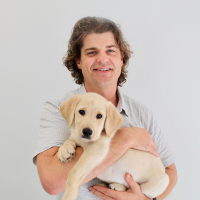 Brian Hare, PhD, is a professor of evolutionary anthropology and psychology and neuroscience at Duke University, where he founded and co-directs the Duke Canine Cognition Center. He is the author of the books “The Genius of Dogs: How Dogs are Smarter than You Think” and “Survival of the Friendliest: Understanding Our Origins and Rediscovering Our Common Humanity.” He received his doctorate from Harvard University in 2004.