Kim Mills: When you think of humans working with robots, what comes to mind? Futuristic images of robot assistants? Or maybe R2-D2 and C-3PO from Star Wars? In reality, robots and other autonomous systems are already around us—in doctor’s offices, in the military, in our homes, and in the cars we drive. Now, as humans increasingly incorporate robots and other autonomous systems into our daily lives, psychologists are studying how the science of teamwork can help us maximize the benefits and minimize the pitfalls of working on human-robot teams.
So how common are human-robot teams today? How do trust and collaboration differ when people are working with robots or other autonomous systems versus with other people? What role are robots playing in the military, in medicine, and in other complex, high-stakes arenas? And as humans increasingly rely on robots and artificial intelligence in our lives and workplaces, might we lose some skills that we used to have? How can psychological research help us avoid that?
Welcome to Speaking of Psychology, the flagship podcast of the American Psychological Association that examines the links between psychological science and everyday life. I’m Kim Mills.
My guest today is Dr. Ericka Rovira, a professor of engineering psychology in the department of behavioral sciences and leadership at the United States Military Academy West Point. She studies how humans interact with robots and AI in high-risk, complex environments like the military and aviation. Her work has been funded by the Department of Defense and other government agencies, and she was recently awarded a 5-year, multi-university University Research Initiative grant to study human autonomous teaming. She’s the author of many peer-reviewed journal articles and coeditor of the book Living With Robots: Emerging Issues on the Psychological and Social Implications of Robotics.
Dr. Rovira, thank you for joining me today.
Ericka Rovira, PhD: Kim, thank you for having me. I’m very excited to talk to you today about human-robot teaming.
Mills: Yeah, me too. A moment ago I talked about working with robots. In your research, you use the phrase human-autonomy teams. What does that mean? What’s autonomy in that phrase? What does that refer to?
Rovira: Sure. Autonomous teams or autonomy specifically is without human intervention. So having a robot agent that can perform tasks independently. And so when I talk about human autonomous teams, it’s the integration of this robot agent, this autonomous agent with a human partner.
Mills: And how common are these teams today and what are some of the situations where humans and robots are already working together?
Rovira: Sure, sure. I would say increasingly robots are being used in a variety of different domains, and this has been spurred by the decrease in costs and also the increased sophistication of these autonomous systems. So you can think about in the medical domain, you have robots like the da Vinci. They assist surgeons in very precise surgeries. You can also think about in manufacturing or in assembly, they can lift heavy parts for their human teammate or they can be used to inspect items or products for defects. But robots are also being used widely in agriculture, for instance, or in search and rescue. Increasingly, we’re using them in educational settings to help small children—particularly in STEM—or children with learning disabilities. We can also see them in customer service. So maybe you’ve been to recent supermarkets or large warehouse stores, Costco and things of that nature. You start to see them in different stores. I think they’re even being used for some food preparation these days. And of course, we all know autonomous cars, right? Autonomous vehicles. So lots of different applications for certain.
Mills: So much of your work centers on trust in human-robot teams. What role does trust play both in all human and in human-robot teams? And why is it so important to be studying trust?
Rovira: Yes, yes. Trust has been found to lead to better performance outcomes in teams. Teams that trust each other, they take more risks, they’re more creative, they tend to have less conflict. They communicate well. They’re able to conduct backup behaviors for one another, and all of this results in better performance outcomes.
In that sense, trust is really critical element in terms of the relationship between not only individuals and robots, but between groups of people and a robot or between groups of individuals and groups of robot. And indeed, trust is one of the biggest or most common variables that are measured. When we’re looking at the human-robot interaction literature, that literature has really taught us that when an autonomous system fails, performance is reduced, trust is degraded, and also workload increases. And so when you ask me, Hey, why do we study trust? I guess I would say trust guides reliance, particularly in high complexity situations where unanticipated situations make a complete understanding of the autonomous system impractical.
Mills: More and more robots are looking sort of humanoid, I think, and there’s some research around whether the robot has to have a face or eyes or a mouth. Does that increase trust? How do we react to a robot that’s too human or not human enough?
Rovira: Yeah. Yeah, Kim, that’s a great question. So there’s a lot of research looking at anthropomorphizing and robots, meaning making them more look like humans or animals. And a lot of that is used to embed some trust to help facilitate trust between the human and agents. So if you look at the domains of either education or when we impose robots with older adults, we tend to make them more childlike, more big eyes, for instance. Or sometimes we use animals that are furry, like the PARO seal with older adults to comfort them. When you think about the military or robotics, you want them to look strong and sturdy and capable. So how we trust an agent, really how it looks plays a big part of that. And certainly there’s a lot of researchers looking at that.
Mills: What other ways do human-robot teams differ from all human teams? What are the particular challenges of working with robots?
Rovira: I would say human-human teams, there are a lot of ways in which we communicate, and so we can communicate verbally, give nonverbal cues. When we do something wrong, we work to repair and rebuild that trust in that relationship. And so when you’re working with a robot or an autonomous system, I think some of the challenges are we don’t necessarily want for the humans to always have to work around the robot. We want the robot to be able to also be agile.
I’d say another challenge is when we study human-robot teaming, we tend to do it with a dyad, meaning one person, one robot. And that’s not really how we work in high critical safety environments. We work with a lot of different people, so we need to learn how to onboard that robot appropriately to a team. I think another issue is when we study these robots in the lab, it’s usually it’s one and done. A participant comes into the lab or even maybe a group of participants comes into the lab and then they leave. Or sometimes we have the ability to study robots for—have participants come a few times or put a robot into a home or into a classroom, but we don’t have these really long, extended interactions. So we want to really look at that. I think the last thing I would say is field studies. So having the robots out, working in the real world with humans doing real tasks, I think that’s another area where we really struggle as scientists to be able to do that.
Mills: So as I mentioned in the introduction, you work at West Point, so you’re doing a lot of work regarding the role of robots on the battlefield, in other systems related to the military. Can you talk about the sorts of things that you’re working on and where you see the future of robots in the military?
Rovira: Sure, absolutely. So a lot of the work I do at West Point involves using research as a vehicle for teaching. And so specifically, I’m interested in exposing my students to technologies that the Army is exploring to enhance soldier performance. And this ranges from virtual reality technologies to soldier equipment. For example, I’m working on a project with students this semester looking at body armor that’s specifically designed for women. But as you mentioned, the bulk of my work largely focuses on autonomous systems. And so I’m currently looking at a quadrupedal robot, so a four-legged robot, and how to embed that with dismounted soldiers.
So last summer, a team of myself, maybe we were six to 10 of us, we went out into the field with a four-legged robot during cadets’ summer leader training. And we collected data on over 600 cadets interacting with this robot. And we really just wanted to see, hey, what types of tasks is it useful for you? Does it slow a team down? Does it help with communication? Does it help them to reach their objective quicker, faster? And we saw the gamut of it. We saw instances where you would see the robot in line formation marching with the soldiers through the field, but then you saw when they would maybe use it as a decoy, which isn’t the smartest thing, I guess, from a dollars perspective, right? But we saw really wonderful creative things where the students were sending it through the back stairs so then they could get eyes on to see what was happening in a room. And so that was really exciting just to see how they would use it.
And so that’s one area where I’m really interested in looking at not only how do we onboard this autonomous teammate, how does this autonomous teammate then impact how the team works, how the team communicates, how the team trusts the robot, continues to trust each other. Particularly because people have different types of what we call in the literature dispositional trust, how they feel about a robot coming into a situation, how much they’re going to trust it. And that we’re finding in our data collection actually really plays out in how they then interact with it later in terms of, Hey, this robot’s really part of our team or isn’t, I’m going to utilize it this way because I trust it or I don’t.
In any event, a lot of my work right now is really looking at also what happens when a robot fails? How do we repair that trust? So one can think about violations in terms of the competency of an agent. So it fails because it’s a technical problem or also an integrity violation where it fails because it doesn’t follow our norms or cultural norms, if you will. So how do we apply different repair strategies to this? And for some people providing a lot of information about why the robot failed is really important, but for others it’s like, Hey, I’m really sorry. I’m going to do better next time, or It wasn’t that big of a deal. Let’s just keep going. So really this type of repair and how long that repair lasts in that relationship is really interesting for me to look at right now.
Mills: I’m really fascinated by the idea of a quadrupedal robot, and I’m thinking back to earlier days in the military where they use dogs and horses as four-legged assistants. And I’m wondering whether the soldiers you’re working with, are they reacting to a quadrupedal robot as if it’s an animal?
Rovira: There’s certainly a reason why we made it look that way. So on the one hand, dogs have worked a lot with military soldiers, but really the reason why it’s quadrupedal is for technical reasons. It can upright itself if it falls over, versus a track or wheeled type of robot. Another thing that we found was when we put a yellow robot out there with them versus a robot that was camouflaged, they liked the camouflaged one better because it was more like them. It was part of their team. And this goes back to your previous question on the anthropomorphization of these tools. So I’m not sure if I answered your question there.
Mills: No, you did. I mean, and that’s very helpful. Do they give the robots names? Do you give the robot a name?
Rovira: This is something else we’re really exploring. So we call it Scout, because Scout means something to them. We don’t want to give it a boy or a girl name, per se. We want to keep it sort of gender neutral. Yeah.
Mills: Are you programming it in such a way that it won’t do certain things? Like let’s say one soldier got ticked off at another soldier and said, Scout, go get him. With the robot, does it do that, or does it have some limits?
Rovira: So right now, our robot is controlled by the research team, so we call that Wizard of Oz in robotic terms. And the reason why we do that is I think oftentimes soldiers are given a lot of equipment and it takes a long time for them to learn how to use it. And sometimes they don’t have the interest or time to learn. So right now we’re just saying, Hey, you know what? The robot team is going to us researchers. We’re going to control it, and these are the things it can and cannot do, and these are the things we would like you not to do to it, right? Because there’s some research out there that people abuse a robot, so they’ll kick it over or they’ll do things like that. So right now we’re just trying to keep it pretty clean and really try to understand in terms of the specific mission or tasks that the cadets or soldiers are doing out in the field, how they would use this robot and what is impeding them including it sooner in some of the roles.
Mills: Here’s a futuristic question. Are we moving toward a time when robots would be the actual soldiers?
Rovira: I think we, society, we would want to keep our sons and daughters safe. And so you look at the evolution of robots in the military. So we used them a lot for detonating bombs for decades, explosive ordinance disposal. We’ve used them as drones to go in and to survey areas that we can’t get to, or it’s unsafe for us to put soldiers on the ground. Increasingly, we’re looking at what we call large room robots, which are big tanks. And so the idea is that it would be a surrogate tank going in with our tank, and that would reduce the number of soldiers and units that we have out in dangerous areas.
And so will a robot take over a human role? Will the robot take over a soldier role? I think these are very dangerous and complex situations. And so the creativity that humans have, the ability to solve problems, the experience that they have, certainly with the advent of AI, the pattern recognition has certainly surpassed human capability. However, we want that human to be in the loop in making these very difficult life and death decisions. But can we send robots to support soldiers? Absolutely. That’s our intent. That’s where we are right now.
Mills: So I have to ask, how did you get involved in robotics and what was your route to West Point?
Rovira: Yes, thanks for asking this. So I did my graduate work in DC. I was looking at decision support tools for air traffic controllers. While in grad school I did a few small projects for the Army Research Lab, and I’m originally from New York, and a job opened up at West Point to teach. I actually was not looking for an academic position. I thought I was going to go work for Boeing or someone making stuff for aviation or air traffic control. And I said, you know what? I’m going to give this a try. I was just so curious about it. And I arrived here, and two things. The students—phenomenal young men and women, I mean, you tell them the bar is here and they will jump much higher. The types of research I’m able to do with them is just incredible because they’re just so bright and curious and interested.
And I think part of that is me being able to, the second thing is I’m able to work on real-world tools. So tools that my cadets are going to see in a year, in 2 years, in 3 years, in 5, in 10. And in fact, I have cadets email me back now and they’re like, Hey, I just got IVAS to my unit and I’m actually ripping it out of the boxes and showing my teammates how to use it. And they’re getting different types of hearing protection devices or that sort of thing. So what has kept me here really is the ability to work on real-world tools and applications and change lives for soldiers in the field, and also the students in the colleagues that I get to work with.
Mills: Let’s talk for a minute about the way that most of us interact with robots and AI in daily life today. Are we losing skills in some areas because we become robot or AI dependent? For example, there’s no need for us to memorize phone numbers anymore. We don’t need to be able to read maps to drive someplace. Is this a problem?
Rovira: Yes, Kim, I would say deskilling is real. It is a problem. Certainly you can think of in the aviation industry. They experienced this deskilling issue for pilots. As the cockpit became increasingly automated, pilots got caught overrelying on the technology, leading to catastrophic results. So in emergency situations where pilots needed to revert to manual flying, they were sometimes caught out of the loop, meaning they didn’t know what was going on, where they were spatially, why a particular alert was sounding off and so forth. So as a result, the FAA and the airlines, they’ve recommended that pilots fly manually to maintain this proficiency. They also have training simulators that have built in scenarios where pilots need to quickly recover and take over this manual control during emergency situations. So we’ve learned a lot of lessons from the aviation industry, especially human factors professionals.
We have studied how individuals work with technology for decades, but really we really focused on highly trained individuals. And so now when these tools are available to the masses, we really have to be a bit more wary or maybe more focused on how this impacts people. I guess here’s one of my main concerns: Is there is a widening gap that we’re seeing, particularly when we think about generative AI, between the expert and the novice? So generative AI gives us outputs. As an expert, if it’s on psychology or human factors, I can say, hey, that’s not really right, or it’s missing something very critical. My students on the other hand, they can’t identify that just yet. So I think there is this widening gap between experts and novices that we have to be aware of.
Mills: So we’re not going to lose all of our thinking ability, we hope.
Rovira: Right.
Mills: Now, I mean, speaking of the robots and AI taking over all kinds of tasks that we have traditionally done ourselves, do you envision that we’ll ever have fully automated self-driving cars? Or will there always be a need for some human oversight in such a complex task as driving?
Rovira: Yeah, I think a lot of people feel a lot of strong ways about this. I think this is a great question. I think self-driving cars are exciting. Who does not want to sit back and eat a snack and watch a movie on a long distance drive? I think this is absolutely going to be a game changer potentially for older adults. It’ll help them to get out and be more social or to get to their medical appointments to the supermarket without having to be dependent on others. But I think while there’s a lot of goodness, we’re not there yet, and this really gets back to a serious safety concern or issue in that drivers are going to be caught over trust in these autonomous systems. So as human factors professionals we’re left to sort out issues like trust.
And so I think one thing I haven’t shared much with you yet today is I’m studying individual differences in normal cognition, and researchers are finding that trust is influenced by these individual differences. For instance, work in memory or control of attention. And so with the advent of autonomous systems being available to the masses, individuals with too little training, we really need to understand how these basic individual differences may play into over-reliance on some systems.
Mills: Yeah, I’m always struck by the choices that an autonomous car has to be programmed to make. And I’m thinking of, say the trolley experiment, very famous in psychology. How does an autonomous vehicle make a decision between whether it runs into a person in a crosswalk or takes another evasive action?
Rovira: And to loop this back to some of the work that I’m doing on trust, depending on how that autonomous vehicle makes that decision, what it decides to prioritize, is it going to prioritize a dog or is it going to prioritize a ball or a small child or a bicycle or an oncoming ambulance? That gets into, when I was talking earlier about different types of trust violations. So for instance, that would be what I would classify as an integrity violation because it is violating my norm as a user, but we all have different norms as users. So I think really those types of decisions or prioritization of these autonomous systems and what decisions and outcomes they’re making, we really need to study a little bit more how humans would respond to it, how repair will happen, and how long that repair can last.
Mills: A moment ago, we talked a little bit about the human-robot relationships where there are these companions, say for older people or people with Alzheimer’s or other cognitive issues, and I’m just wondering whether you believe a robot can really provide companionship in a way that another human might?
Rovira: I’d have to say no. I think certainly they can fill a space, they can provide some companionship, but in the end, we are social beings and we need to be with others. I think we’ve learned a lot of lessons from the pandemic about the importance of interacting with others. We’re seeing a lot of lessons coming out of having adolescents move from being out in the environment, interacting with one another, to being in their homes and interacting with virtual agents or only online. So I see a robot as a tool, yes, it can be my teammate, but to do a task, there’s a goal we have in mind.
So similarly, when I think about a robot with maybe say an older adult, well, not all of us can have our parents living with us, or maybe we live many states away from our parents, but knowing that a robot can help our older adults lift heavy things or do these types of tasks that may be more difficult for them, I think that’s certainly helpful and useful. I think the more social pieces are really hard, and certainly I think there’s a lot of research being done right now on social robotics, that interaction piece for older adults, for younger children, and even just for anybody. For everybody. And the more that we’re able to learn about that, the more we’re able to embed these social components with robots, then the better that interaction is going to be. But are people replaceable in the end in terms of a companion? I’m not really buying that one. No.
Mills: Even if I totally programmed a robot to act like Dr. Rovira, it still wouldn’t be as good as spending time with you.
Rovira: Well, I hope not, Kim.
Mills: Well, let me ask you just to crystal ball a little bit as we wrap up here. What are you working on? Where do you see robotics in the next 10 or 20 years, particularly related to the kinds of work that you’re doing at West Point?
Rovira: I think what would be really fascinating to understand more of or more about is multiple robots working with multiple humans, and that interplay and the dynamics of that interplay being successful, I think that would be very exciting.
Mills: Well, Dr. Rovira, I want to thank you for joining me today. I think the work you’re doing is just amazing. Thanks a lot.
Rovira: Great. Thank you. I really enjoyed my time with you.
Mills: You can find previous episodes of Speaking of Psychology on our website at www.speakingofpsychology.org or on Apple, Spotify, YouTube, or wherever you get your podcasts. And if you like what you’ve heard, please subscribe and leave us a review. If you have comments or ideas for future podcasts, you can email us at speakingofpsychology@apa.org. Speaking of Psychology is produced by Lea Winerman.
Thank you for listening. For the American Psychological Association, I’m Kim Mills.


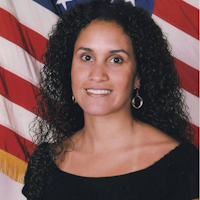 Ericka Rovira, PhD, is a professor of engineering psychology in the department of behavioral sciences and leadership at United States Military Academy, West Point. Her research investigates human autonomy teaming in high-risk, complex environments. Rovira brings expertise in human-robotic interaction, trust, and autonomous decision support tools. She is a fellow and past president Division 21 (Applied Experimental and Engineering Psychology).