


WASHINGTON — The American Psychological Association presented a Presidential Citation to Rep. John Lewis, D-Ga., on Friday in recognition of his more than five decades “of courageous, trailblazing leadership in the civil rights movement and for serving as a powerful voice for the disenfranchised.”
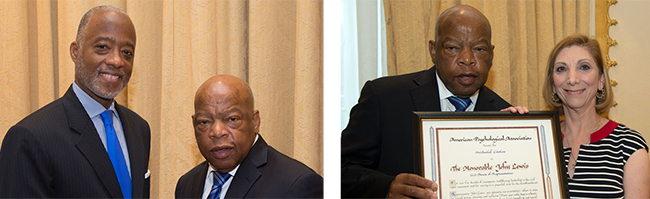
Left photo: APA CEO Norman B. Anderson, PhD, (L), congratulates Rep. John Lewis, D-Ga., upon his acceptance of an APA Presidential Citation. Right photo: APA President Nadine J. Kaslow, PhD, presents an APA Presidential Citation to Rep. John Lewis, D-Ga.
In making the award, APA President Nadine J. Kaslow, PhD, noted that Lewis epitomized the association’s value of striving for social justice, diversity and inclusion. “From your early days as a heroic young Freedom Rider, you have fought a long, hard struggle to end racial discrimination and segregation,” she said. “As a member of Congress, you introduced and gained bipartisan support for legislation to ensure that sexual orientation and gender identity no longer provide a basis for discriminating against prospective foster and adoptive parents and that lesbian, gay, bisexual and transgender youth have access to a secure family placement.”
She also cited his work to improve America’s child welfare system, eliminate pay disparities for women, and aid disadvantaged families. “You have been a stalwart supporter of universal access to health care and efforts to eliminate health disparities,” she added.
The American Psychological Association, in Washington, D.C., is the largest scientific and professional organization representing psychology in the United States. APA's membership includes nearly 130,000 researchers, educators, clinicians, consultants and students. Through its divisions in 54 subfields of psychology and affiliations with 60 state, territorial and Canadian provincial associations, APA works to advance the creation, communication and application of psychological knowledge to benefit society and improve people's lives.