



Even though aspects of the U.S. economy continue to improve, some Americans are squeezed by sharp increases in health care costs and the cost of living.1, 2 This year’s Stress in America™ survey shows that stress about money and finances is prevalent nationwide. In fact, regardless of the economic climate, money has consistently topped Americans’ list of stressors since the first Stress in America survey in 2007.
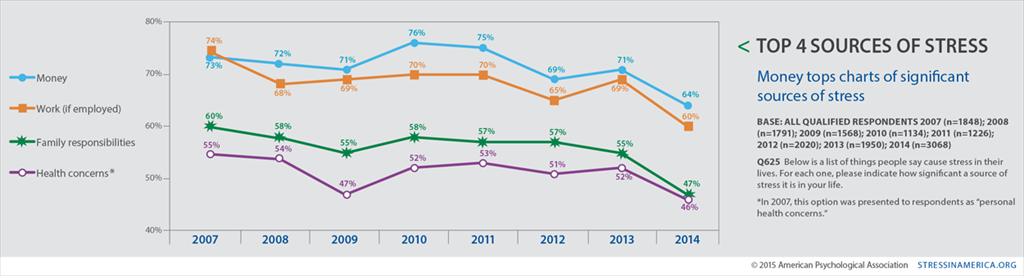
Overall, Americans seem to be doing fairly well — average stress levels are trending downward (4.9 in 2014 vs. 6.2 in 2007 on a 10-point scale, where 1 is “little or no stress” and 10 is “a great deal of stress”) and people generally say they are in good health (80 percent say their health is excellent, very good or good). But it seems that parents, younger generations and those living in lower-income households (making less than $50,000 per year) have a different experience — they report higher levels of stress than Americans overall, especially when it comes to money, and those who have particularly high stress about money are more likely to say they engage in unhealthy behaviors to manage their stress.3, 4 Women, who consistently report high levels of overall stress and unhealthy behaviors to manage stress, also report high levels of stress about money. What’s more, the gap between the percentage of those who appear to be doing well when it comes to managing their stress and the percentage of those who are not is growing.5
These findings stand against a backdrop of research that shows the profound effects of stress on health status and longevity.6 Research also shows that financial struggles strain individuals’ cognitive abilities, which could lead to poor decision making and may perpetuate their unfavorable financial and health situations.7 But there is good news. Survey findings show that those feeling the weight of money-related stress are able to cope and manage their stress in healthier ways when they say they have emotional support.8
Stress about money and finances appears to have a significant impact on Americans’ lives. Nearly three-quarters (72 percent) of adults report feeling stressed about money at least some of the time and nearly one-quarter say that they experience extreme stress about money (22 percent rate their stress about money during the past month as an 8, 9 or 10 on a 10-point scale). In some cases, people are even putting their health care needs on hold because of financial concerns.
- More than one-quarter of adults (26 percent) report feeling stressed about money most or all of the time.
- More than half of adults (54 percent) say they have “just enough” or not enough money to make ends meet at the end of the month.
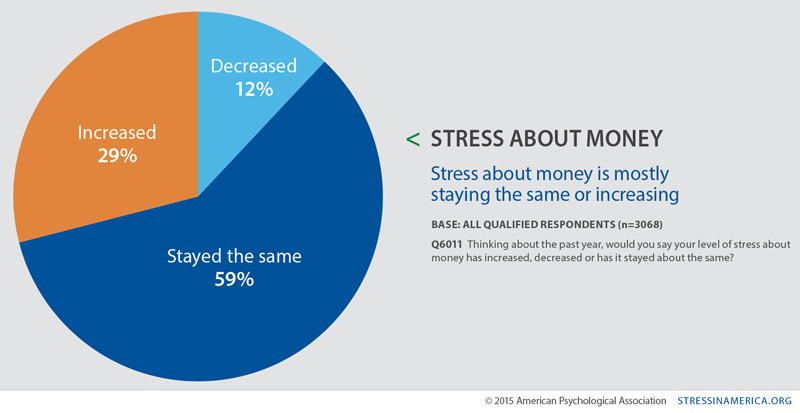
- Most adults say their level of stress about money has remained the same (59 percent) or increased (29 percent) in the past year.
- Significant sources of money-related stress reported by Americans include paying for unexpected expenses (54 percent said very or somewhat significant), paying for essentials (44 percent said very or somewhat significant) and saving for retirement (44 percent said very or somewhat significant).
- Over the past year, the majority of Americans have taken steps to live more economically by shopping during sales or using coupons (53 percent), cooking more at home (52 percent) and cutting back on nonessentials (51 percent).
- Nearly one-third of Americans (32 percent) say that their finances or lack of money prevent them from living a healthy lifestyle.
- One in 5 Americans say that they have either considered skipping (9 percent) or skipped (12 percent) going to the doctor in the past year when they needed health care because of financial concerns.
Regardless of the role money plays in creating stress for the majority of Americans, people appear to have a positive attitude about finances: 80 percent say they have confidence in their ability to manage their money and 71 percent say they have a healthy relationship with money. At the same time, 71 percent say that having more money would make them happier and more than one-third say that money makes them tense (38 percent). These findings underscore the complexity of the relationship that many Americans have with money.
The United States is the world’s richest country, with a gross domestic product nearly double that of the runner-up, yet our economic inequality is among the highest in the world.9, 10 The Great Recession may have officially ended, but most American households face stagnant wages and increasing debt — many Americans are actually considered to be poorer than they were a decade ago.11, 12, 13
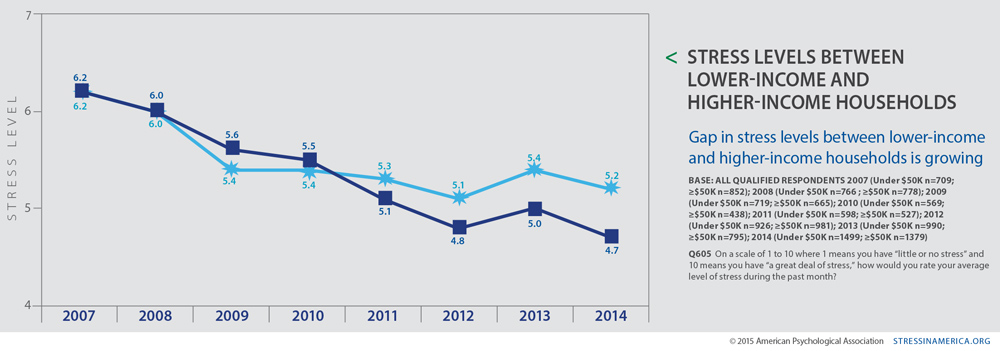
It also appears that the gap between the haves and the have-nots is widening. In 2007, average reported stress levels were the same regardless of income, but now, those living in lower-income households report higher overall stress levels than those living in higher-income households (5.2 vs. 4.7 on a 10-point scale).
For adults living in lower-income households, financial concerns are a common source of stress.
- Adults in lower-income households are twice as likely as those in higher-income households to say they feel stress about money all or most of the time (36 percent vs. 18 percent).
- Many lower-income Americans barely scrape by each month. Thirty percent of adults in lower-income households report that at the end of the month, they don’t have enough money to make ends meet, compared with 11 percent of adults in higher-income households.
- Forty-four percent of lower-income Americans say paying for out-of-pocket health care costs is a very or somewhat significant source of stress (compared with 34 percent of higher-income Americans). For those lower-income Americans who have out-of-pocket health care costs, 31 percent say they have difficulty paying for these costs (compared with 14 percent of higher-income Americans with out-of-pocket health care costs).
Survey results suggest that for those living in lower-income households, both finances and stress about money stand in the way of a healthy lifestyle.
- Those living in lower-income households are almost twice as likely (45 percent) as those in higher-income households (24 percent) to say that their financial situation or lack of money prevents them from living a healthy lifestyle.
- Nearly 3 in 10 lower-income Americans have either considered skipping (9 percent) or actually skipped (20 percent) necessary doctors’ visits due to their finances.
- More people with lower reported income say that they have felt a sense of loneliness and isolation in the past month due to stress (29 percent vs. 21 percent of people with higher reported income).
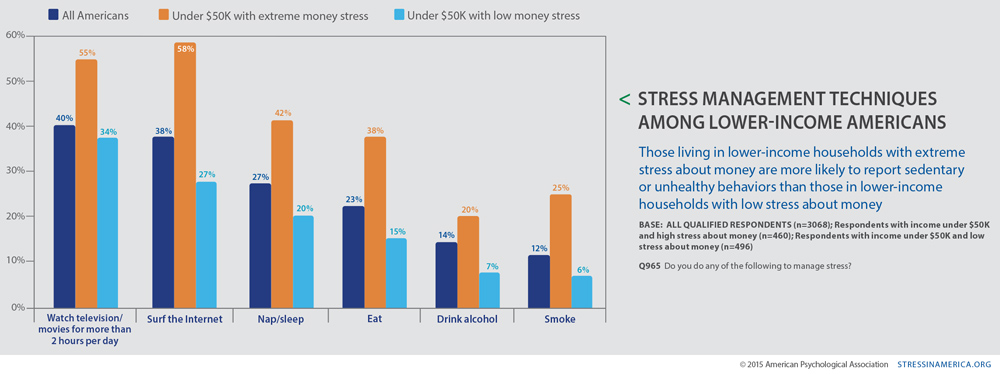
- Those living in lower-income households who also say their stress about money is extreme (8, 9 or 10 on a 10-point scale) are more likely than those living in lower-income households reporting low stress about money (1, 2 or 3 on a 10-point scale) to say they engage in sedentary or unhealthy behaviors to manage their stress, such as watching television/movies for more than two hours per day (55 percent vs. 34 percent), surfing the Internet (58 percent vs. 27 percent), napping/sleeping (42 percent vs. 20 percent), eating (38 percent vs. 15 percent), drinking alcohol (20 percent vs. 7 percent) or smoking (25 percent vs. 6 percent).
- Those living in lower-income households who also say they have extreme stress about money are more than twice as likely as those living in lower-income households with low stress about money to rate their health as fair or poor (44 percent vs. 17 percent).
The impact of stress about money appears to be worse among those who also report higher levels of overall stress — younger generations (millennials and Gen Xers) and parents of children under the age of 18.14
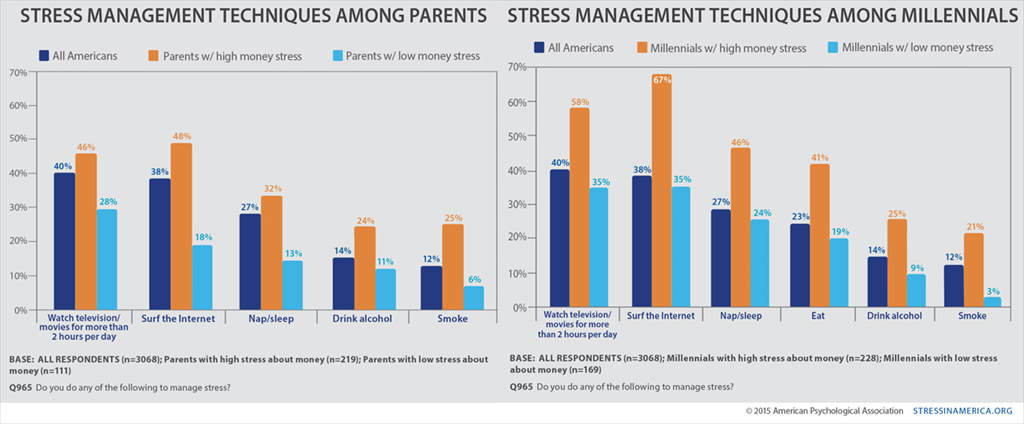
Overall, younger generations and parents rate their stress higher than Americans overall:
- Parents say their overall stress is a 5.7 on a 10-point scale and more than one-third (34 percent) say that their overall stress has increased in the past year. Parents also report higher levels of stress about money compared to nonparents (5.8 vs. 4.4 on a 10-point scale).15
- Millennials and Gen Xers report comparable levels of overall stress — 5.5 and 5.4 on a 10-point scale, respectively — and in both groups, more than one-quarter say their overall stress has increased in the past year (36 percent of millennials and 30 percent of Gen Xers).
- Millennials and Gen Xers report higher levels of stress about money compared to Americans overall (millennials: 5.4 on a 10-point scale; Gen Xers: 5.5; all adults: 4.7).
Younger generations and parents are also more likely than other Americans to point to financial concerns as sources of stress.
- Money is a somewhat or very significant source of stress for the majority of Americans (64 percent) but even more so for parents (77 percent), millennials (75 percent) and Gen Xers (76 percent).
- Parents and younger generations are less likely than Americans overall to report being financially secure (parents: 5.0 on a 10-point scale, where 1 means “not at all financially secure” and 10 means “completely financially secure;" millennials: 4.8; Gen Xers: 4.8; all adults: 5.5).
- More than half of parents (58 percent) and millennials (57 percent) say that paying for essentials is a somewhat or very significant source of stress, compared with 44 percent of Americans overall reporting the same.
- The majority of parents (71 percent) and Gen Xers (70 percent) say they have “just enough” or not enough money to make ends meet at the end of the month.
- Roughly half of parents (48 percent) and Gen Xers (47 percent) say paying for out-of-pocket health care costs is a somewhat or very significant source of stress, compared to 38 percent of all Americans. For those who have out-of-pocket health care costs, more than one-quarter of parents (28 percent) and Gen Xers (27 percent) say they had difficulty paying for these costs in the past year.
For many parents and younger generations, finances and stress about money are barriers to living a healthy lifestyle.
- Nearly half (45 percent) of parents, 43 percent of millennials and 41 percent of Gen Xers say that their financial situation or lack of money prevents them from living a healthy lifestyle, compared to 32 percent of all Americans saying the same.
- Parents who say their stress about money is extreme (8, 9 or 10 on a 10-point scale) are more likely than parents with low stress about money (1, 2 or 3 on a 10-point scale) to report engaging in sedentary or unhealthy behaviors to manage their stress, such as watching television/movies for more than two hours per day (46 percent vs. 28 percent), surfing the Internet (48 percent vs. 18 percent), napping/sleeping (32 percent vs. 13 percent), drinking alcohol (24 percent vs. 11 percent) or smoking (25 percent vs. 6 percent).
- Parents who say their stress about money is extreme are nearly three times as likely as parents with low stress about money to rate their health as fair or poor (27 percent vs. 10 percent).
- Millennials who say their stress about money is extreme are more likely than millennials who report low stress about money to say they engage in sedentary or unhealthy behaviors to manage their stress, such as watching television/movies for more than two hours per day (58 percent vs. 35 percent), surfing the Internet (67 percent vs. 35 percent), napping/sleeping (46 percent vs. 24 percent), eating (41 percent vs. 19 percent), drinking alcohol (25 percent vs. 9 percent) or smoking (21 percent vs. 3 percent).
- Millennials reporting extreme money stress are significantly more likely than millennials who say they have low money stress to rate their health as fair or poor (31 percent vs. 6 percent).
Year after year, women’s experiences with stress continue to be troubling. They consistently report higher stress levels than men do and they appear to have a hard time coping.16 These patterns also emerge when it comes to their relationship with money and finances.
- Women report higher levels of stress about money than men (5.0 vs. 4.3 on a 10-point scale) and are more likely than men to say they feel stress about money all or most of the time (30 percent vs. 21 percent).
- Nearly half of women (49 percent) say that paying for essentials is a somewhat or very significant source of stress, compared with 38 percent of men.
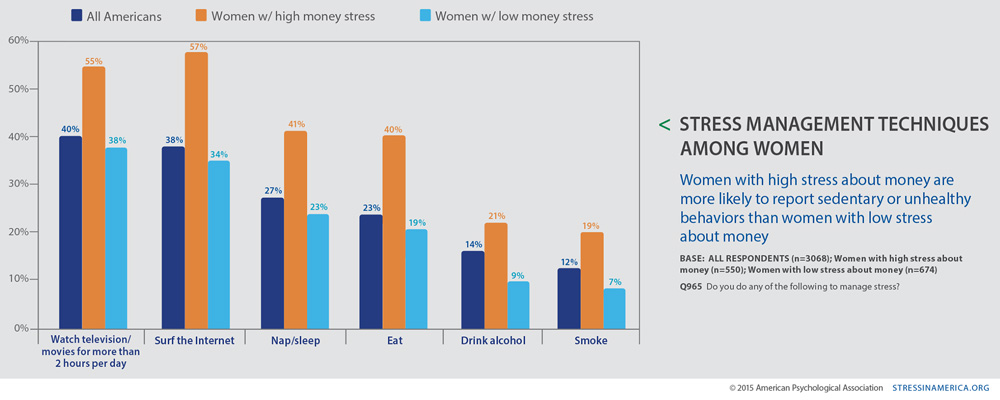
- Women who say their stress about money is high (8, 9 or 10 on a 10-point scale) are more likely than women who say they have low stress about money (1, 2 or 3 on a 10-point scale) to say they engage in sedentary or unhealthy behaviors to manage their stress, such as watching television/movies for more than two hours per day (55 percent vs. 38 percent), surfing the Internet (57 percent vs. 34 percent), napping/sleeping (41 percent vs. 23 percent), eating (40 percent vs. 19 percent), drinking alcohol (21 percent vs. 9 percent) or smoking (19 percent vs. 7 percent).
- Women who say their stress about money is high are significantly more likely than women who say they have low stress about money to rate their health as fair or poor (34 percent vs. 13 percent).
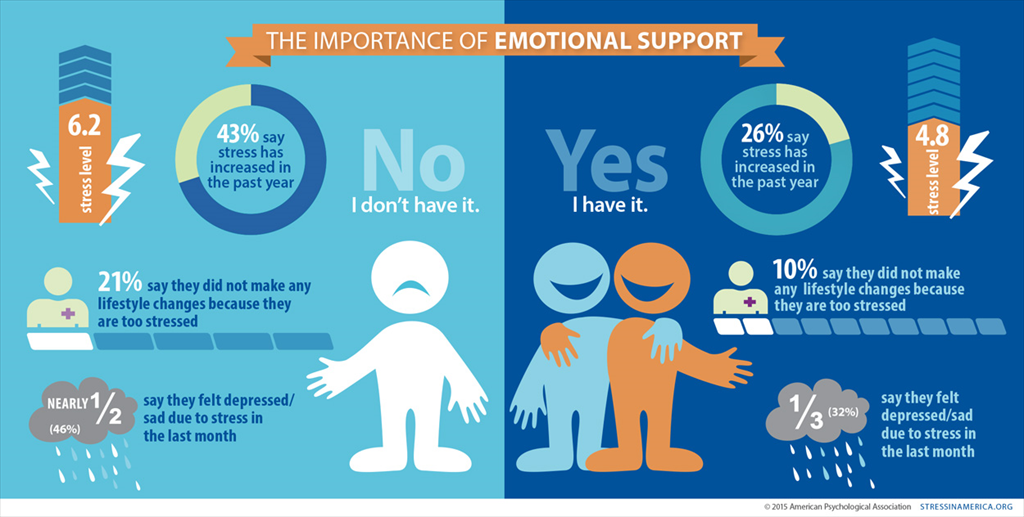
While the connection between stress and health is clear, both appear to be affected by the social and emotional support we perceive in our lives.17, 18 Survey findings show that Americans who say they have emotional support — specifically, that they have someone they can ask for emotional support if they need it, such as family and friends — report lower stress levels and better related outcomes than those without emotional support.19, 20 But finding that support when you need it can be difficult: 1 in 5 Americans (21 percent) say they have no one to rely on for emotional support. A similar percentage of Americans (18 percent) say money is a taboo subject in their family and more than one-third (36 percent) say that talking about money makes them uncomfortable.
- The average overall stress level for those who say they have no emotional support is 6.2 on a 10-point scale, compared with 4.8 for those who say they have emotional support.
- Forty-three percent of those who say they have no emotional support report that their overall stress has increased in the past year, compared with 26 percent of those who say they have emotional support.
- Twenty-one percent of those who say they have no emotional support report that they did not make any lifestyle changes because they are too stressed, compared with 10 percent of those who say they have emotional support.
- Nearly half (46 percent) of those who say they have no emotional support say they felt depressed/sad due to stress in the last month, compared with one-third (32 percent) of those who say they have emotional support.
For those Americans who feel the burden of stress about money the most — parents, younger generations, lower-income households and women — it seems that emotional support is even harder to come by. Even within families, talking about money and finances can be challenging. Only 37 percent say they talk with their family members about money often and 31 percent of spouses and partners say that money is a major source of conflict or tension in their relationship. Nearly all adults (95 percent) think parents should talk to their children about money.
- Significantly more Americans from lower-income households than those from higher-income households say that they do not have emotional support (27 percent vs. 17 percent).
- Roughly one-quarter of parents (26 percent) and millennials (25 percent) say that they do not have emotional support.
- Twenty-eight percent of parents and 34 percent of millennials report feeling a sense of loneliness/isolation due to stress in the past month, compared with 24 percent of Americans overall.
- These groups in particular — and those living in lower-income households — say they could use more emotional support (52 percent of those from lower-income households, 62 percent of parents and 59 percent of millennials say they could have used a lot, some or a little more emotional support in the past year than they received).
- A fair number of Americans — 14 percent — say they could have used a lot more emotional support in the past year.
- While women are less likely than men to say they do not have emotional support (19 percent vs. 23 percent), more women report feeling a sense of loneliness/isolation due to stress in the past month (29 percent vs. 19 percent of men) and they are more likely to say that they could have used a lot more emotional support in the past year (16 percent vs. 11 percent of men).
1 Bureau of Economic Analysis, U.S. Department of Commerce. (2014, October 30). Gross domestic product: Third quarter 2014 (advance estimate) [Press release]. Retrieved from https://www.bea.gov/newsreleases/national/gdp/2014/pdf/gdp3q14_adv.pdf
2 Knutson, R., & Francis, T. (2014, December 1). Basic costs squeeze families. The Wall Street Journal. Retrieved from https://www.wsj.com/articles/americans-reallocate-their-dollars-1417476499
3 Income <$50,000 n=1499; >=$50,000 n=1379. $51,939 is the median U.S. household income according to the 2013 census. DeNavas-Walt, C., & Proctor, B. D. (September 2014). Income and poverty in the United States: 2013. Retrieved from https://www.census.gov/content/dam/Census/library/publications/2014/demo/p60-249.pdf
4 Adults with children under 18 living at home n=569; Adults without children under 18 living at home n=2499; millennials 18–35 n=720; Gen Xers 36–49 n=548; boomers 50–68 n=1324; matures 69 and older n=476.
5 Multiple linear regression was used in order to determine whether there were significant differences in how various subgroups changed in perceptions over time. Read the full Methodology here.
6 Schneiderman, N., Ironson, G., & Siegel, S. D. (April 2005). Stress and health: Psychological, behavioral, and biological determinants. Annual Review of Clinical Psychology, 1, 607–628.
7 Mani, A., Mullainathan, S., Shafir, E., & Zhao, J. (2013, August 30). Poverty impedes cognitive function. Science, 341(6149), 976‒980. Retrieved from https://www.sciencemag.org/content/341/6149/976.
8 Q702: Is there someone you can ask for emotional support if you need it, such as talking over problems or helping you make a difficult decision?
9 International Monetary Fund. (October 2014). Report for Selected Countries and Subjects. Filtered for United States and China in U.S. dollars. Retrieved from https://www.imf.org/external/pubs/ft/weo/2014/02/weodata
10 OECD. (n.d.). Income inequality. Retrieved from https://data.oecd.org/inequality/income-inequality.htm
11 Saez, E. (2013, September 3). Striking it richer: The evolution of top incomes in the United States
(updated with 2012 preliminary estimates). Retrieved from https://eml.berkeley.edu/~saez/saez-UStopincomes-2012.pdf
12 Federal Reserve Bank of New York. (February 2014). Household Debt and Credit Report. Retrieved from https://www.newyorkfed.org/microeconomics/hhdc.html#/2014/q3
13 Joint Center for Housing Studies of Harvard University. Tabulations of U.S. Census Bureau. Current Population Survey Data.
14 The four generations are defined as the following: millennials (18- to 35-year-olds), Gen Xers (36- to 49-year-olds),
boomers (50- to 68-year-olds) and matures (69 years and older).
15 “Nonparents” signify those who do not have a child under 18 living at home.
16 Men n=1204; women n=1864.
17 MedlinePlus. (n.d.). Stress. Retrieved from https://www.nlm.nih.gov/medlineplus/stress.html
18 Southwick, S. M., Vythilingam, M., & Charney, D. S. (2005). The psychobiology of depression and resilience to stress: Implications for prevention and treatment. Annual Review of Clinical Psychology, 1, 255–291. Retrieved from https://www.ncbi.nlm.nih.gov/pubmed/17716089
19 Uchino, Bert N. (2004). Social support and physical health: Understanding the health consequences of relationships. Yale University. Retrieved from https://books.google.com/books?hl=en&lr=&id=VxUgC6S255wC&oi=fnd&pg=PP5&ots=6AwhG7hr9m&sig=r9DByAV1GBsCA3BgDiLDVjcXM-Q#v=onepage&q&f=false
20 Emotional support yes: n=2042; emotional support no: n=649.